
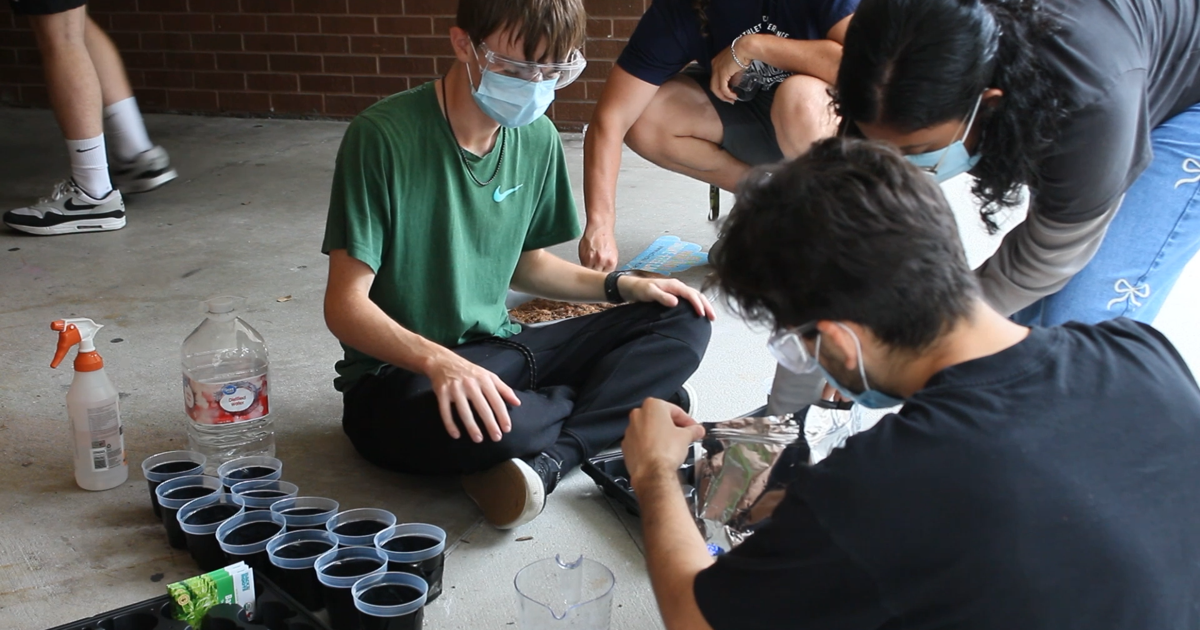

Sachita Saravanan, junior biomedical science major and the lead of the Astraeus Research Team, helps Aiden Ponthieux, freshman materials science major, and Andrew Fetyko, junior computer science major, measure out simulant lunar regolith outside the Engineering II building on Oct. 2.
Orion Boone
Members of the UCF chapter of Students for the Exploration and Development of Space are growing plants in simulated lunar and Martian soil to research how to best grow plants on off-world missions.
Project Astraeus stemmed from NASA’s Plant The Moon Challenge, which asks students and professionals to test what nutrients, fertilizers or other modifications to the lunar or Martian regolith – a mix of rock and dust – are needed to “grow nutrient-rich, sustainable food sources for future astronauts.”
Helen Navach, junior mechanical engineering major and competition team lead for Project Astraeus, holds a package of blue oyster mushroom spawn in her kitchen on Oct. 7, near UCF.
Orion Boone
Project Astraeus consists of two groups: a research team and a competition team, the latter of which is led by junior mechanical engineering major Helen Navach.
The competition team will grow oyster mushrooms this semester as a trial run for its spring competition entry. The project aims to demonstrate the mushrooms’ potential for three applications: food production, soil enrichment and brick making using mycelium, according to the Project Astraeus competition team’s research prospectus.
“I was thinking, if we do one organism, then we can get three things out of it, and recycle the whole thing; we don’t really have to put much payload into the rockets,” Navach said. “Just one kilogram of payload is thousands and thousands of dollars. It would save us financially and help the astronauts out in space if they need one thing or another.”
Helen Navach, junior mechanical engineering major and competition team lead for Project Astraeus, measures simulant Martian regolith in her kitchen on Oct. 7 near UCF.
Orion Boone
The mycelium, or root-like structures in mushrooms, die off once mushrooms grow. According to Navach, part of this experiment will be figuring out how to have fruiting bodies, but also reuse the mycelium that’s still alive to make bricks.
Mycelium bricks can be made by combining mycelium with plant waste like straw or sawdust, packing it into a mold, letting it grow for about a week, and baking or drying it to stop the growth, Navach said.
Helen Navach, junior mechanical engineering major and competition team lead for Project Astraeus, and Kai Rodriguez, junior biology major, go over the experiment process in Navach’s kitchen on Oct. 7 near UCF.
Orion Boone
“[Our experiment] may only result in a very small amount of brick,” Navach said. “But if it’s possible, we can at least say that in a large-scale production, we could make bigger bricks and produce an actual shelter on Mars and the Moon.”
Navach competed last year. Although mold contamination prevented the experiment from producing the desired results, Navach said the team earned the Best Experimental Design award.
“You know, if you prove that there is a possible outcome, you could still get something out of it,” Navach said.
Sachita Saravanan, junior biomedical science major and the lead of the Astraeus Research Team, explains the planting process to Chelya Cruz, sophomore biomedical sciences major, inside the Engineering II Atrium on Oct. 2.
Orion Boone
Sachita Saravanan, junior biomedical science major, is the lead of the Astraeus Research Team. The team is testing different concentrations of nutrients from Hoagland solution, which provides all the essential chemical elements plants need to grow without soil, on basil in lunar regolith.
Basil’s phenolic compounds, like vitamin K, would help astronauts’ hearts and bones, according to Saravanan.
“I think the whole process of trying to live in a place that’s very hard to inhabit is a good challenge, and space medicine is such a new field on its own that obviously we’re going to face a bunch of challenges,” Saravanan said. “I think that hopefully it would give us a key to unlocking future medicine that can also be applied to people still living on Earth in like fifty years from now.”
Saravanan said projects like Astraeus aren’t just for engineers.
“Everyone’s first thought is UCF was designed for engineers,” Saravanan said. “SpaceU has obviously expanded since [its founding]. Astraeus has a very key role because it combines two different fields. It shows that many interdisciplinaries can also combine for the love of space.”
Each team is currently in the 8-week plant-growing period, after which the plants will be harvested and analyzed, according to the teams’ research prospectuses.