
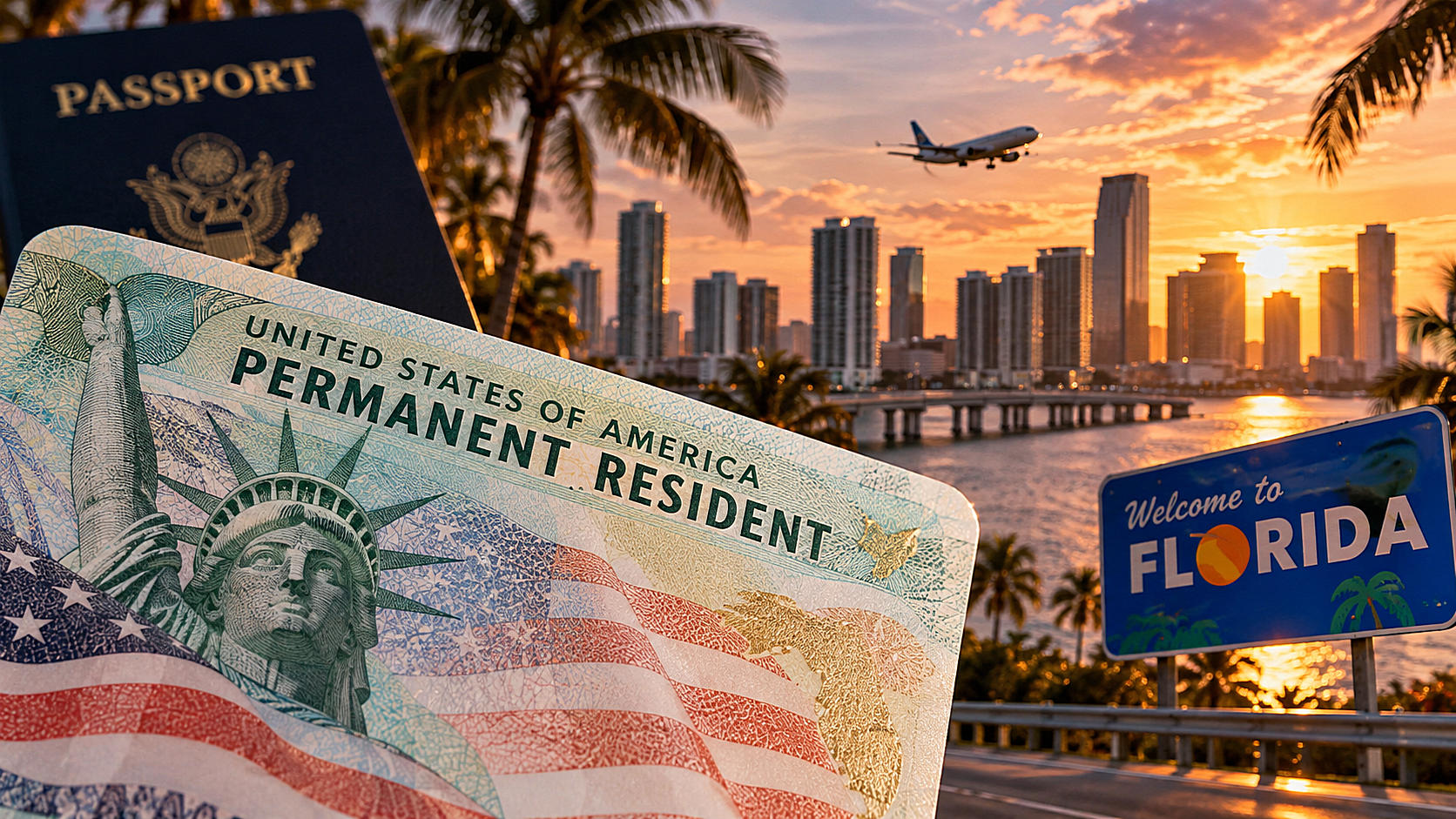
A federal judge has ordered the Donald Trump administration to reopen America’s Green Card Lottery, reviving a pathway to permanent residency that attracted more than 20 million entries in its last completed registration cycle. The ruling comes as federal statistics show Florida has overtaken California as the nation’s leading state for new green card holders.
U.S. District Judge Jinsook Ohta in San Diego issued a preliminary injunction Wednesday, Oct. 14, directing Secretary of State Marco Rubio and the State Department to proceed with the Diversity Visa Lottery for fiscal year 2027. Under a revised court timetable, officials must announce registration details by Oct. 29 and open applications by Nov. 1. Registration must remain open for 30 days, with selected applicants notified no later than Dec. 3.
The ruling follows months of uncertainty surrounding a program Congress established in 1990. The State Department postponed registration for the 2027 Lottery while implementing changes to the application process. Immigration attorneys challenged the delay, arguing that the administration could not effectively suspend a program mandated by federal law. The administration could appeal the decision.
Florida has become the nation’s leading state for new green card holders. According to the Department of Homeland Security’s 2024 statistics, 219,470 people obtained lawful permanent resident status in Florida during fiscal year 2024, surpassing California’s 217,420. Florida’s total increased 41% from 155,500 in 2023 and accounted for more than 16% of the 1.36 million people granted permanent residency nationwide.
The increase was substantial even compared with previous years. In 2022, Florida recorded 113,650 new permanent residents. Within two years, that figure had nearly doubled. California, meanwhile, saw a considerably smaller increase, from 205,040 in 2023 to 217,420 in 2024.

The figures include immigrants arriving from abroad as well as people already living in the United States who obtained permanent residency through a change in immigration status. They cover family sponsorship, employment-based immigration, humanitarian categories and the Diversity Visa program. Federal statistics do not provide a readily available state-by-state breakdown of how many Lottery recipients settled specifically in Florida.
Unlike most American immigration pathways, the Diversity Visa program does not require applicants to have an American employer or qualifying family sponsor. Instead, it offers people from countries with historically low immigration rates a chance to obtain permanent residency through random selection.
The program has a statutory allocation of 55,000 immigrant visas annually, although legislative deductions reduced the available number to approximately 51,850 for fiscal year 2026. The State Department recorded 20,822,624 qualified entries for that Lottery. Selection does not guarantee permanent residency. Applicants must satisfy education or work-experience requirements and pass immigration and security screening.
The Trump administration has raised national security concerns about the program. Diversity Visa issuance was initially suspended in December 2025 following a deadly shooting at Brown University and the killing of an MIT professor. The original suspension ended Aug. 28 under a federal court order, but the State Department immediately imposed a new pause, citing a review of screening and vetting procedures.
Under that guidance, applicants may still submit visa applications and attend interviews, but no Diversity Visas are being issued, with no exceptions. The latest court order requires the government to reopen Lottery registration but does not itself lift the separate suspension of visa issuance.
