
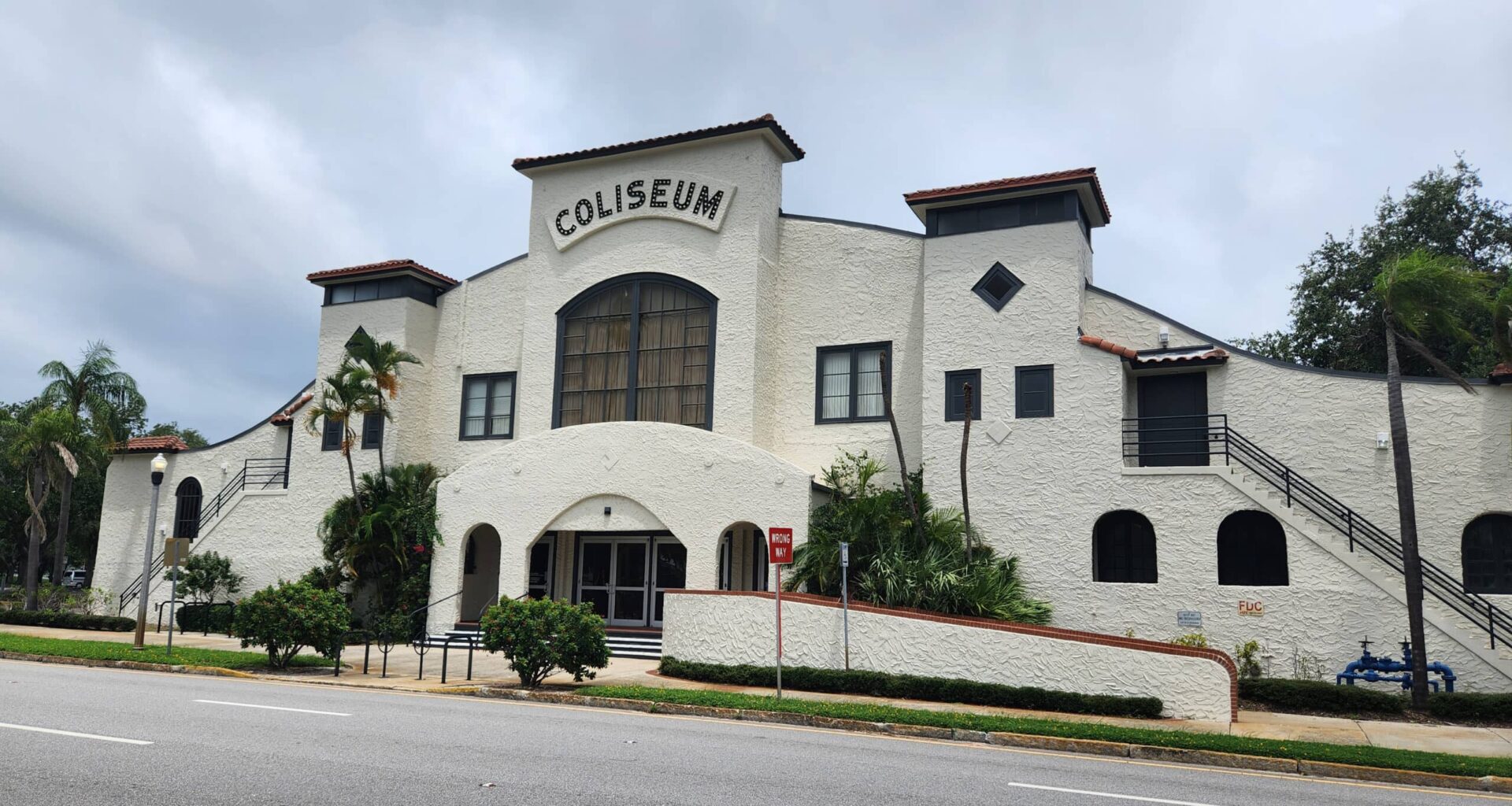
The Coliseum has stood just north of St. Petersburg’s Mirror Lake since 1924, when the city was making a name for itself as a winter destination and the ballroom was among its grandest attractions.
A century later, the neighborhood around it looks considerably different. The 18-story Reflection condominium tower stands a few blocks away, while a property immediately west of the Coliseum is being marketed for an approved 18-story apartment building with 150 units.
Amid that development, the city is preparing to replace the roof of one of its oldest entertainment venues. Last week, St. Petersburg’s Community Planning and Preservation Commission unanimously approved changes to the project after problems emerged with materials selected earlier this year.
The commission initially approved the replacement in June, but city engineers later learned that the roofing manufacturer could not produce the textured material commissioners wanted with the backing needed to maintain the building’s distinctive curved appearance.
That curve is one of the Coliseum’s defining features. Massive wooden trusses span the ballroom without interior columns, leaving an expansive dance floor beneath the arched ceiling.
City historic preservationist Cindy Kohanic explained that the original textured material was intended to resemble the building’s earlier roofs while reducing the shine of a modern replacement.
Commissioners considered alternatives before settling on a darker green roof with an uncoated finish. The choice is intended to better match the Coliseum’s historic appearance, although the material may be more susceptible to staining as it ages.
Brejesh Prayman, the city’s engineering director, acknowledged that keeping the roof looking new indefinitely was unrealistic.
“I mean, a perfectly clean roof, it doesn’t really exist,” Prayman said. “Roofs are going to patina over time no matter what material it is.”
But the decision also raised questions about durability.
“Is there a difference in the longevity, the overall longevity of the roof as far as coated and non-coated?” Commissioner Treva Davis asked.
Prayman said the replacement would still carry a 20-year warranty, although the manufacturer did not recommend the uncoated material. When Davis asked why, the discussion centered on potential staining rather than concerns about the roof’s lifespan.
The commission ultimately approved a smooth, uncoated roofing material in a color called aged patina, a darker green intended to complement the building’s appearance. Felt backing will help conceal fasteners and irregularities beneath the material while following the roof’s curve.
The project also includes insulation, roof access and safety equipment, replacement cladding on the dormers, and new gutters and downspouts. An updated construction schedule and project cost were not established during the meeting.
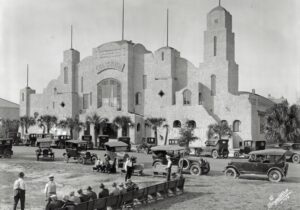
The St. Petersburg Coliseum in 1925. Photo: Burgert Brothers Collection/Hillsborough County Library.
The venue opened Nov. 20, 1924, during Florida’s land boom. Its founders envisioned a destination for residents and winter visitors, complete with a large dance floor, stage, balcony seating and a nursery where parents could leave their children while they danced.
As Bill DeYoung chronicled in a 2024 Catalyst retrospective, the Coliseum became one of the city’s central gathering places. For decades, it was among the few local venues capable of accommodating major concerts and large community events.
Its stage hosted Glenn Miller, Tommy Dorsey and Duke Ellington, along with Louis Armstrong, who performed there in 1946. When Armstrong returned to St. Petersburg 11 years later, he reportedly refused to perform at the whites-only Coliseum and instead appeared at the Manhattan Casino.
The ballroom’s calendar extended well beyond music. Boxing matches, political rallies, trade shows, graduations and wedding receptions all found a home there. In 1984, director Ron Howard rented the building to film a dance sequence for the movie Cocoon.
Even the building’s familiar exterior is the product of change. A storm damaged its original Moorish-inspired facade in 1935, prompting alterations that helped give the Coliseum its present appearance.
The venue later faced an uncertain future as private ownership came to an end. St. Petersburg purchased the property in 1989 for $824,500 and invested approximately $1 million in renovations. Five years later, the Coliseum received local historic landmark designation.
The Coliseum remains a venue for dances, celebrations and other public gatherings, even as the character of downtown St. Petersburg continues to evolve.