
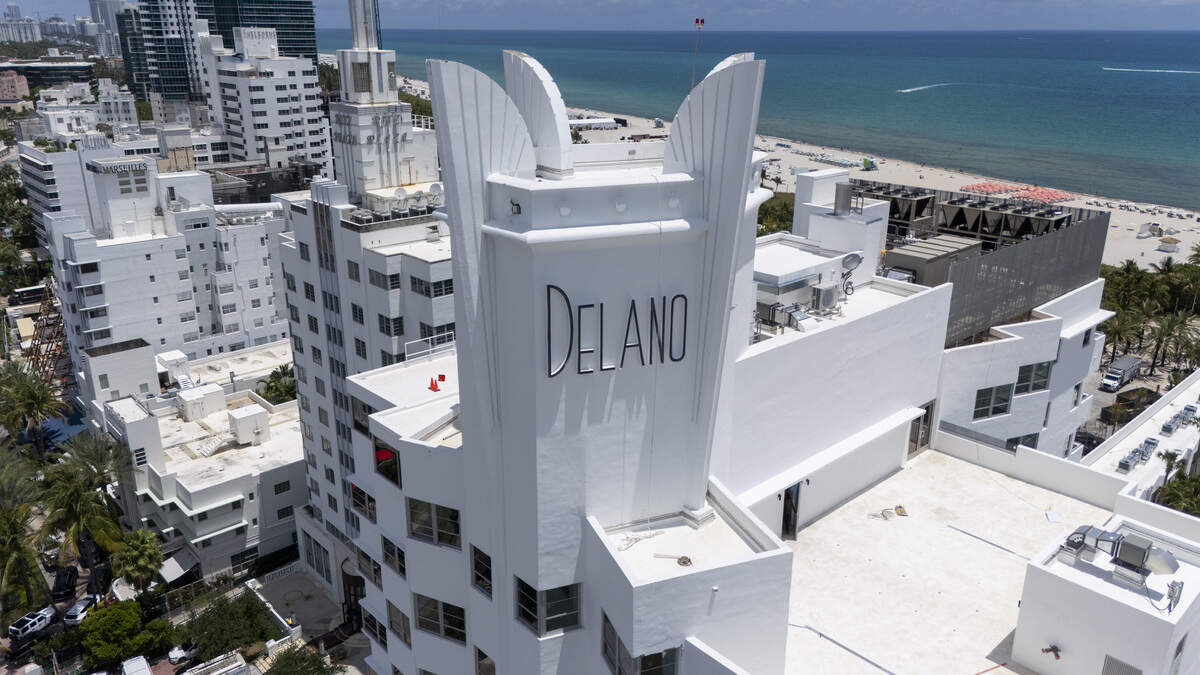
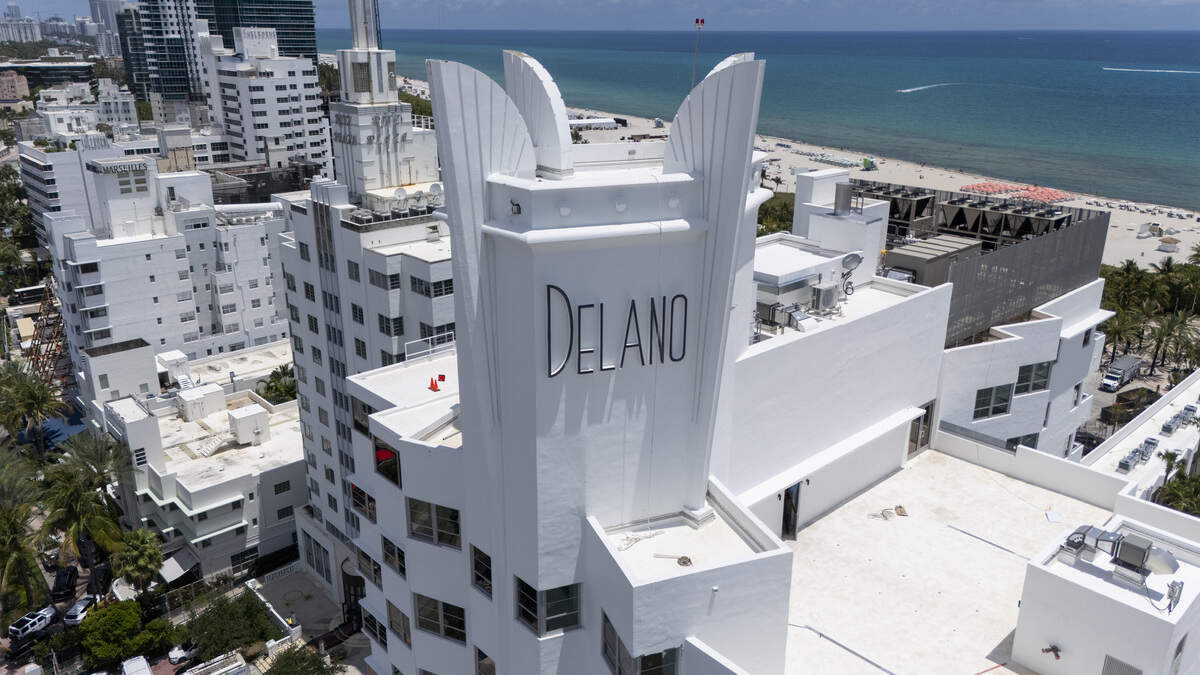
The Delano Miami Beach opened to the public in May. The Art Deco hotel, first opened in 1947, was closed in 2020 for restoration.
Photograph by Al Diaz
adiaz@miamiherald.com
Unintended consequences
The Live Local Act (LLA), on the surface, has noble goals in that it seeks to create an incentive for developers to build affordable housing for Florida workers in areas where they work. To accommodate this, the Act addresses constraints on scale and building size that communities impose to maintain design cohesion. Zoning critics say the system discriminates against workers and lower income families.
Miami Beach contains the world’s largest and most meaningful collection of Art Deco buildings. The area is a major tourist attraction, drawing millions to South Florida annually. The LLA enables aggressive builders to breeze through approval processes and erect massive towers more suited for Shanghai or Tokyo than South Florida, let alone the famous Art Deco district.
Why?
Perhaps these builders have a deep affiliation for local working families and want to help. But obviously that is not their motivation. By including a few floors of rental units inside a massive tower, these builders can create a huge lucrative venture for their companies by offering increasingly rare ocean views to well-heeled patrons. Beach clubs, valets and high-end service round out the offerings.
Miami Beach will be redesigned to look like Shanghai and many part-time residents will have lovely, albeit lofty, ocean views. Over time, rents will creep up on the 40 or so units on floors 3,4 and 5 of these new — and some would say architecturally bland — edifices. Eventually, these units will be converted to starter-condos. Local workers will be forced to adapt again.
It may have been better, in retrospect, to have more options inland on the Beach, which is still walkable to the resorts. Unfortunately, it won’t matter, as in a few short years Miami Beach will just resemble every other bloated and overdeveloped seaside town (hello, Atlantic City). Perhaps funnel cakes will make a comeback or maybe a petting zoo.
The beauty of the historically significant Art Deco district will be dead, with no reason for anyone to visit because there will be nothing to see. Tourists will just move on, as they always do. The builders will be wealthier from their fast-tracked projects, politicians will retire and Florida’s 100-year-old international landmark will be a faded Wikipedia entry, sort of like a cultural Kodak, not made extinct by technological change, but by sheer short-sightedness and greed.
Patricia McKenna,
Miami Beach
Exiles in limbo
Re: Amanda Rosa’s Oct. 13 Miami Herald report, “Nicaragua’s exiles trapped in limbo.” South Florida’s congressional representatives should be ardently pushing for legislation that secures for Haitian, Nicaraguan and Venezuelan immigrants the TPS status that has been so arbitrarily stripped by President Trump’s administration.
Many of these fine people have been forced to flee their countries for their opposition to tyranny. Many face horrendous violence and economic chaos if forced to return.
How can our South Florida community not be at the forefront of defending their right to be among us?
How can Secretary of State Marco Rubio, with his illegal oil sanctions against Cuba, not speak up for actual patriots who suffered for their opposition to communist rule?
Ralph Remis,
Miami
A.I. accountability
The sensationalist headline of the Oct. 11 article, “Jailed by AI,” misdirects the debate. AI identified a person in a photograph supplied by a police investigator. The critical question is not whether AI can identify someone, but how police use that information to make decisions that affect people’s lives.
If I called the police and told them my neighbor was a drug dealer, and they arrested her based on my tip without adequate investigation, would the headline be “Jailed by phone system?”
If we want better social outcomes, we should focus on the responsible use of AI tools, adequate verification of their results and accountability for the decisions made by law enforcement — not simply blame the technology.
Linda S. Carmy,
Sunny Isles Beach
Blackboard quagmire
As a daily volunteer at a public school, I have seen that the teaching staff consists entirely of educators near retirement age or, at the youngest, in mid-career. I suspect this is true throughout the system.
A tsunami of teacher vacancies is coming as surely as the seas. Reading the Miami Herald’s dispiriting barrage of articles about the state of public education, this is no surprise.
Why would any young college student, especially one with debt choose to become a teacher?
The pay in Florida is pathetic (last or next to last in the nation), facilities are not being upgraded, and the cost of living in Miami-Dade is equal to the most expensive national urban areas. These are just a few of the many reasons to avoid this noble and no longer esteemed profession.
The recognition of this vacuum will come far too late to avoid the hollowing out of elementary and high school public education. This catastrophic scenario is probably 10 years away. The disappearance of university departments of education is a harbinger.
L. Gabriel Bach,
Key Biscayne
Energy affordability
Miami’s cost of living topped that of New York City’s for the first time this year, according to data from the Bureau of Economic Analysis. We have Gov. Ron DeSantis to blame. His appointed board of utility regulators have rubber-stamped the rate hikes that have situated Florida as an energy affordability battleground.
A report from the Energy and Policy Institute from earlier this year found that Florida Power & Light, which serves more than 1 million customers in Miami-Dade and nearly a million in Broward, had one of the highest profit margin of any utility surveyed. The money we’re missing can be found in the pockets of corporate executives and shareholders.
DeSantis’ pro-fossil fuel stance and affinity for propping up corporate players have consistently raised our bills, but Byron Donalds and David Jolly — whoever becomes our next governor — can course correct.
Food & Water Action, the nonprofit political and lobbying arm of national advocacy group Food & Water Watch, knows that by working to end Florida’s reliance on dirty energy, rejecting power-hungry data centers and checking corporate greed at the door, Floridians will see a change for the better.
All that remains is our next governor’s willingness to champion these needed changes.
Brooke Ward,
Florida State director,
Food & Water Action,
Largo
So much drama
Russia, it seems, will solve our diesel fuel crisis, at least in the short term. How about our government bringing the unauthorized Iran war to a genuine close?
It doesn’t even make the news anymore, as the nation barrels from one drama or scandal to the next.
How about well-thought-out plans and policies for the genuine benefit of the country? We the people are exhausted and floundering while the emphasis is on massive election spending.
Where does it end?
Sonja I. Pantry,
Miramar
Marlins dismissals
My husband and I are diehard Miami Marlins fans. We did not mind paying our cable provider extra to watch all the games. It is our favorite evening TV watch.
We really enjoyed Kyle Sielaff and Craig Minervini broadcasting and narrating the games, despite the team’s losing season — and losing 12 games in a row. The Marlins made it interesting and we never felt like the team was out of contention.
However, just like the Marlins organization every year trades their best players for a “rebuilding” process, it similarly does the same with the team announcers and that is a real shame.
Craig Mish has shown no personality, and we usually change the station when he or Jeremy Tache get on. We do, however, love Kelly Saco.
Shame on the Marlins for not keeping their loyal announcers and taking away our best.
Avi Lichter,
Aventura