
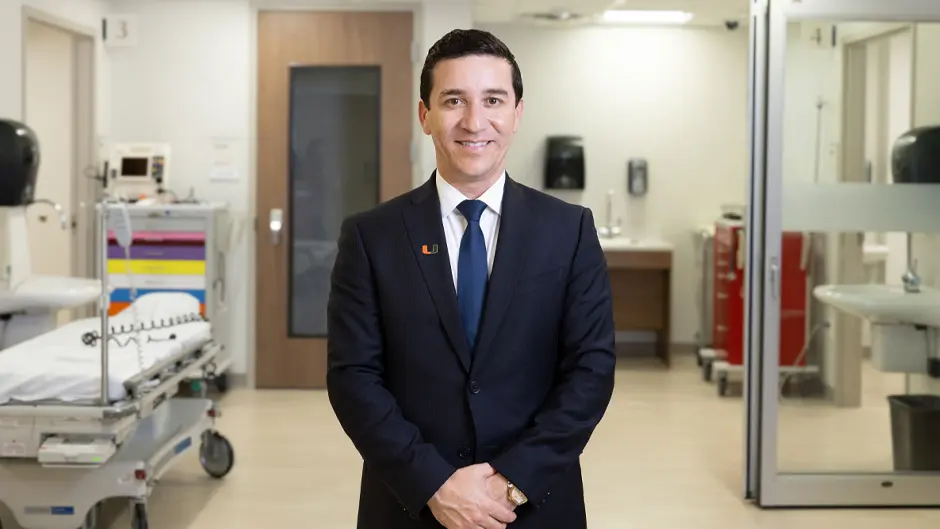
As a youth growing up in a small town in the state of Bahia, Brazil, Hudson Santos often spent the after-school hours in the cafeteria of the local hospital where his mother worked as a nurse. A friendly pharmacist there ushered him into the world of medicine, explaining procedures and demonstrating how to use needles and syringes that a fascinated young Santos took home to practice with on his sister’s dolls.
Little did Santos imagine how far that early fascination would lead him, providing an avenue of professional success and a pathway of purposeful service.
Santos—today a professor, the Dolores J. Chambreau Endowed Chair in Nursing and, since 2024, dean of the School of Nursing and Health Studies—has dedicated his career to bridging the gap between the biological and social domains in nursing science. His methodological expertise includes genomic studies, longitudinal cohorts and clinical interventions that serve to address the developmental origins of health and disease.
In recognition of his groundbreaking research, Santos was recently selected for membership to the National Academy of Medicine (NAM), one of the highest honors in the fields of health, medicine and biomedical science. His membership, effective Oct. 1, was officially announced at the NAM annual meeting on Oct. 19.
“It’s an extraordinary honor to be recognized by one of the most prestigious honorific societies in the fields of health and medicine globally. It’s quite the honor, but also heightens my sense of responsibility,” said Santos. “I have to contribute at an even higher level, to help determine what else we do to continue improving health and shaping the future of healthcare.”
Santos was the only nurse elected for membership this year to NAM, one of three academies that make up the National Academies of Sciences, Engineering and Medicine (the National Academies) in the United States.
“For me, the honor is especially meaningful because it shines a light on the extraordinary contributions that nurses and nurse scientists make to science and healthcare. I’m honored to be representing the profession,” he added.
Though opportunities in his small hometown were scarce and his means were limited, Santos thought he might never have the wherewithal to leave. Yet his drive to learn the healing arts prompted him to earn first a Bachelor of Science in nursing from the State University of Paraiba, then a Ph.D. in nursing science from the University of São Paulo.
As a graduate student, he met Dulce Gualda, a scientist and the most transformational of the many mentors he credited with guiding his learning. He went on to work closely with her in his doctoral work.
“Dr. Gualda was iconic. She pioneered a whole campus at the University of São Paulo—she had the vision to do those types of things,” Santos noted. “She really helped me to think more broadly and boldly, and not to be afraid. She definitely was the turning point in my career.”
While pursuing his Ph.D., Santos was awarded a scholarship to go abroad for clinical trials training. He spent a year as a visiting scholar between the University of British Columbia at Vancouver and the University of North Carolina at Chapel Hill (UNC-). Prior to joining the University of Miami, Santos was a tenured distinguished associate professor and director of the biobehavioral laboratory at UNC-CH School of Nursing and conducted postdoctoral training on symptom science and molecular mechanisms at Duke University.
The recognition from NAM highlights his impact as a scientist, he said.
“I studied something that is pretty basic in a way. Our experiences early in life are very important to success in the long run. In my clinical career as a psychiatric mental health nurse and an emergency nurse led me to ponder how can we help families have a better beginning to life,” he said.
“I’ve been spending most of my research career on understanding the impacts of the environment and early life adversity that predispose you to detrimental health outcomes such as obesity, diabetes, neurological dysregulation, neurodevelopmental problems among others,” he added.
Santos noted that currently his team has one of the largest National Institutes of Health-funded grants at the Coral Gables Campus, one that is focused on understanding how the environment—in all its capacities—shapes the health of the next generation.
For aspiring health professionals, he offered this advice.
“Don’t settle for the easy path. Focus on the questions that need to be answered and find the team members who can help you answer those questions,” he suggested. “Keep your eye on the target: improving the health of the people that you chose to dedicate your career to. That is the goal. Everything else is a distraction.”
He urged new professionals to believe in themselves, know that they belong at the table and make sure their voices are heard—not to advocate for their own interests but instead for the larger goal of improving the health of their communities. Persistence is the key, he said.
The honor of NAM membership strengthens the voice and authority and levels of expertise and influence that can be brought to conversations related to health and healthcare.
“But for me, it’s very simple: You can’t hide behind titles and accolades. You have to use them for the greater good and do the work,” he said.
Santos urged leaders of the healthcare industry and officials to partner with healthcare providers and the populations they serve and to see them as key assets in solving complex problems.
“Trust the front-line workers, those who are doing the work. Trust their input because that is where the solutions are. Listen to the people on the ground and the front lines—the researchers, clinicians, patients and members of NAM and other academies,” Santos highlighted. “See them as a partner in solving the problems. Think of them as effective partners in finding solutions for daily problems and the biggest problems that we face, such as healthcare access and chronic conditions,” Santos said. “Bring them to the table and the solutions will emerge.”
Santos becomes the 10th University faculty member to be elected to the esteemed academy. He joins Dr. Henri Ford, dean and chief academic officer of the Miller School of Medicine; Dr. Omaida Velazquez, professor and David Kimmelman Endowed Chair in Vascular and Endovascular Surgery in the DeWitt Daughtry Family Department of Surgery at the Miller School of Medicine; Dr. Julio Frenk, former University president and professor; Donna E. Shalala, former University president and professor; Margaret Pericak-Vance, the Dr. John T. Macdonald Foundation Professor of Human Genomics Executive Vice Chair and director of the John P. Hussman Institute for Human Genomics; Dr. Diana D. Cardenas, professor emeritus; the late Mary Bartlett Bunge, professor emeritus; Guillermo “Willy” J. Prado, professor of nursing and health studies, public health sciences and psychology; and the late Dr. Ralph L. Sacco, professor and chair of neurology and the Olemberg Family Chair of Neurological Disorders.