
One of the reasons I stick around Miami University’s chapter of Engineers Without Borders, despite not being anything close to an engineer, is because I love interacting with people who do work nothing like my own.
It’s fun to tell them about my homework or what I did in class: “Today, we communicated in only Morse code to simulate the telegraph” or “I have to edit three hours of documentary footage down to three minutes tonight.”
Sometimes, I complain — about my workload, how my one class is really hard, whatever — and I’m met with exasperated disbelief. Most of my friends in Engineers Without Borders do not think my humanities classes (or my majors) are difficult. It’s not that shocking. Honestly, many of my friends within the humanities don’t think their degrees are difficult.
I disagree. The humanities majors are challenging courses, especially when you’re doing them right. When we don’t recognize this, we risk falling into a cycle of devaluation that results in real-life consequences.
It begins with grades and the academic worth we give them.
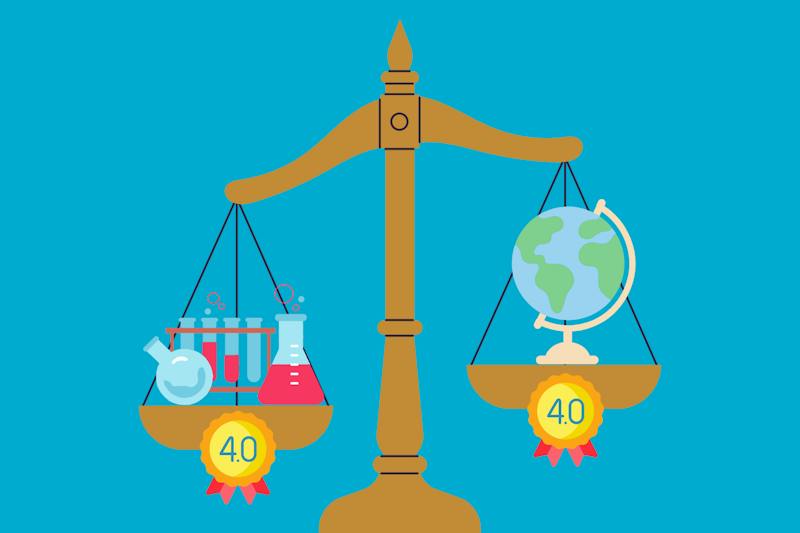
Look at the value we assign to different majors’ GPAs. If I told you I have a 4.0, you might think that I’m pretty smart. What if I told you I have a 4.0 and my major is strategic communication, or another similar concentration? You might still think I’m pretty smart, but not as smart as if I told you I have a 4.0 in chemical engineering.
I’m not saying I could take an organic chemistry test right now. I do not have the foundational skills that would set me up to succeed; I’ve never even taken a chemistry class. But this line of thinking goes both ways.
Because the next harmful step is devaluing the work that happens in class.
If a STEM major with zero foundational skills in filmmaking were asked to make a 15-minute short film (something all students in MJF 146 are asked to do), they might not be able to do it. Or, if they did produce something, it might not be good.
I would argue that the subjective nature of many non-STEM majors should make them more difficult. On a physics test, there is one right answer. It is a hard path to get there, but the parameters are clearly defined. If you write a short story, your craft is being measured against everything ever written and the professor’s preferences. What is an A+ to one teacher is a C to another.
Sure, learning to write well sounds easier than organic chemistry, but they are both learnable concepts. Just because one has a higher barrier to entry than the other does not mean the other is necessarily easy to do. I could learn to do multivariable calculus, just like an applied mathematics student could learn to use Adobe Illustrator.
This gap in perceived value creates pressure for humanities students to be perfect, even at the cost of understanding the material. Students feel that in order to succeed in an “easy” field, they must be the best. When this happens, students become perfectionists, which I believe leads to grade inflation and a willingness to cut corners.
Enjoy what you’re reading?
Signup for our newsletter
Last year, I was in a campaign design class. For the final project, two groups presented nearly identical campaign scripts, probably because they were given the same prompt to the same artificial intelligence.
Why? Because the class was a lot of work, and if they struggled through doing the project, they might have received a bad grade. They would rather cheat than risk receiving a bad mark, a mark that might affect their GPA and (rightfully so) signal to employers that they had no idea how to formulate or propose a public relations campaign.
In one of my current communication classes, the average test result is around 70%. Students are dropping out in droves. In my friend’s engineering class, there are similar test results, but not nearly the same number of students quitting.
The difference might be grit, but I would argue it’s also because STEM kids are allowed and even expected to fail, while humanities kids are expected to be perfect due to their “easy” coursework.
Still, I don’t think my professor should make the tests any easier, and honestly, I don’t think he could. What we need to change is the expectation that a communication class (or any humanities class) should be any easier than an engineering class.
When we undervalue certain majors, we pave the way for lower expectations in class and higher expectations in results. It’s a system that goes on to cheat kids out of truly learning and discredits the very real, important work the humanities do in our world.
College should be difficult, and students should prepare to be challenged. When we treat humanities majors as fallbacks for those who can’t or won’t do STEM or business, we create environments of expected mediocrity. If we want people to start valuing the humanities, we need to start valuing ourselves, even at the cost of our comfort.
Parker Green is a junior studying English and strategic communication who likes to read and hike. She writes for the Campus & Community, Opinion and Culture sections of The Miami Student.