
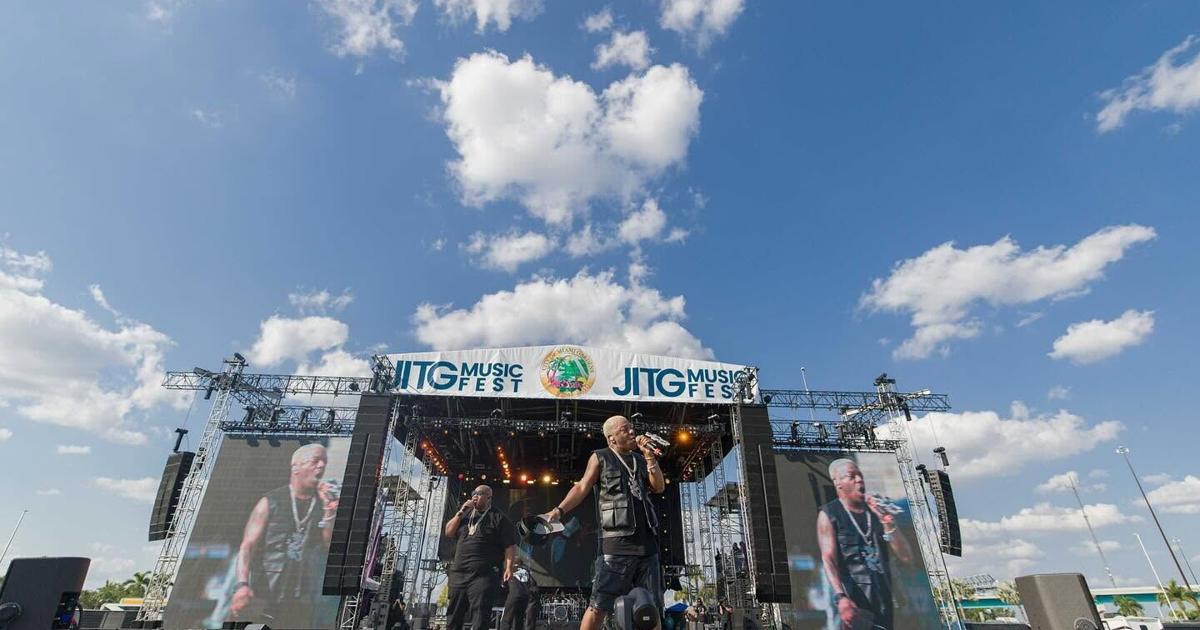
South Florida municipalities have long turned to high-profile music and cultural festivals to build community pride and attract tourists. But behind the headlining acts and elaborate production setups lies a complex financial picture: staging major festivals requires substantial public investment, while the revenue cities collect can fall short compared to spending.
The Miami Times examined spending on signature festivals in Miami Gardens, North Miami and Opa-locka through public records requests, budget documents, interviews and written statements by elected officials. The records detail costs, reported revenue and cited benefits, from tourism and business activity to utility assistance.
Those investments are facing renewed scrutiny, however, as cities prepare for the possibility of losing property tax revenue if Florida voters approve Amendment 3 in November. Miami Gardens recently cut Jazz in the Gardens from its FY 2027 budget in anticipation of the measure’s possible passage, as reported by The Miami Times.
Jazz in the Gardens


Attendees at JITG 2026.
(JITG via Facebook)
Jazz in the Gardens, Miami Gardens’ annual two-day music festival, celebrates R&B, jazz, hip-hop, soul and gospel. City officials describe it as an attraction for tourists, investors and residents alike.
However, executing an event of its size requires a massive financial commitment. Public records show 2026 expenses exceeded $7.5 million for talent, production and associated programming. The largest listed payment was approximately $4.81 million to producer and organizer Black Promoters Collective LLC.
Artists at JITG 2026.
(JITG via Facebook)
Other major expenses included approximately $1.08 million for production and technical services, $324,237 for operations and rentals, $412,022 for hospitality, décor and festival services, and $456,991 for insurance.
A significant portion of the budget also went to ancillary programming and community events that took place during JITG Week — before the main festival.
Food & Poetry, a spoken-word competition with performances, awards and food vendors cost around $25,788. The Women’s Impact Luncheon, honoring Women’s History Month, totaled $158,305, while the White Smoke All White Affair rooftop party drew a price tag of $24,597. Opening Night and activation nights totaled $66,100, and Sponsor Garden/VIP experiences, the festival’s most premium, upscale ticket and hospitality tiers, accounted for $85,290.

The 2026 Women’s Impact Luncheon.
(JITG via Facebook)
Against these expenses, the revenue generated is modest. The revenue summary lists $288,758.88, including $201,000 in sponsorships and $49,110 in ticket sales, as well as additional donations, table purchases and luncheon transactions. The recorded revenue entries amount to about 3.7% of expenditures.
According to the city, Miami-Dade County committed $500,000 in support in 2026 — as it has done in previous years — while the Greater Miami Convention and Visitors Bureau (GMCVB) provided more than $80,000.
“Since its inception, the festival has leveraged a mix of funding to execute the event, including city-budgeted funds and private investments such as sponsorships and vendor participation,” the city said in a statement.
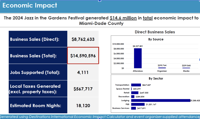
A page from the 2024 GMCVB JITG report.
(Courtesy of the City of Miami Gardens)
The city’s case for the investment also rests on regional spending. A GMCVB economic impact report for the 2024 festival estimated approximately $14.6 million in total impact on Miami-Dade County, including $8.76 million in direct business sales.
The report estimated 18,120 purchased hotel room nights associated with the festival and $567,717 in local tax revenue. Direct sales included approximately $5.29 million for lodging, $1.20 million for food and beverages, $867,447 for transportation and $647,555 for retail.
Those figures reflect countywide economic activity, not money returned to Miami Gardens’ treasury.
“The City does not have analysis specific to businesses located in Miami Gardens, as the report is prepared by the Greater Miami Convention and Visitors Bureau and the information is examined countywide,” said Assistant City Manager Vernita Nelson.
Nelson, who oversees festival production, said the event contracts with local food, merchandise and production vendors, as well as more than 10 local artists. However, reviewing business addresses, The Miami Times identified only four Miami Gardens-based vendors among those listed in the 2026 festival expenditure records.
“With over 19 years of producing Jazz in the Gardens Music Festival and its ancillary events, the City has worked with various Miami Gardens-based residents and businesses,” Nelson said. “Since this is a public investment, the City takes measures to secure the best products and services for the best prices – this means sometimes working with businesses outside of Miami Gardens.”
The city also cited temporary employment, increased business sales and publicity that can attract visitors and investment.
“The tourism impact extends beyond the festival weekend,” the city said. “The positive national media coverage and social media visibility the festival attracts further enhances the City’s brand, positioning Miami Gardens as a vibrant destination for arts, culture and entertainment.”
Budget documents place 2025 spending at approximately $8.7 million and list a $5 million allocation for 2026. However, reported 2026 expenses exceeded that allocation by more than $2.5 million. The fiscal 2027 budget contains no allocation for the festival.
NoMi Fest

City of North Miami officials at the 2025 NoMi Fest.
(Courtesy of Hiprockstar)
North Miami did not hold its annual outdoor R&B and soul festival in 2026 due to the city’s centennial, according to Mayor Alix Desulme.
Records for the 2025 festival list $482,457.09 in expenses and an estimated Eventbrite revenue of $130,387.25, accounting for approximately 27% of spending. Initial funding amounted to $258,300, including $237,500 from the General Fund, $10,800 in vendor fees and $10,000 from the GMCVB.

Anthony Hamilton, NoMi Fest’s 2025 headliner.
(Courtesy of Hiprockstar)
Entertainment costs totaled $210,000, including $155,000 for 2025 headliner Anthony Hamilton. Production and technical services accounted for approximately $94,987, while marketing, branding and advertising totaled $92,192. Other costs included security, hospitality, photography and promotional materials.
Desulme, who created the event in 2016 as “Music in the Plaza,” said NoMi Fest celebrates the city’s culture and provides accessible entertainment.

The LeVert Experience; (L-R) Marc Gordon, Dave Tolliver and Joe Little.
(Courtesy of Hiprockstar)
“But it’s also an economic engine for the city,” Desulme said in an interview. “You have people coming from everywhere — South Florida, the region, all the way from Orlando, coming to Nomi Fest, coming to the businesses in the city and working with our different businesses.”
The City Clerk’s Office said the city has no reports, summaries or internal presentations evaluating the 2025 festival’s financial or economic impact.
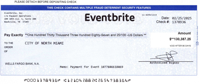
Ticket sales for the 2025 NoMi Fest.
(Courtesy of the City of North Miami)
Desulme describes NoMi Fest as a “party with a purpose.” The event supports the NoMi Water Bill Assistance Program for North Miami residents, with ticket revenue placed in the General Fund to help with water and sewer bills. Desulme said eligible residents generally receive a $500 annual credit; assistance is intended for residents who have fallen behind on their payments.
“If you are paying your monthly or quarterly bill on time, then you would not get a benefit. So the only way you do get a benefit is if you are behind,” Desulme said. “We would apply the $500 credit towards your account, and if your bill was $800, then your balance would be $300.”

North Miami Mayor Alix Desulme
(City of North Miami)
Some residents rely on the assistance annually, creating a waiting list every year, Desulme said, while others remain unaware the credits exist.
According to the city, North Miami provided more than $713,000 in utility assistance to 1,105 residents from 2023 through 2025, with some of the money coming from NoMi Fest.
When asked why the city chooses to host the festival rather than allocate money directly to assistance, Desulme cited community programming as another benefit.
“We go to the North Miami Senior High School, getting a conversation with the kids on staying and doing right,” he said, describing a NoMi Fest-related program known as The Conversation, through which artists are brought to speak with local students.
The city set aside $600,000 for NoMi Fest in the 2027 budget after cutting $200,000 from the initial allocation.
Arabian Nights

The Opa-locka Arabian Nights Fest in 2026. /
(Courtesy of the City of Opa-locka)
In the City of Opa-Locka, special-event budgeting is scaled for a smaller municipality. Opa-Locka revived Arabian Nights for its centennial this year after going more than 20 years without the festival.
The expense summary details a total cost of $219,618.44. Entertainment amounted to $62,300, including $40,000 for bookings featuring Ball Greezy and LeToya Luckett.
Other major costs included $45,830 for décor and rentals, $29,999 for photography and video, $25,140 for sound and technical production, $17,200 for event management and $14,025 for police security.

The Opa-locka Arabian Nights Fest in 2026.
(Courtesy of City of Opa-locka)
Contributions totaled $64,500, including $16,000 from the city’s Community Redevelopment Agency, $15,000 from Klub 24, $11,500 from Concourse Club and $7,500 from Safa Construction. Other support included $2,500 from the GMCVB and $1,500 from the Miami-Dade County Mayor’s Office.
The festival generated no direct revenue for the city, as it was free and garnered no ticket sales. Officials said $3,050 in vendor fees went toward operational expenses rather than being treated as general revenue.
Mayor John H. Taylor’s office did not respond to multiple interview requests.
Some of the artists on the festival’s lineup were local to Opa-locka or raised within the city’s boundaries, including Brisco, Bushy B and Ball Greezy.
For FY 2026, the city allocated $280,000 for the festival and centennial celebration combined.
The FY 2027 budget initially included $200,000 for Arabian Nights and school book bags. However, after the city manager recommended eliminating special event spending to direct resources toward infrastructure, commissioners agreed on Oct. 14 to allocate just $20,000 for the festival and seek sponsorships to cover additional costs.
“If you’re a true Opa-lockian, you know that Arabian Nights is our history,” said Commissioner Natasha Ervin at the meeting. “Even though we spent a lot of money this year on Arabian Nights, we did get a lot of donations as well. We can go ask for sponsorships.”
She suggested approaching major sponsors early and eliminating some expenses, including the VIP area.