
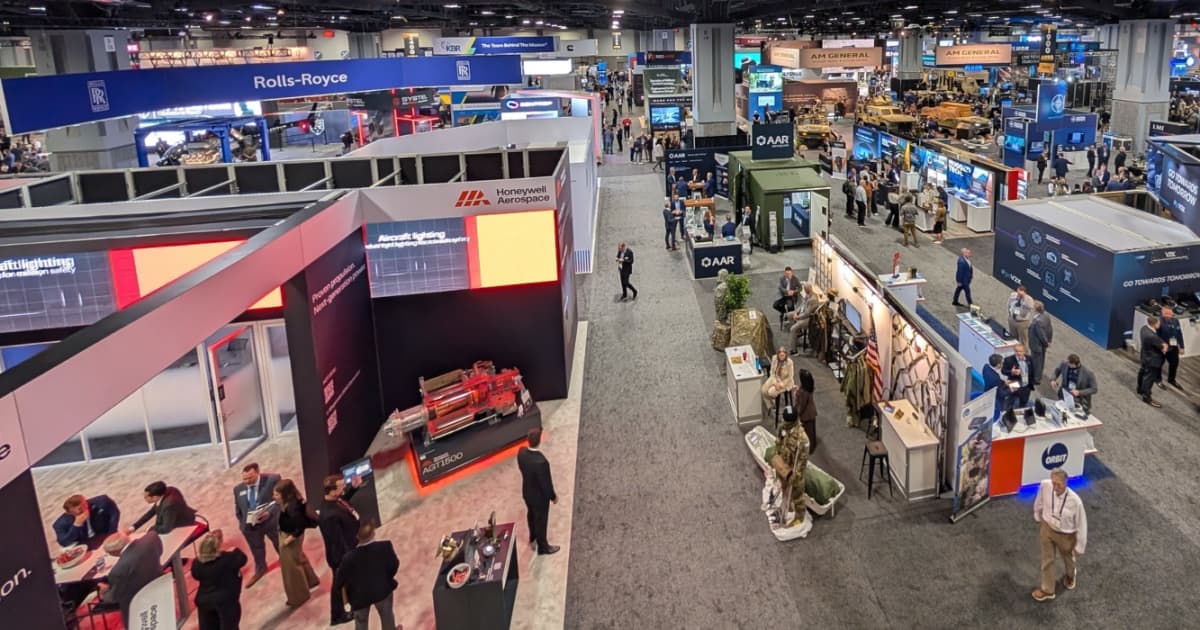
FIU came on strong at the recent United States Army Conference in Washington, D.C. The university promoted its innovations related to cybersecurity, communications, energy, manufacturing and more as they relate to national security and defense.
Participation in the annual gathering has broad value for FIU as faculty and others engage with members of government and industry to create opportunities for collaboration, future funding and the transitioning of university research into practical applications.
“One of the most valuable aspects of AUSA is bringing together researchers, defense contractors and government organizations in one place. These interactions can help bridge the gap between university research and the development of technologies that address real defense needs,” said Stavros Georgakopoulos, a professor at the College of Engineering & Computing who leads the university’s Transforming Antennas Center.
“AUSA provides an important opportunity for FIU researchers to engage directly with Army representatives and defense companies, understand their technological challenges and identify where our research can provide solutions. Interactions at AUSA can help us understand specific defense needs, obtain feedback on our technologies and identify opportunities for collaborative research, funding and technology transition.”
FIU has nearly $50 million in recent funding from the Department of War for projects such as wearable solar technology designed to power soldiers’ gear; reconfigurable antennas, radar communications and sensing systems led by Georgakopoulos; and additive manufacturing. The DOW also has provided seed funding for cyberspace and cybersecurity research.
In addition to faculty and administrators, students attended the event, which drew some 40,000 visitors and 750 exhibitors.
Student Broderick Galloway, a fellow with FIU in DC, the university’s official advocacy and student-talent development hub, shared social media posts during the conference to explain FIU’s mission. He also introduced Clint Arhelger of FIU’s National Forensic Science Technology Center, based in Largo, Florida. The NFSTC advances forensic science through applied research, tech evaluation and hands-on professional training. It takes crime scene tools and puts them into the hands of soldiers on the front lines to help them, for example, detect chemical threats or identify bomb-makers.