
By Matthew Cimitile, University Communications and Marketing
A long-term study of deep-sea ecosystems in the Gulf finds a sudden, severe and unprecedented
decline in marine life, and suggests the likely cause is the Deepwater Horizon oil
spill from 16 years ago.
Using deep-sea sampling and genetic analysis, a research team comprising 10 institutions
from across the country, including the University of South Florida, documented that
certain species in the Gulf’s deep-pelagic zone declined by 60% to 85% from 2011 to
2015. Ongoing research and data collection suggests marine populations have yet to
recover since.
Steep declines were seen among fishes, arthropods such as shrimp and krill, and cephalopods
such as octopus and squids at water depths of 200-1,500 meters below the surface.
The magnitude of ecosystem decline, the authors write, is greater than any observed
over 60 years from comparable datasets, suggesting that the decline in the Gulf is
the greatest recorded in a deepwater ecosystem. The study was published in the Proceedings of the National Academy of Sciences.
“The Gulf is amazingly diverse, but deep-pelagic communities themselves are fragile
because the system appears to be finely tuned,” said study lead author Tracey Sutton, a biological oceanographer at Nova Southeastern University and an alum
of the USF College of Marine Science. “This study exemplifies how industrial excursion
in the deep ocean is outpacing our knowledge of what lives there.”
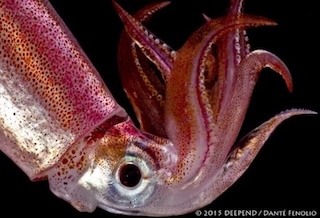
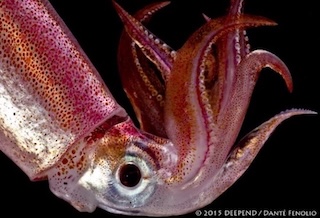
Deep sea squid.
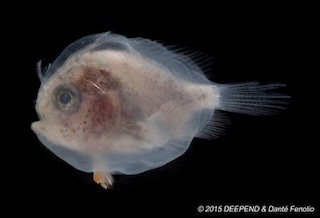
Angler fish larvae.
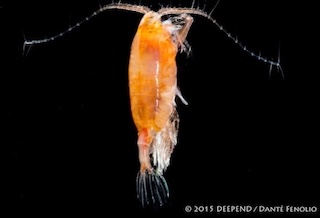
Orange copepod.
This groundbreaking research was conducted by DEEPEND (Deep-Pelagic Nekton Dynamics of the Gulf of Mexico), a consortium of marine scientists that examined the short- and long-term impacts
of the 2010 Deepwater Horizon oil spill on marine life and ecosystems below 200 meters.
The research team spent more than a decade collecting data on animal populations,
oil contaminants and food web impacts to determine changes in ecosystems and marine
life from the environmental disaster.
USF St. Peterburg marine biologist Heather Judkins oversaw the collection and analysis of octopods, squids and pelagic snails during
DEEPEND research cruises. She has been part of the consortium since it began in 2010.
“These important scientific findings have been a long time coming,” Judkins said.
“The team behind them has done extensive work to uncover what is happening in the
Gulf and it shows how vital long-term monitoring is for understanding population dynamics,
especially in remote areas like the deep sea.”
The deep-pelagic habitat comprises more than 90% of the Gulf and is still a largely
mysterious body of water. Besides hosting a diverse array of species, the deep-pelagic
zone is vital as a food source and for carbon cycling.
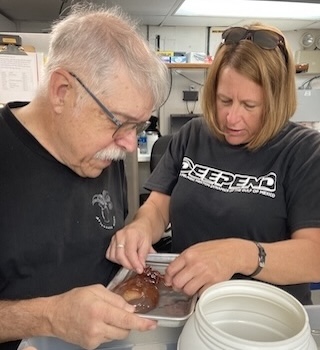
Marine biologist Heather Judkins examining a squid.
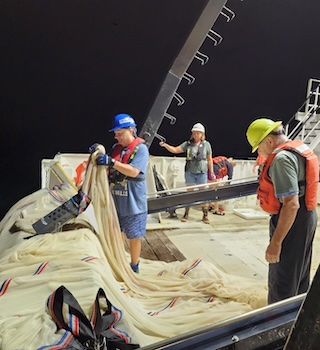
Retrieving organisms from the deep sea using net system.
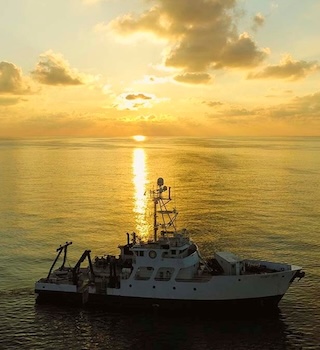
DEEPEND research vessel in the Gulf.
Though the consortium was established as a response to the largest marine oil spill
in history, the research has led to a greater understanding of this mostly unexplored
region of the planet. New species were discovered, water bodies classified, species
movements in the deep sea mapped, and food webs better understood because of the many
DEEPEND research cruises.
The research and data collected have also been used by dozens of graduate students
to further their studies and careers.
“There is so much to explore, see and document in this realm of the ocean. With each
research cruise, we may discover new species and just how fascinating life is in the
deep sea,” Judkins said. “There is a lot we know now that we didn’t know before the
spill that we can share with the world.”
Scientists from USF have been studying the Deepwater Horizon oil spill since 2010. During the disaster, a team from the College of Marine Science embarked on USF’s
newly acquired research vessel Weatherbird II to collect data near the blowout site.
Over the course of 12 ensuing research expeditions, scientists sampled water, sediments,
fishes and other marine animals. The data gathered helped scientists investigate the
spill’s overall impacts on ecosystems in the Gulf.
The college went on to lead an international consortium – consisting of 18 institutions
with $36.6 million in research funded by the Gulf of Mexico Research Initiative –
to study the environmental impacts from the spill. This interdisciplinary effort culminated
in more than 250 scientific publications and a two-book series synthesizing research
by the consortium.