
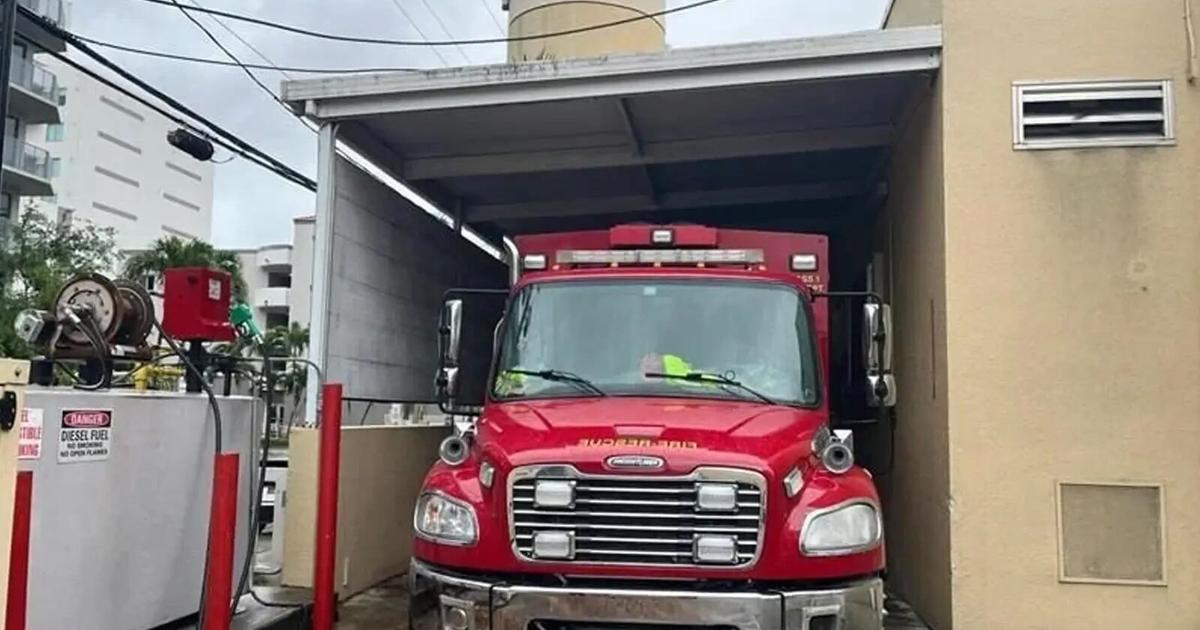
Mayor Eileen Higgins says Miami’s fire stations are so old that one relies on eBay for spare parts.
“Fire station 1 in downtown is just about 65 years old,” Higgins said. “The fuse box — if you go in there and you need to replace the fuse, you cannot actually buy them. You have to go on eBay and buy them from a person that collects them. That’s how old they are.”
She said more than half of the city’s fire stations are over 50 years old while two of them are over 60 years old, adding that lack of maintenance has brought mold and corroded plumbing. Meanwhile, the Homicide Department within the police headquarters building has trashcans set up to catch leaks from the ceiling “in the fifth floor in the middle of the building,” Higgins said.
Rescue workspaces seen in disrepair. (safeandreadymiami.com)▲
She quoted a veteran officer who said it’s been raining in the department for 20 years.
Incidents like these are the motivation behind the $450 million Safe and Ready Miami bond initiative that voters will be deciding on Nov. 3.
The bond — on the ballot as City of Miami Referendum 1 — would authorize the city to repair, replace and build public safety facilities.
Mayor Eileen Higgins. (Mayor Higgins via Facebook)▲
Higgins said the initiative is well overdue. She said thousands of voters live in neighborhoods that don’t have fire stations “because the city hasn’t built a new fire station in decades.”
She said that absence could be fatal.
“We have response times when someone calls — perhaps their grandmother’s having a heart attack, their husband’s having a stroke,” Higgins said. “In some neighborhoods in Miami, our response times can be eight minutes, nine minutes, 10 minutes, 11 minutes, 12 minutes. That is far above the national standard of six minutes to save a person’s life.”
Higgins encourages residents to visit safeandreadymiami.com to see the response time in their neighborhoods.
“It’s not just about buildings,” Higgins said. “It’s really about making sure that people get the life saving responses that they need.”
Opponents to the bond say the City of Miami is already running a $2 billion deficit. Higgins countered that putting off the projects the bond would pay for will just add to that debt.
“If I wait one more year, for every year I wait, it’s $20 million more. So five years from now, it’s actually $125 million more to get started,” Higgins said. “The least expensive way to do this is to do this now because it saves money and it saves lives. You know things just don’t get cheaper.”
Putting the cost into perspective, she said:
“It’s not free. It is not free to build new fire stations and do this, but you have to ask the voters. And $450 million sounds like an awful lot of money, but when we break it down and we share that cost as a community, our finance department has estimated in the first year it would cost $2.38 a month, so that’s less than a cup of coffee for me. I would gladly sacrifice a cup of coffee if I can help save one of my neighbors’ lives.”
Commissioner Damian Pardo. (Damian Pardo via Facebook)▲
But Commissioner Damian Pardo says the real costs are being covered up.
“The Safe and Ready bond is a $450 million bond that over the 30-year life of the bond will be $800 million in cost,” Pardo said. “The city right now is under an affordability crisis. People are struggling: groceries, gas, rent, etc. If you read that ballot language, that ballot language does not tell voters that they’re going to have a tax increase at all, it’s incredibly misleading.”
“The truth is, for a $500,000 property value, you’ll be paying $194 a year on average, and over the life of that bond, $6,000. So, people need to know this is a tax increase,” he added.
Commissioner Christine King. (Christine King via Facebook)▲
He and Commissioner Christine King said there are alternative options to solving the issues at hand.
“Public-private partnerships work, and we’re not against police or fire,” King said. “We were just asking to let’s look at other options before we pull the trigger and ask the community to pay for what is essentially the responsibility of government.”
King also said impact fees should have been considered.
“The city has collected impact fees for years, and those impact fees (come) from development. And if you look, there’s development all across the city of Miami,” King said. “Those fees, millions and millions of dollars collected in impact fees, are designated for this exact purpose: to build fire stations, to renovate fire stations … We cannot take the road of least resistance and just ask our taxpayers to pay for what is squarely our government’s responsibility.”
“When we have families in jeopardy of losing their homes, even $1 extra is too much of a burden,” she added. “It is our responsibility to look at every other option before we ask residents to take on this debt.”
King also said the measure went on the ballot without enough exploration beforehand
“This is the first time that I know of where we are asking residents to take on this tremendous amount of debt, and there was no, zero, community engagement prior to this happening,” King said. “It’s akin to a shotgun wedding. None of the commissioners were able to … talk to our constituents before this was approved to go on ballot.
“It’s a sexy campaign, Safe and Ready, and scaring folks. ‘If you don’t vote for this, you’re gonna die.’ That is unfair to our residents. I don’t care how they vote, as long as they have all of the facts. And what the mayor is presenting is disingenuous and misleading to our community. And what Commissioner Pardo and I are doing is trying to get the facts, all of the facts, to our residents, so they can make an educated decision and not a decision based on fear.”
Pardo also said the measure is premature.
“If you read the debt policy management, the procedures and the policies for the City of Miami, this should have gone to the Finance and Audit Committee,” Pardo said. “It never went to the Finance and Audit Committee, so there was no exploration or explanation of any of this to the commissioners. So unless you have a finance background, how are you supposed to appreciate what we’re putting before the voters? If you’ve had absolutely no one look at it, it’s like building a home and then sending it for engineering review after the fact.
“We’re not here to tell people how to vote, but we want them to have every single bit of information. We don’t think that’s been the case here,” Pardo said. “We’ve both been very strong supporters of police and fire. We will continue to do so. We think there’s just a better way and more fiduciary way and a way that’s responsible to taxpayers to get it done.”