
JACKSONVILLE, Fla. – Several local teachers and school administrators have faced criminal charges in recent months, raising questions about what the law actually says about teacher-student relationships.
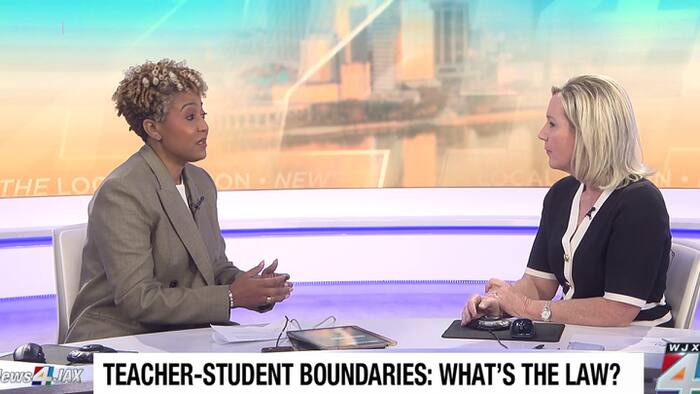
Jacksonville attorney Millicent Daniels with The Daniels Law Firm joined us on The Morning Show to explain the legal boundaries — and the consequences for crossing them.
Mandatory reporting: Why a principal was arrested
Among the recent cases was the arrest of Baldwin Middle Senior High School Principal Michael Townsend, who was accused of failing to report alleged inappropriate behavior between a teacher and a student. The case drew attention because the principal was charged not for his own conduct, but for failing to act on someone else’s.
Daniels says that distinction matters under Florida law.
“School employees here in Florida are considered mandatory reporters,” Daniels said. “That means that they are charged with having to report suspected child abuse, sexual abuse, abandonment, neglect, as long as they have reasonable cause, they have to go ahead and report it to the child abuse hotline.”
She added that failure to report is not simply a policy violation.
“In situations where it’s not reported, then that person could face felony offenses,” Daniels said.
When texting becomes a crime
Some of the recent investigations began with text messages between school employees and students, a scenario that Daniels says is increasingly common.
“The text in itself is not a crime,” Daniels said. “However, the content of the text may very well be criminal.”
Daniels explained that Florida law prohibits school employees from pursuing romantic or sexual relationships with students, and that digital communication can add an additional charge.
“If they choose to use an electronic device, like a computer, a tablet, a cell phone in order to attempt to lure or solicit a child or a student into a sexual activity, then that in itself is an additional separate charge that’s also a felony,” she said.
Physical contact, consent, the law
In the case involving a math teacher at Darnell Cookman School of the Medical Arts, the allegations involve physical contact.
Brian Orr was arrested and accused of lewd and lascivious touching of a teenager and has pleaded not guilty.
Daniels was direct about what the law says.
“Very simply put — don’t do it,” Daniels said. “If you intentionally touch a child, and it’s done in a lewd way, which means that you’re touching their genitals, their private areas, whether they consent to it or not, because the law says they cannot give consent, then you are gonna face felony charges.”
What ‘not guilty’ means
Several of the accused in these cases have entered not guilty pleas, including Orr and substitute teacher Cameron Coverson, who was charged with two counts of unlawful sexual activity with a student. Daniels says a not guilty plea is a standard part of the process.
“A not guilty plea is very common in the criminal justice system,” Daniels said. “It’s one of those things that starts off the criminal process.”
She noted that the burden in these cases falls squarely on the state.
“The state has the burden of proof. That means that they have to prove every element of the offenses that they charge beyond a reasonable doubt,” Daniels said.
Recognizing grooming
Daniels emphasized that inappropriate relationships often develop gradually, and that the warning signs extend well beyond the classroom.
“Grooming is a real thing,” Daniels said. “It can be the late-night text, or the text about things that are not related to the school activity, or emails that are unrelated to the school assignment.”
She says parents and school employees alike need to recognize the signs.
“It can be that hug that lasts too long, giving of gifts, the singling out, the secrecy behind it — those are all indicators of inappropriate conduct that parents, we need to all be watchful for,” Daniels said.
The responsibility, she added, is shared.
“As school employees, you have a duty to go ahead and report it because if you don’t, you’re facing felony charges,” Daniels said.
Civil liability for school districts
Beyond criminal charges for individual employees, Daniels says families may also have legal recourse against the school district itself.
“Many times we’re seeing that it’s not an isolated incident — there are red flags that were apparent and the school district didn’t do anything about it,” Daniels said. “Not only is it in criminal court for those employees that actually commit these offenses, families then can go ahead and also pursue civil damages against the district.”
Copyright 2026 by WJXT News4JAX – All rights reserved.