
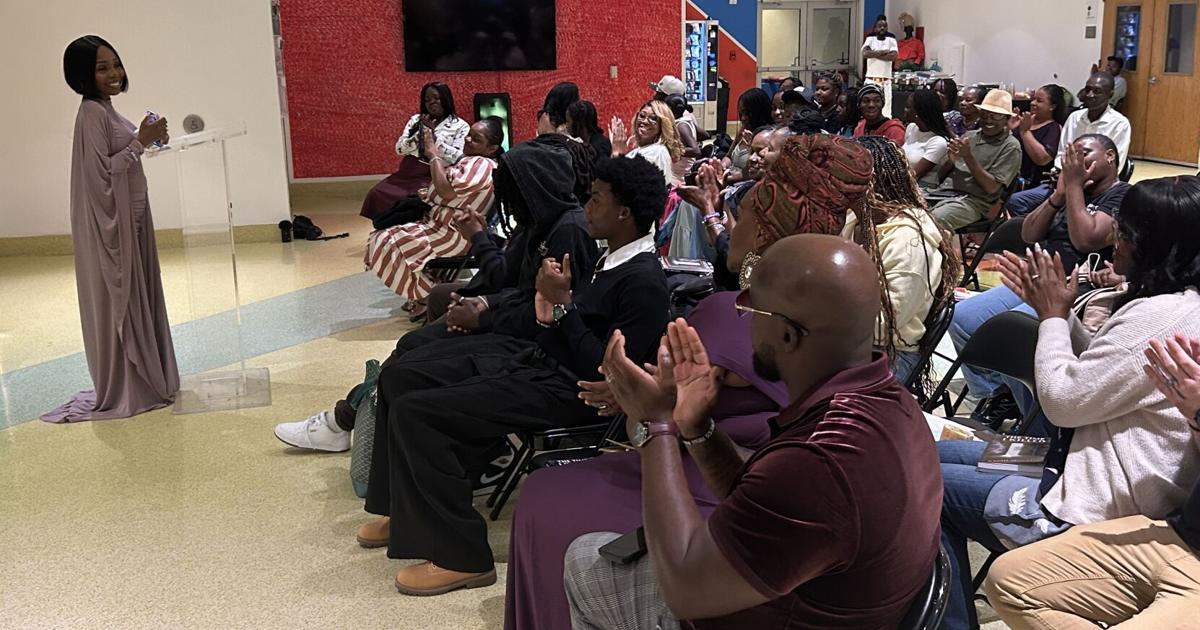
Inside a meeting room at the Little Haiti Cultural Complex, over 30 people were asked if they knew anyone personally impacted by domestic violence.
Almost all of them raised their hands.
October is Domestic Violence Awareness Month, and last Saturday, members of the Miami community assembled to honor the stories of the survivors in their community.


Naomi Augustin during the release event for her new memoir.
(Rafael Hernandez for The Miami Times)
Centered around the release of survivor Naomi Augustin’s self-published memoir The Time I Killed: Nothing Was Random, the event was anchored by the accounts of people affected by domestic violence and their solemn calls for change.
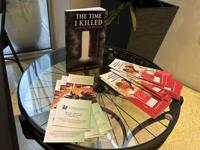
Naomi Augustin’s self-published memoir “The Time I Killed: Nothing Was Random” is displayed alongside pamphlets with resources for victims of domestic violence.
(Rafael Hernandez for The Miami Times)
“When one person speaks, we can’t change the world,” Augustin said. “However, we can do it one person at a time, starting with ourselves — by speaking, sharing our experience, just letting the next person know, ‘Hey, you’re not alone.’”
Beyond her book release, Augustin wanted the event to be a platform where people could channel their grief into advocacy and community awareness.
According to data gathered by the CDC from 2023 to 2024, more than one in three women (or nearly 43.5 million) and one in six men (or about 20.7 million) in the United States experience physical violence, sexual violence or stalking by an intimate partner during their lifetime.

Naomi Augustin signs a copy of her memoir.
(Rafael Hernandez for The Miami Times)
Of those impacted, one in four women and one in seven men will face severe physical violence at the hands of their intimate partners.
Statistics like these weigh heavily on Augustin, who said she was still grappling with her own abusive dynamic to this day.
While she declined to share the specifics of her situation and pointed those interested toward her memoir for the full story, she also did not shy away from the pain she had to relive putting pen to paper.
“The Time I Killed was the person that I could have become, what I almost did. Nothing was random because I was weak; I didn’t know my worth,” she said. “I allowed the abuser — knowing with all the red flags — I still allowed my abuser to step into my world. And it literally changed decades of my life.”
Natalie Jean was invited by Augustin to share a story that few in the room had heard.
When her son was 17, Jean says he tried to end a relationship with a girl that was obsessed with him. Enraged, the girl lured him down to the family’s parking garage and stabbed him in the chest, piercing his heart. The girl was sentenced to 17 years in prison.
Jean said it was not the first time the young woman had pulled a knife on him, but he never told his mother about the earlier incidents.
“We talked about everything, but he didn’t tell me that part,” Jean said. “He probably thought he had it in control.
For Jean, the loss has become a message about how anyone can be a victim — no matter their gender or age.
“Boys go through domestic violence. Men do get domestic violence as well. We mostly focus on women. I’m not trying to discredit it, but men do not like to talk about it because it makes them feel weak,” she said.
Jean used her time on the podium to encourage families to be open and honest with each other so that kids can recognize unhealthy behavior and feel safe talking about it. She urged parents to teach their children that rejection is a part of life.
“You don’t love what you hurt,” Jean said. “That’s not called love. That’s called obsession, and people need to learn how to differentiate that.”
Lake Worth Democratic Rep. Debra Tendrich, who also attended at Augustin’s invitation, said gatherings like this one give survivors a sense of wholeness that is hard to find alone.
“One thing about domestic violence is that the place you’re least safe is where you’re supposed to be the safest,” Tindrich said. “It’s within your home, and when you lose that safety, it takes an entire community to come together to make you feel like you’re whole again.”
A survivor herself, she split from her abusive relationship in 2012, taking her then-3-year-old daughter with her — a move that forced her to quit her job and start from scratch in Florida.
Last session, she filed HB 277, which passed unanimously in the state legislature. The bill makes a second violation of a protective injunction an automatic third-degree felony, increases penalties for repeat offenders and raises the relocation allowance for victims through the state’s Victim Crime Compensation Trust Fund.
“Right now, restraining orders are only as good as the paper they’re on,” Tendrich said. “What this does is it strengthens penalties for more accountability to the abusers.”
She said her next priorities include coercive control and stronger protections for children, who are more likely to become victims or perpetrators themselves if they witness domestic violence.
For her part, Augustin also wants more done on the policy front.
She wants Florida to adopt a “look-back” law, similar to those in California and New York, that would allow survivors to press charges against abusers years or even decades after the abuse occurred.
“A lot of times, survivors and victims, they don’t talk about it until years and decades later for so many reasons, for example, fear or just lack of understanding or just wanting to move on,” she said.
As the evening came to a close, though, Augustin described the night as more than a book release.
“It was a movement,” she said. “I believe it was a change of trajectory, change of hearts, people repositioning and understanding what’s taking place in the lives of the community.”