
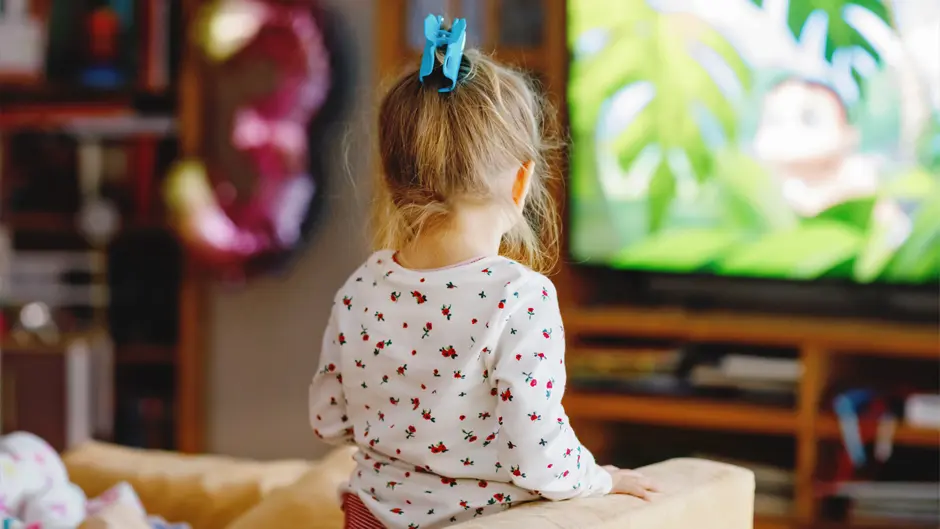
Digital media consumption among toddlers has spiraled upwards for more than a decade—and spiked during the pandemic—prompting concern that the increased exposure would compromise vocabulary development at a critical developmental age.
Yet studies by Lynn K. Perry, a professor in the Child Division of the Department of Psychology at the University of Miami College of Arts and Sciences and part of an intercollegiate research team, have found that while media consumption certainly should be monitored and limited, there can also be some modest benefits.
“We expected more negative associations across the board, that watching more video might be associated with a decrease in vocabulary in a variety of domains,” said Perry. “And we did find that if kids watch more video, they knew fewer body part words. Yet the kids who watched more video actually knew more ‘people’ words, such as postman, firefighter, teacher, and family names—mommy, daddy, grandma and grandpa, pets’ names, etcetera.
“We’re considering that certain media content might expose them to more people and characters and professions compared to their everyday experiences if they don’t encounter these people,” she added.
Perry provided data analysis on two studies examining how often and for what purpose 17- to 30-month-old children use media, one in 2024, the other in 2026 and both headed by Sarah C. Kucker, in the Department of Psychology at Southern Methodist University.
The first study focused solely on the consumption of the different types of media and how that relates to the size of their vocabulary and if that was impacted by the parents’ motivation or rationale for having their child consume media.
“We found some interesting differences,” said Perry, who joined the University in 2015 and helped launch the Object and Word Learning Lab soon after.
The tendency for parents to try and use media to regulate their child’s emotions—to calm them for example—was associated with negative impacts on their vocabulary. Media use for educational purposes or connection, either connection between parent and child or like using Facetime to connect with family members, seemed to have benefits for the child.
“Intuitively, people know that not all video or media is bad—it’s how you use it. This study provided insight into ways that parents and kids use media that might be supportive of learning and social engagement or ways in which they use it that might disrupt that learning,” Perry said.
Perry pointed out that the birth-to-age 3 period is critical for language growth and highly predictive of later educational outcomes. The experiences they have during that period are really helpful for their acquisition of language and the skills they’re developing during that period are very predictive of their later outcomes—readiness for kindergarten, academic successes in the school years, and also associations with ongoing academic success and decreases in the likelihood of incarceration, she noted.
“We know that early period is really important to understand what sort of experiences best support children’s language development,” Perry said.
She highlighted that, especially in the original study, the parent’s motivation for their child to consume media was pivotal.
“Parents have a lot of guilt about their child’s media consumption because in the big picture we hear all these negative associations, so it’s helpful to have some nuance here,” Perry said.
“Digital media can be a useful tool, especially, when as we found, it’s useful for forming social connections for education and using Facetime video for catching up with family members. And using it in the context of conversation rather than replacing opportunities for conversation can be helpful,” Perry said. “But the flipside is when parents use it to try and calm the child that seemed to be a negative predictor of outcomes.”
Perry highlighted that while both studies generated extensive data sets, neither examined the quality of the media. She noted that other research has evaluated more closely how quality programs such as Sesame Street support children’s language and social emotional learning.
“The range of things that children are exposed to on YouTube and through apps has really increased and there needs to be additional work evaluating the strengths and weaknesses of some of these newer media,” Perry noted. “That is a future direction that we can certainly go.”