
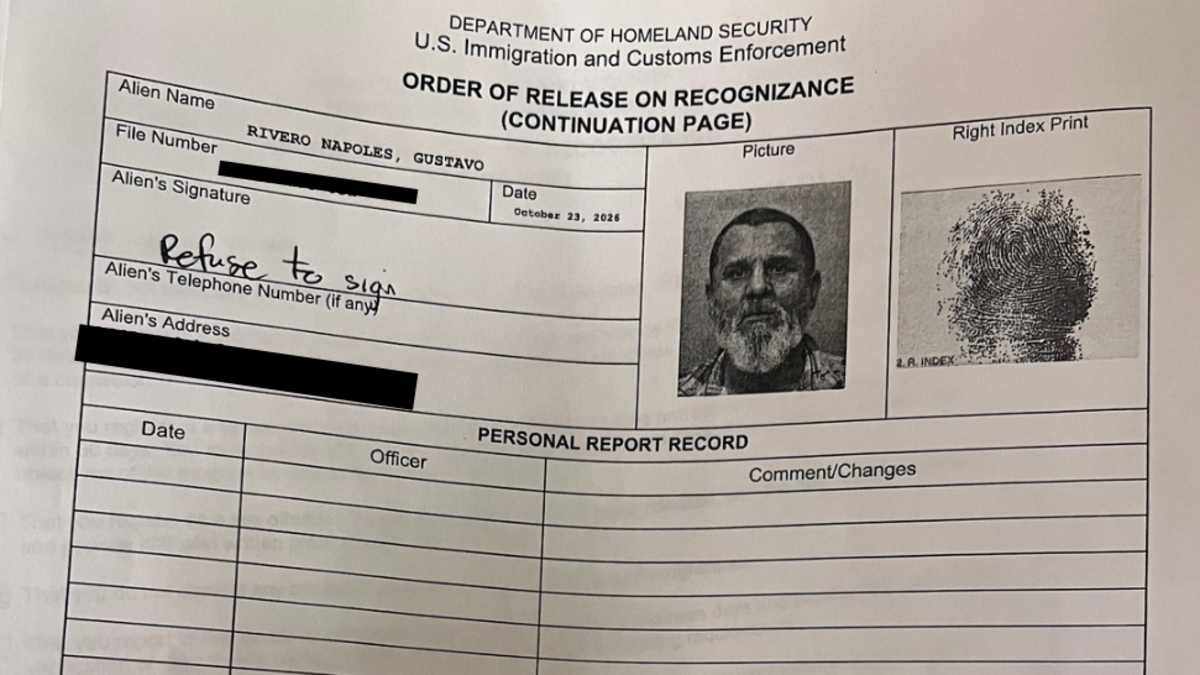
A release form ICE gave Gustavo Rivero Napoles when he was transferred to the intensive care unit of a hospital. It says he refused to sign, but his family said his health had deteriorated so badly, he was incapable of signing and likely unconscious.
Courtesy of the Rivero family
On Oct. 25, in the intensive care unit of a California hospital, a Cuban man who spent nearly his entire life in Hialeah died of cancer after about six months in immigration detention.
But the government has not reported Gustavo Rivero Napoles’ death — because U.S. Immigration and Customs Enforcement released him from its custody the day he was moved to the ICU, likely unresponsive, about 48 hours before he died.
“He died being treated like a dog,” his niece, Angelina Rivero, 33, told the Miami Herald.
In previous years, ICE was directed to publicly report and conduct reviews of all deaths of individuals in custody, including those who died within 30 days of release.
The agency reversed those standards in June. Now, the government is no longer required to report deaths once a person has been released.
Deborah Fleischaker was assistant director for policy at ICE in 2021, when her office drafted the initial policy. She later became the acting chief of staff, and said the original policy was implemented in part to discourage the agency from releasing sick or dying people to avoid accountability for their death.
“Somebody, like in this case, where they were very sick in custody, ICE held them anyway and then released them when they were on death’s door,” said Fleischaker. “It’s very hard to conclude that they don’t do that to avoid claiming the death in custody.”
“Have there been others? We wouldn’t know,” she said.
At least two other deaths within days of release from custody this year have sparked scrutiny — a Haitian asylum seeker who died of hypothermia outside of Pittsburgh and a Rohingya asylum seeker left in a parking lot in New York who also died in part of hypothermia. Both deaths were ruled a homicide.
Deaths in immigration custody have jumped significantly since the beginning of 2025, when the Trump Administration launched a mass deportation campaign. Over 30 people died in 2025 and at least 29 so far in 2026 — outpacing every year for the last two decades. A Miami Herald investigation into two deaths found evidence that the men received inadequate or delayed medical treatment.
His death has not been previously reported. The Herald reached out to representatives for ICE and DHS. They responded asking for identifying information about Rivero Napoles but had not provided comment by the time of publication.
The Herald spoke with four relatives of Gustavo Rivero Napoles, who said they wanted his story shared, that he was deeply loved and they are horrified at how he was treated. He was in the hospital starting Oct. 20, they said, and transferred to the ICU on Oct. 23, at which point records show ICE released him from custody. By then, his family said, he was unresponsive.
“They didn’t have any intentions of releasing him. When they knew he was dying, they said, ‘All right, let him go,’ and then he dies,” said Carolina Rivero, 47, his sister-in-law, who was with him when he died. “That’s infuriating.”
“They just kind of threw him away,” she said. “They just waited for him to die.”
Rivero Napoles, 65, was diagnosed with stage 4 liver cancer before he was taken into ICE custody. He was in a wheelchair. For months, they had been fighting for his release, and didn’t believe he was receiving proper medication or treatment.
In September, his sister Catalina Rivero, 72, filed a lawsuit challenging the legality of his detention and seeking his release. A judge ordered that an attorney be appointed on Oct. 26, the day after he died.
ICE did not inform his family he was in the hospital for days, they said. On Oct. 24, a doctor called his sister to say he was in the ICU — “more dead than alive,” kept alive only by machines, she said — and that ICE had left him there. For months, her brother had told her on the phone: “I’m going to die here.”
“Keep him alive, por Dios,” she told the doctor, sobbing.
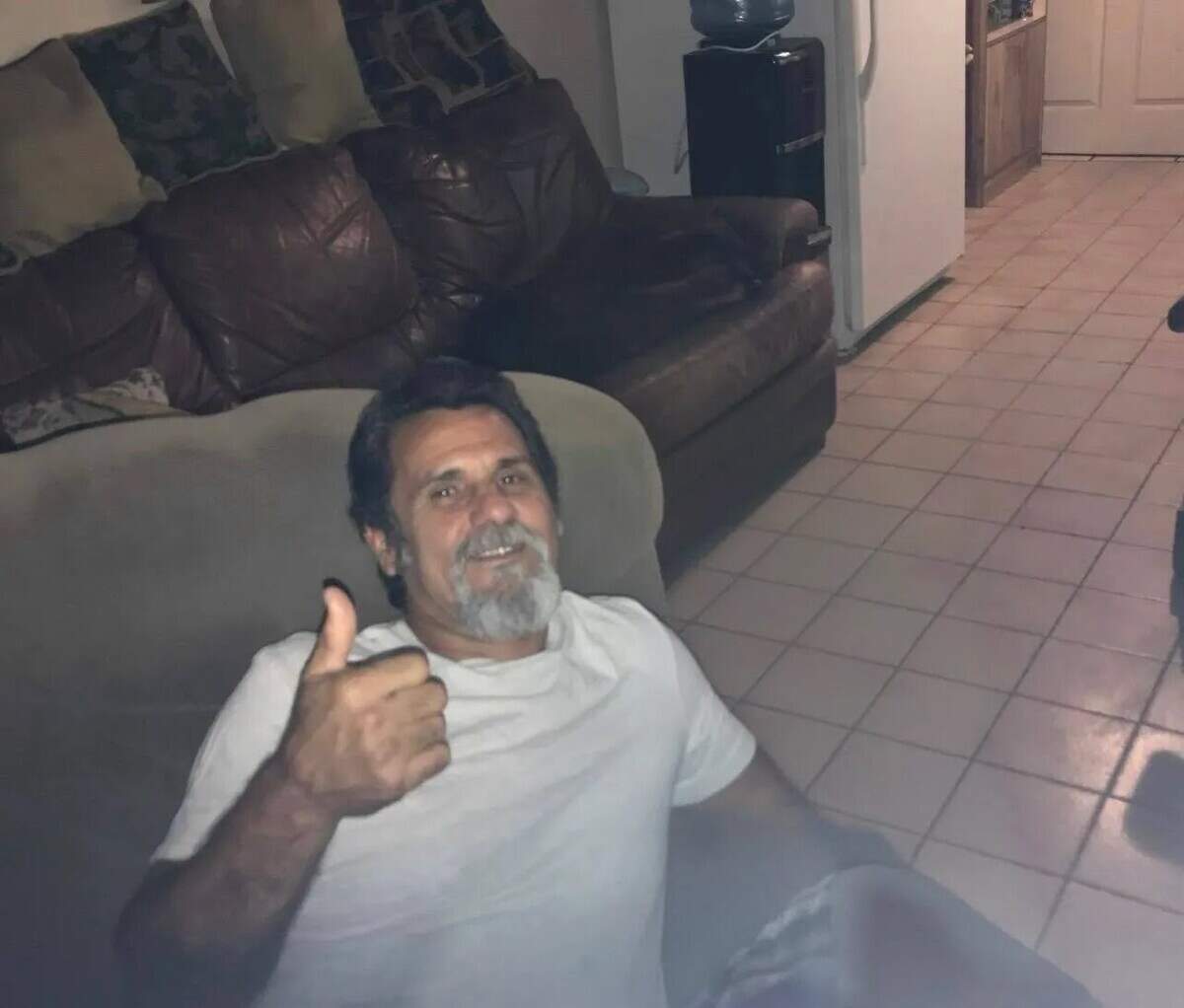 Gustavo Rivero Napoles in an undated photo provided by his family. Courtesy of the Rivero family ‘I don’t want to die like this’
When his relatives arrived at the hospital late Oct. 24, Gustavo Rivero Napoles’ health had deteriorated so badly that his skin was yellow, almost green, they said. He was not moving, unresponsive and bleeding from his mouth.
Even judges had told them he should go home, they said.
He was in a wheelchair because the condition in his liver made his legs so inflamed that it was painful to walk. He told his family that sometimes he lay on the floor of his cell crying out in pain, and that he wasn’t receiving his medication on a regular basis. He said a doctor in the detention facility had told him “all you illegals just want drugs” when he asked for his medication.
“I don’t want to die in here,” he told his sister on the phone from detention.
“He would call me any hour of the day, any hour of the night. I would sit with him,” Catalina Rivero said. “I would shake in my bed and listen to him crying, begging me to help.”
Rivero flew to the United States from Cuba around 1970 when he was 8 years old. He grew up, and spent most of his life in Hialeah, one of nine siblings. He married and had two daughters. He received permanent status in the country, his relatives said, alongside many Cubans who arrived around the same time in the 60s. He loved fishing, skateboarding and surfing when he was younger. He suffered from bipolar affective disorder, anxiety and depression.
“He’s one of the most loving, genuine people I’ve ever met,” said Carolina Rivero. She named her son after him. She described him as emotionally strong, and said it was terrifying to see his fear in detention. He had previously worked as a welder, she said.
Records show he had decades-old charges related to drugs and other offenses. In 2023, he was arrested in connection with a 1984 rape case, but prosecutors declined to pursue sexual battery charges, records show. His family told the Herald that the woman did not recognize him and had described her assailants as several Colombians. He denied having anything to do with the rape, but was in pain and wanted to be released from jail, they said. In a plea deal, he was given a battery charge, two years house arrest and probation, with an agreement to take random drug tests, his family said. He failed a test, and was placed in jail this year.
“I think the prosecutor took advantage of him,” said his brother, Alex Rivero, 67. “Since they couldn’t get him on rape, they just wanted to get him on something. […] My brother should’ve just walked away from that.”
Rivero Napoles found out he had cancer in jail in Miami. The judge wanted to release him, but knew that he would be quickly picked up by ICE, his sister-in-law said.
She remembered the judge saying, “I can’t have it on my conscience that you’re going to die with them.”
Another judge released him, saying he should be able to die with his family. He was immediately placed in immigration detention at a check-in center in Miramar so overcrowded he slept on the floor in packed rooms, then Krome North Service Processing Center before he was transferred across the country to California City Processing Center.
“I know that some people are going to hear his story and then they’re going to want to know what his past was, and they’re like, ‘Oh well, he deserved it,’” said Carolina Rivero. “No, he didn’t. He did his time.”
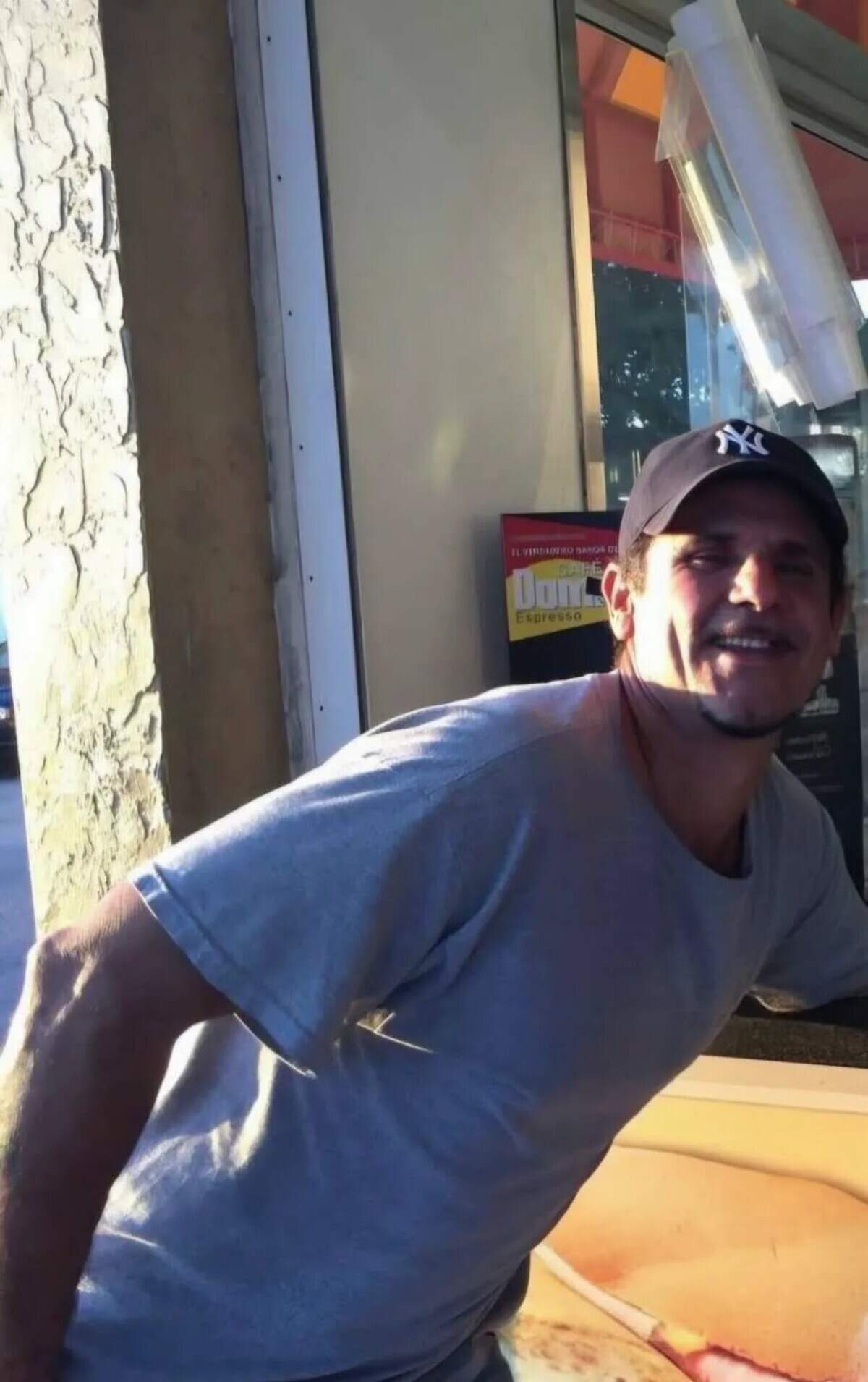 Gustavo Rivero Napoles in an undated photo provided by his family. Courtesy of the Rivero family
He was in touch with his family constantly until last week — especially his sister, with whom he lived and was the closest. She thought of him more as a son than a brother. When they did not hear from him, they began calling, asking about his wellbeing. On Thursday, Oct. 22, his brother spoke with immigration officials, who said he was in custody and the family could visit him. He asked if Rivero Napoles was okay, and the woman said she could not share information. The family would later find out that he was already in the hospital.
A form shows that the agency released him on Oct. 23, and instructed him to check in with authorities in Miramar in November. In place of his signature, an officer wrote “refuse to sign.” But his family said he was unable to understand or respond at that time, with the level of toxins in his body.
On Oct. 24, an immigration officer called his sister, saying he had been placed in a local mental health institute, but would not share which one. When they called the number provided, the facility said he wasn’t there. A doctor called her hours later, saying he was in the ICU at Adventist Health Tehachapi Valley Medical Center.
“If you’re close enough, come now,” the doctor said. Carolina Rivero and her husband got in the car and drove five hours. His sister took a flight from Miami. They arrived around midnight, and the sister the next morning.
Nurses said that they had been pleading with agents for the family’s contact, but they refused. When he was placed in the hospital initially, nurses said two agents watched him at all time.
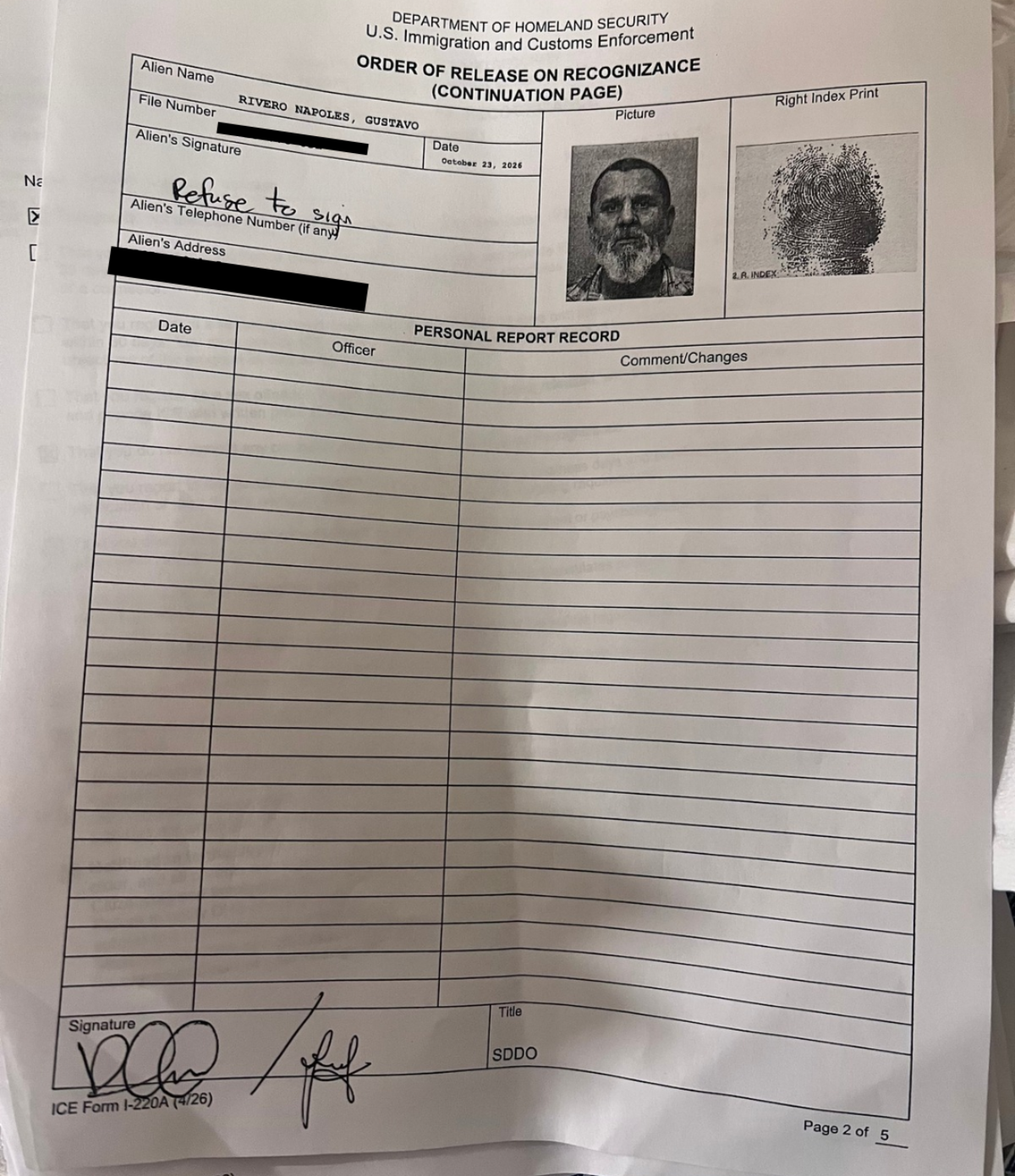 A release form ICE gave Gustavo Rivero Napoles when he was transferred to the intensive care unit of a hospital. It says he refused to sign, but his family said his health had deteriorated so badly, he was incapable of signing and likely unconscious. Courtesy of the Rivero family
The family did not know he had been released from custody until they got to the hospital, and found the form among a box of his belongings. “His papers, medications and belongings were left in a dirty donut box in the closet,” Carolina Rivero said. He only responded to them once: when he shed two tears when his sister walked in and told him, “I’m here.”
He died Sunday night. His family said they believed if he had received better treatment he would have lived longer, or been able to explore the possibilities of a liver transplant.
“The doctors did tell us that, if he would have gotten the right care — no matter what he was going to die, we knew that and we understood that — but he could have lasted longer,” Carolina Rivero said.
“He could have at least died knowing that his family was there with him,” she said.
It appears that ICE may not know he died.
On Friday, nearly a week after his death, an immigration officer called Catalina Rivero, she said, to confirm that he would be checking into an appointment they scheduled for him in Florida on Nov. 23. When she told them he died, they asked her where he had died.
“ICE killed my brother,” she told them.
This story was originally published October 30, 2026 at 3:43 PM.

Miami Herald
Claire Healy is an Esserman Investigative Fellow at The Miami Herald. Prior to her current role, she wrote for The Washington Post, where she was a 2024 Pulitzer Finalist for “Searching for Maura.”