
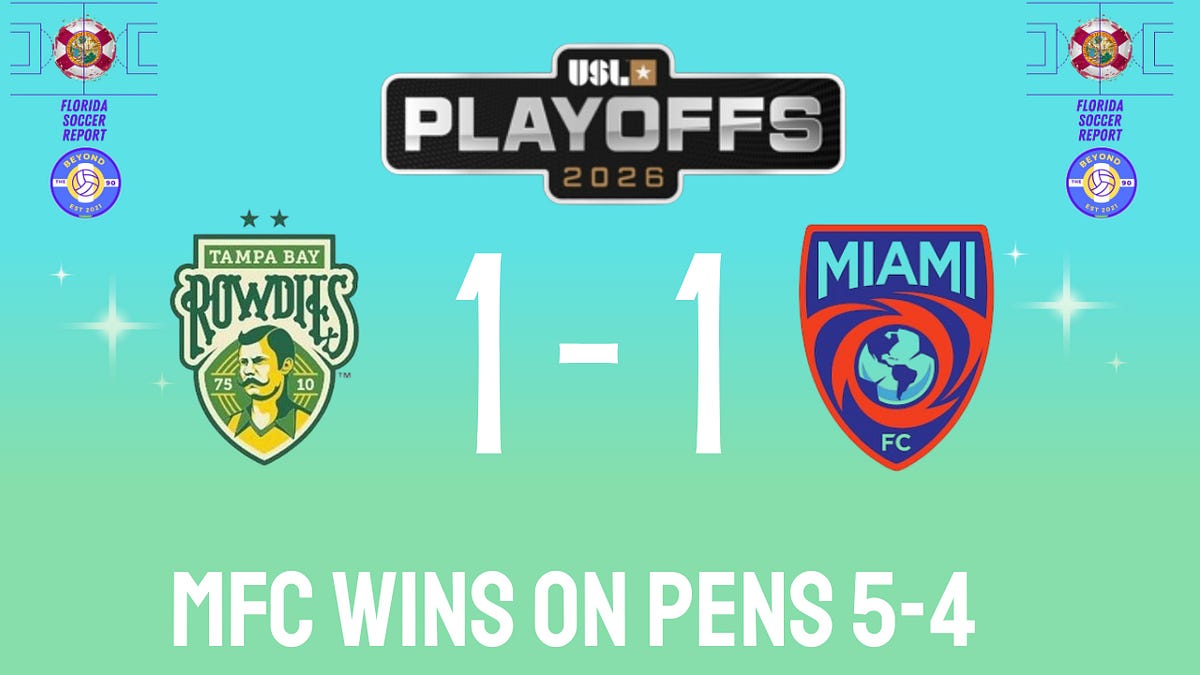
Miami FC’s advancement over the Tampa Bay Rowdies on Friday night is just latest in an increasingly long (and disturbing from where I sit) chapter of higher seeds beating lower seeds in the early stages of the USL Championship Playoffs. What’s the point of the Regular Season if Pittsburgh, LouCity, and Tampa Bay can win Players Shields one week and then get undone by mediocre opposition the next ending their seasons?
But this chapter doesn’t sting as much because quite honestly if you watched these two sides the last six weeks, Miami FC was pretty much equal to Tampa Bay. The Rowdies excellence of early season has long since passed and it feels like they limped into the postseason.
And in fact for the first 60 minutes last night, despite a Tampa Bay goal it felt like Miami FC were the far superior side in terms of shape, ideas and technical play in St Petersburg.
Miami’s lack of composure and was the reason they were not firmly in control after an hour on the scoreboard which read 1-1. After that Tampa Bay was better but still not good enough.
For the opening hour last night, Miami FC were fundamentally the superior side.
Rather than deploying a passive, bunkered low block, as we predicted in our match preview podcast, Miami set up in a coordinated mid-block that stepped into high pressing traps whenever the Rowdies circulated the ball across their back three.
TAMPA BAY BUILDUP (Struggling vs. Traps)
[CB] [CB]
\ /
[DM] <— Rocha / Da Costa cutoff
/ \
[WB] [CM] [CM] [WB]
| |
======|==========================|====== MIAMI MID-BLOCK
[RWB] [CM] [CM] [LWB]
\ /
[CB] [CB] [CB]
[GK]
Severing the Central Pivot: Arney Rocha and Rodrigo da Costa executed a masterclass in screening passes into Tampa Bay’s central midfielders. By cutting off interior passing lanes, Miami forced Tampa Bay’s center backs to play slow, looping lateral balls toward the touchline, where Miami swarmed with immediate double-teams. There was space out wide for the Rowdies but they didn’t take advantage of it – just yet.
Vertical Punch in Transition: When Miami won possession, their first look was direct and vertical into the channels. They bypassed Tampa Bay’s counter-press, repeatedly finding space behind the Rowdies’ advancing wing-backs. Sometimes these chances would not appear but MFC kept the ball and took the air out of the match. Miami dictated the game’s tempo both in transition and on the ball, and capitalized with a deserved opener. But then got undone in transition to see Tampa Bay level 1-1.
A note on the officiating in this phase. I could argue that both sides goals should have been disallowed based on a foul to win the ball back in midfield- but generally feel the official got it right. This was playoff football in addition to being a derby so the physicality that was on display enhanced the spectacle and the stakes. This been said, Miami FC began to lose their composure after a non-call in the area in first half stoppage time that could have resulted in a penalty. Halftime allowed them cool their nerves but still that lack of composure very well could have doomed them.
It is notable however the Rowdies very best chances in every phase of this match came off of transition moments. In the flow of play when Tampa Bay had possession, much like the October 3 meeting between these sides at Al Lang, the Rowdies were lousy. The best moments for them where when Miami was stretched.
The tactical inflection point arrived right around the 60th minute. With Miami beginning to show signs of physical fatigue from their high-intensity pressing shifts, Rowdies head coach Dominic Casciato went to his bench, introducing fresh legs, direct width, and extra firepower to reshape the match. Also moving Lawerence Wyke to CB and playing with a back three was a masterclass in tactical changes to adjust to how the flow of the match was working against the Rowdies.
Overwhelming the Flanks: Tampa Bay’s substitutions gave them vertical pace and 1v1 dribbling ability that immediately stressed Miami’s backs, forcing Miami into an emergency situation where the very effective Riyon Tori was being consistently called upon to supplement the back line. The Rowdies wing-backs created overloads and problems that continued right through extra-time.
The Box Assault: With MD Myers among the goals as always and fresh attacking pieces inserted behind him to pull Miami’s center backs out of position, the Rowdies flooded the penalty area with numbers. But the finishing touch was missing
The Extra-Time Siege: Over the 30 minutes of extra time, Tampa Bay held well around 65% possession as contrasted with 42% during the 90’ (it felt even more pronounced than that, it felt like Miami had 65% possession in regular time and 25% in extra-time). The Rowdies produced multiple half-chances, but Miami’s central core—anchored by Daltyn Knutson’s aerial clearances and Eloy Room’s command of the six-yard box—closed down every high-danger shooting lane to drag the match to spot-kicks. And toward the end of extra time Miami again felt more in control as the Rowdies flurry of half-chances petered out.
But of course Tampa Bay missed a penalty at the death when Room read Myers body language and guessed right. But that phase of play that led to the penalty seemed to come out of nowhere as Miami had numbers high and were slowly working the ball around the Rowdies are to create a last scoring change. In this case it was Tampa Bay’s transition that created the penalty much like their first half goal which came when Miami was in possession and seemingly in control of tempo.
Going into penalties, the momentum shifted firmly to Miami thanks to Myers pen miss at the end of regulation.
With two outstanding keepers, there were always going to be saves or misses in the shootout. Ultimately Miami won, but it is such a crapshoot it could have been the opposite and does not merit any sort of real analysis.