
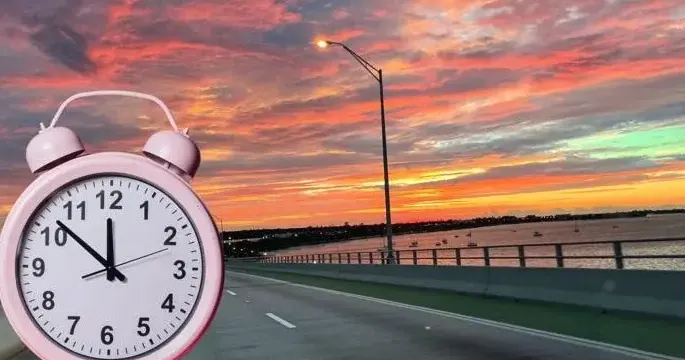
Enjoy that last long evening. Daylight saving time ends at 2 a.m. Sunday, Nov. 1, when clocks fall back one hour to 1 a.m. You get an extra hour of sleep, but starting Sunday the sun will be setting over Biscayne Bay before 6 p.m.
Phones and computers will update on their own; the microwave, the car dashboard and that stubborn kitchen wall clock will not.
Benjamin Franklin often gets credit for the idea, though his 1784 essay urging Parisians to rise earlier and save on candles was mostly a joke. Germany made it official in 1916 to conserve fuel during World War I, and the United States followed in 1918. The practice came and went for decades, going by “war time” during World War II, until the Uniform Time Act of 1966, the same year Islander News began publishing, set uniform dates nationwide.
The current March-to-November schedule dates to 2007.
Florida lawmakers voted in 2018 to stay on daylight saving time year-round, but that can’t happen without Congress, and the federal Sunshine Protection Act remains stalled. So twice a year, we keep changing the clocks.
Not everyone does. Hawaii and most of Arizona stay on standard time all year, as do Puerto Rico, the U.S. Virgin Islands and Guam. Much of Latin America gave up on it too. Mexico dropped the practice in 2022, except for some border areas, and Brazil quit in 2019. Argentina, Colombia, Venezuela, Peru and Central America don’t change their clocks at all.
Closer to home, Cuba, Haiti and the Bahamas fall back right along with us.
The clocks spring forward again at 2 a.m. Sunday, March 14, 2027. Until then, it’s also a good time to test smoke and carbon monoxide detectors and swap in fresh batteries.
An extra hour of sleep, a lot less evening light