
MIAMI — There are times when it’s as if Heat coach Erik Spoelstra is trying to will a reality into existence.
“We’re a very good rebounding team,” he insisted this week.
More like middling, if even that.
While the Heat went into Wednesday night’s game against the Cleveland Cavaliers at Kaseya Center ranked No. 14 in rebounds per game, they also stood all the way down at No. 26 in terms of rebounding percentage — the amount of available total rebounds per game secured.
Part of the analysis is the obvious, with the Heat electing to go into the season with Bam Adebayo and Kel’el Ware as their only de facto centers under standard contract, and then recently — by both choice and necessity — starting undersized lineups that essentially have featured one big man (either now-sidelined Adebayo or Ware) and four wings.
Playing 6-foot-7 Andrew Wiggins or 6-5 Pelle Larsson at power forward isn’t exactly the formula for standing tall on the boards.
Through it all, the Heat have found a path to victory, but not without accompanying pounding on the glass.
Nov. 5 at Nuggets, L: Outrebounded 61-38, outscored on second-chance points 22-8.
Nov. 7 vs. Hornets, W: Outrebounded 57-37, outscored on second-chance points 22-6.
Nov. 8 vs. Trail Blazers, W: Outrebounded 56-47, outscored on second-chance points 25-14.
Nov. 10 vs. Cavaliers, W: Outrebounded 60-56, outscored on second-chance points 29-20.
“We’re well aware of it. We’re working at it,” Spoelstra said of the decided deficits his team has had to overcome both in terms of rebounding and second-chance points. “And we pride ourselves on our rebounding. It just has to improve.”
For years, the Heat approach has been to sacrifice offensive rebounds in favor of covering the defensive backcourt, to prevent opposing fastbreaks, an approach that also had been favored by most opponents.
But now attacking the offensive glass has become a prime NBA approach, as have free-wheeling offenses that feature a variety of random cuts through the paint.
“The league is also changing,” Spoelstra said. “We have to adjust to that. More teams are crashing four guys and crashing their perimeter players.
“And a lot of times cutting off ball, now that cutter becomes the most dangerous offensive rebounder.”
So, Spoelstra said, a process.
“We just need to make that adjustment, and have more awareness with it,” he said. “We’re fully capable of that.”
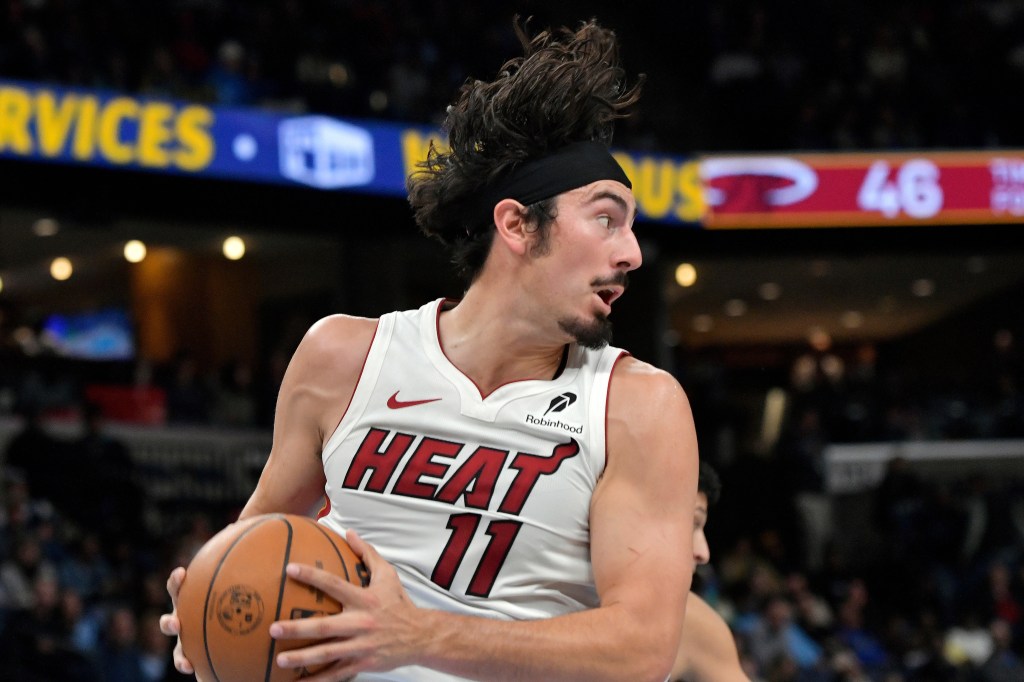
With Adebayo sidelined by a toe sprain since the first quarter of last week’s road loss to the Nuggets, it has required rebounding from other sources, with Jaime Jaquez Jr. among those who have stepped up in that regard.
“I also really like the way Jaime’s rebounding the basketball. We need to check that box. We need to do a better job on the glass,” Spoelstra said.
“We’re fully capable of it. We’re a very good rebounding team, but when we’ve gotten outrebounded this year, even going back to last year, we get outrebounded in a big way.”
Missed, overlooked
The NBA’s officiating report from Monday night’s wild overtime victory over the Cavaliers featured only one call ruled incorrectly over the final two minutes of both the fourth quarter and overtime.
That came with 8 seconds left in overtime, when the league ruled that Cleveland guard Lonzo Ball should have been called for a five-seconds inbounding violation.
Had that call been made, possession would have been awarded to the Heat, instead of the Heat intentionally fouling when up by three with 7.3 seconds to play.
The league also somewhat inconclusively ruled Donovan Mitchell’s game-tying 3-pointer in the final ticks of regulation was legal, without judgement whether Mitchell had stepped out of bounds, noting, “There is no clear and conclusive angle that confirms whether Mitchell stepped out of bounds on the baseline.”