
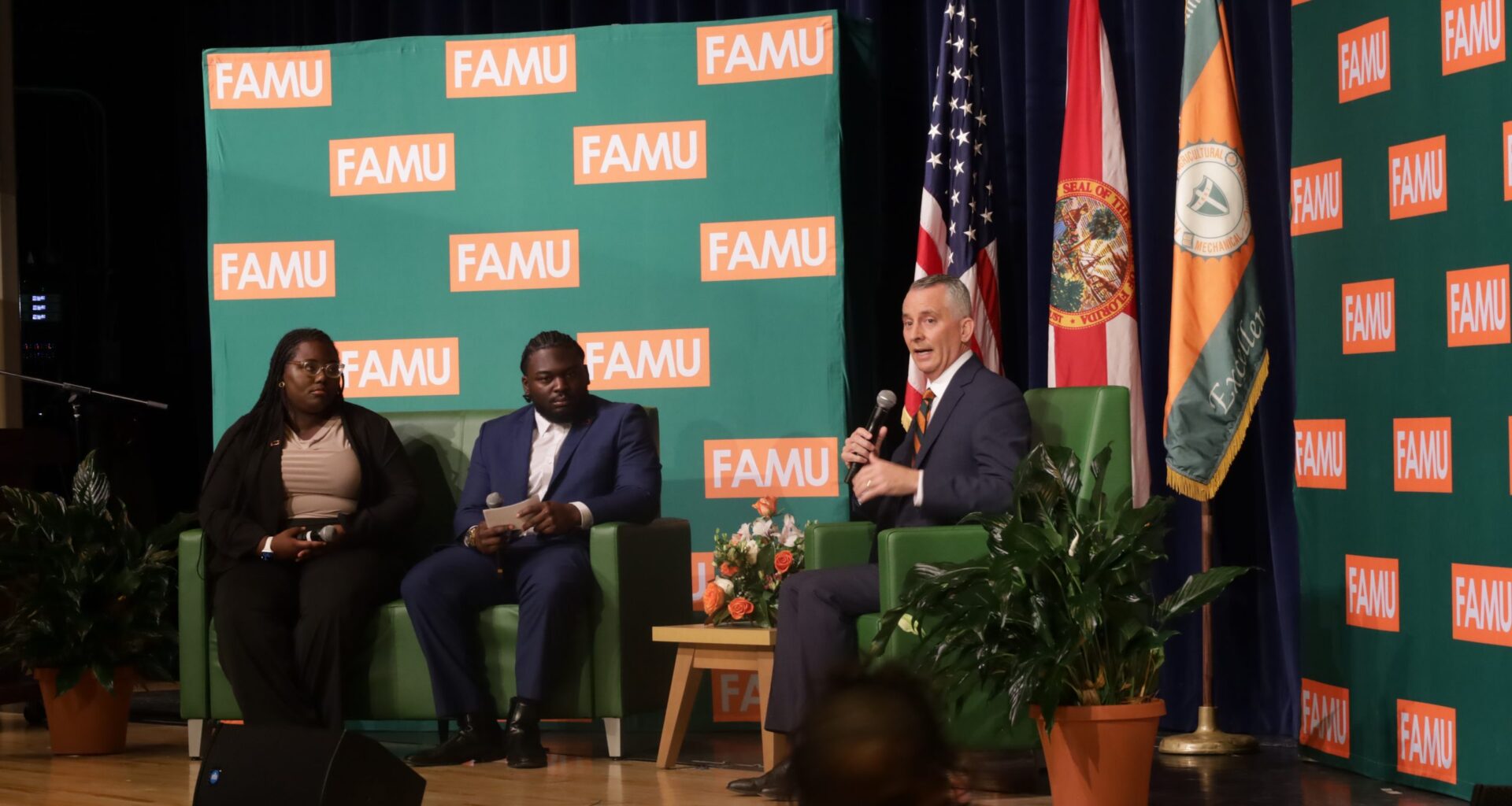
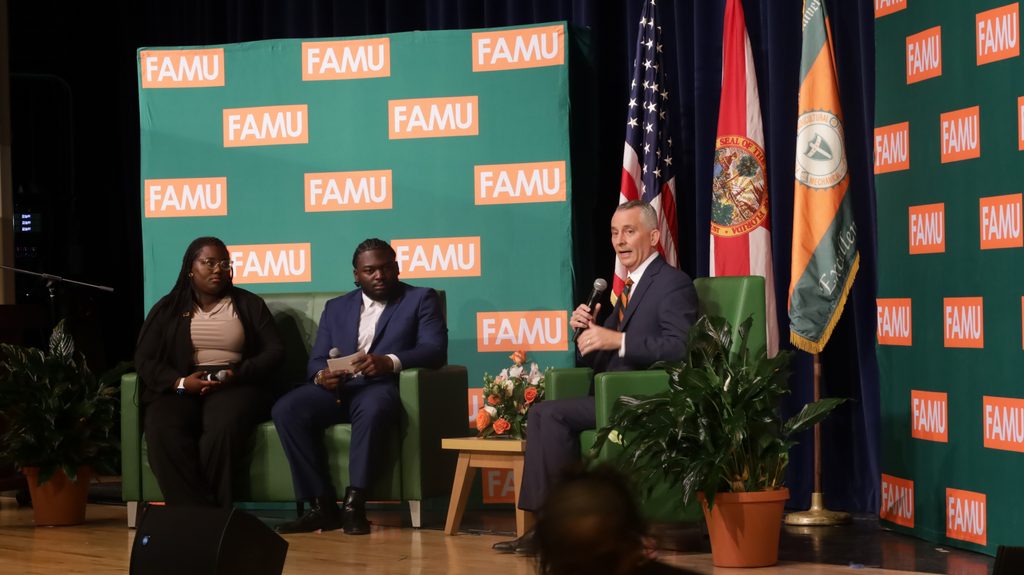
David Jolly speaks at FAMU’s gubernatorial town hall on Oct. 23 (Provided by / Jorde Jones)
On Oct. 23, Democratic gubernatorial nominee David Jolly brought his campaign to Florida A&M University for a student-led town hall.
Addressing students from FAMU, Florida State University and Tallahassee State College, Jolly outlined his platform focused on education, housing affordability, health care and economic opportunities.
Opening the program, FAMU Student Government Association President and University Trustee Kennedy Williams highlighted the importance of student civic engagement.
“FAMU is not just a forefront institution for higher learning, but civic engagement as well,” Williams said, welcoming students and community members. “The decisions made by our next governor will dictate our tuition, university funding, the rent we can afford in our neighborhoods and the quality of our public schools.”
Preceding the event, hosted by community leaders and student representatives, a group of students heard remarks from candidates, university leadership and visiting U.S. Rep. Jim Clyburn at Pittman Law Group.
Speaking to those at Pittman Law Group, Jolly detailed the core tenets of the campaign’s platform, framing the race as a pivotal moment for the state’s future.
“When people talk about the economy, what do we really mean when we use that term?” Jolly asked. “The three basics in people’s lives … it’s always, can you afford your rent, can you afford a house, can you live in the community that you want to… health care, do you know where to get it, and can you continue to pursue education without going into too much debt?”
Jolly’s running mate, former U.S. Rep. Gwen Graham emphasized the importance of creating economic conditions that allow young Floridians to build their lives in the state.
“This race, I believe, is about the future of young people across this state,” Graham said. “It’s about having a state where y’all can have a great life here, where you can send your children to school, you can afford to get a house, you can afford to get good health care.”
Rep. Clyburn urged attendees to consider candidates’ track records and emphasized the historical weight of single votes in close elections, drawing parallels between pivotal historical moments and modern civic duties.
“The best way to tell what a person will do is to look at what he or she has done,” Clyburn said, encouraging students to examine campaign proposals and legislative histories closely.
“Reconstruction came to fruition by one vote, and Jim Crow came from one singular vote,” Clyburn told those at Pittman Law Group, pointing to the 1876 presidential electoral commission decision that ended Reconstruction and enabled the rise of Jim Crow laws across the South.
“Never let anyone tell you that your vote doesn’t matter, because history shows us that the margin of progress or setback often comes down to a single vote.”
Following the town hall, David Jolly spoke exclusively to the FAMUAN, laying out his vision for Florida’s public education system and calling for a fundamental shift in state leadership.
Jolly emphasized that Florida’s public schools remain the primary driver for workforce development and student success. He argued that state leaders must reinvest in the public school system to unlock opportunities across higher education, the arts, trades and career pathways.
He also specifically addressed issues advocating for targeted state investments in historical institutions. He called for addressing historical funding disparities at FAMU and supporting programs that promote student retention and academic excellence.
Highlighting the need for state leadership focused on student outcomes rather than political ideology, Jolly shared his core approach for transforming Florida’s classrooms.
“How do we begin to focus our resources again, not on just the ideology and the governor’s interest, but instead the resiliency of an economy and a workforce and student opportunity?” Jolly rhetorically asked. “This gets back to saying, let’s get the governor out of the classroom, and let our teachers teach and our educators lead.”
Addressing the state curriculum and legislative restrictions on history in public schools, Jolly urged a return to comprehensive education that includes the full, uncensored history of Florida:
“Part of what we have to do is let teachers teach and bring back the books and teach all of history, including Black history. Every child in the state of Florida should know about the Ocoee Massacre, should know about the Rosewood Four, should know that Harry T. Moore and his wife were murdered on Christmas Day for having the audacity to register voters of color… Part of this is ensuring that kids receive a well-rounded education so that they are more capable of leaving school and entering a society that is going to have a lot of demands on them.”
When asked about his vision for appointing leadership over Florida’s educational framework, Jolly noted that his role as governor would be to appoint a commissioner who understands both academic excellence and broad-based access for all students.
“My job is to find an education commissioner with that vision who is going to lead the state forward into a new era of public education; a subject matter expert who yes, understands academic excellence, but also opportunities for all kids,” Jolly said.