
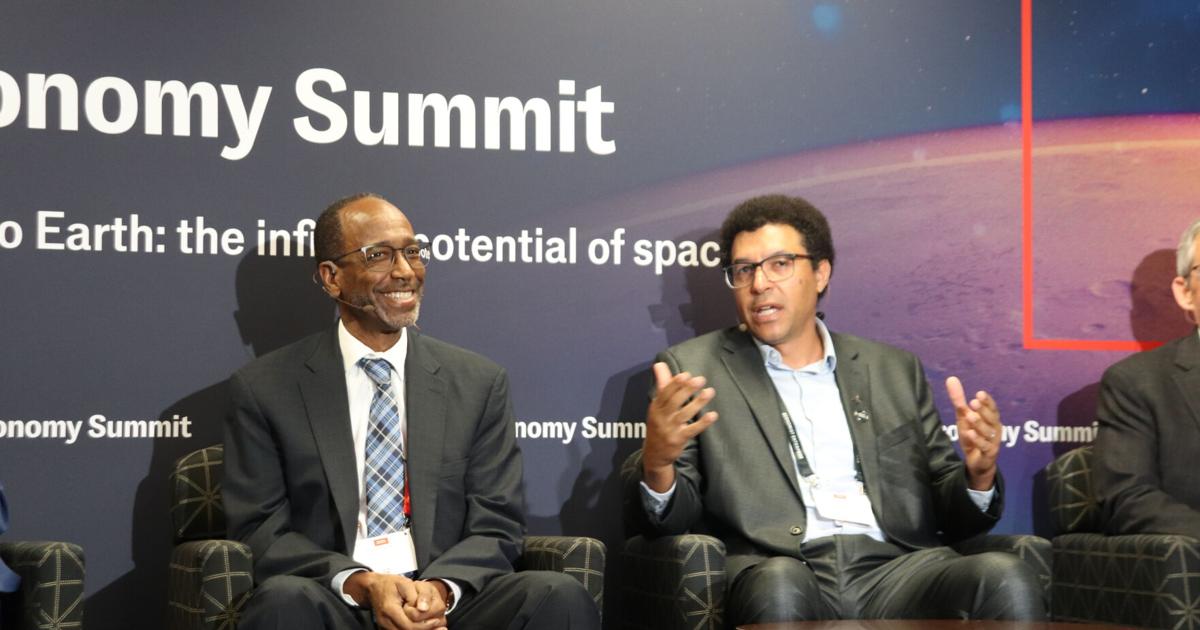

(Left to right) Clayton Turner, operating partner at Andromeda Ventures, and Dr. Tahllee Baynard, vice president of system prototypes at Lockheed Martin, take questions from the audience during a roundtable discussion about future lunar bases in Addition Financial Arena on Thursday. “It doesn’t sound as cool,” Turner said. “But the roads and commodes have to be there so it’s easy to work, easy to start your business, and easy to invest.”
Gio Gonzalez
After Former U.S. Senator Bill Nelson’s speech on the national security need for a permanent base on the moon, space executives met in a room beneath the seats in Addition Financial Arena on Thursday to discuss the business case.
The panel discussion focused mainly on how private industry could work to build the early infrastructure for a permanent base on the moon.
Dr. Manwei Chan, director of international and science development at Voyager Technologies, said there are a pair of basic needs that need to be solved first.
“Just like any mission,” Chan said. “The two most important aspects to ensure that you actually have a mission are power and communications.”
Dr. Chris Iannello, UCF engineering professor of practice, said the private space companies he’s consulted for tell him the barrier to setting up those systems is the extreme temperatures where missions will take place, deep in moon craters that never see sunlight.
“Some of the coldest places known in the solar system are the permanently shadowed regions on the moon,” Iannello said. “So they want to know how you make electronics and power systems that can operate really cold.”
NASA’s Lunar Reconnaissance Orbiter measured temperatures beyond negative 410 degrees Fahrenheit in the darkness of lunar craters.
Chan said after acquiring space exploration company Astrobotic Technology for approximately $300 million in July, Voyager now has access to technology that could solve the power supply problem.
“We have these solar panel towers that if you get to an altitude high above the surface, you can actually get access to solar power at a continuous rate,” Chan said. “Which is going to be critical in the moon operation if you’re in permanently shadowed regions and you’re going to have a base to stay in for a while or you’re going to have to live through a lunar night for a whole two days.”
Just after Voyager announced its intent to purchase Astrobotic in early June, the company was awarded two NASA contracts totaling $298 million to support the space administration’s moon base program with future human exploration of the moon.
Clayton Turner, operating partner at Andromeda Ventures, said the ultimate goal is to build bases on the moon whose operations aren’t tied to constant supply runs from Earth.
“Early on, that’s going to be maybe a couple of weeks on-site and then a couple of weeks back,” Turner said. “But at some point that permanent base has to be established, and it can’t just be dependent on back and forth; we need to be able to use what we have there.”
Turner said that before the moon can open up to full-time inhabitants and broader investment from private businesses, companies like Andromeda and Voyager need to work with the government to build the basic infrastructure.
“It doesn’t sound as cool, but the roads and commodes have to be there so it’s easy to work, easy to start your business and easy to invest,” Turner said.
Damon Feltman, retired U.S. Air Force brigadier general and Space Force Association CEO, said Air Force Major General Stephen Purdy is looking to put money to work on and near the moon immediately.
“He commented last week that he has about $30 million he’s going to put to action as soon as he can, looking for very near-term deliverable space capabilities in the cislunar area,” Feltman said, “‘Hey, I don’t need it five years from now. I need it right away,’ [was the] kind of language that he’s using.”
Iannello said that he doesn’t see an obvious business model for a lunar base; the defense case is clear.
“I’m quite certain that there’s strategic value for the United States to have a military operating moon base with a keep-out zone to all other foreign powers,” Iannello said. “How much value do we get economically other than from defense, putting an installation and creating a moon base? I don’t know.”
Ted Delgado, Lawrence Livermore National Laboratory business development executive, said private space missions and investments are necessary for building the foundation of the lunar economy.
“I believe there’s that opportunity to work with our commercial partners,” Delgado said. “We want to take that tech transfer to industry. We can’t be building all the infrastructure; we have to use our industry partners to help with the further testing that needs to happen with manufacturing to scale and getting it out there to space.”
Iannello used an example from his career as the longest-tenured technical fellow for electrical power at NASA to explain how private business can solve problems in ways that government agencies might not be willing to try.
Iannello said when he first started working at NASA he saw a startup company testing an experimental rocket that could land back on the ground called the Grasshopper and asked propulsion experts why they hadn’t tried it themselves.
“They said It’s so expensive in terms of fuel and mass margin to bring that back,” Iannello said. “It’s not worth it from a performance perspective.”
When Iannello heard Elon Musk say he wanted to launch and return SpaceX rockets years later, Iannello said he remembered the answer he got from the propulsion experts, but the trade-off started to make sense.
“If your mindset was performance, which all of these NASA guys were performance-driven, it was a bad decision,” Iannello said. “If you said, ‘No, I’m going to optimize on cost and schedule and try to get the cost to orbit down so that I can launch all these Starlinks,’ it made sense all of a sudden.”