
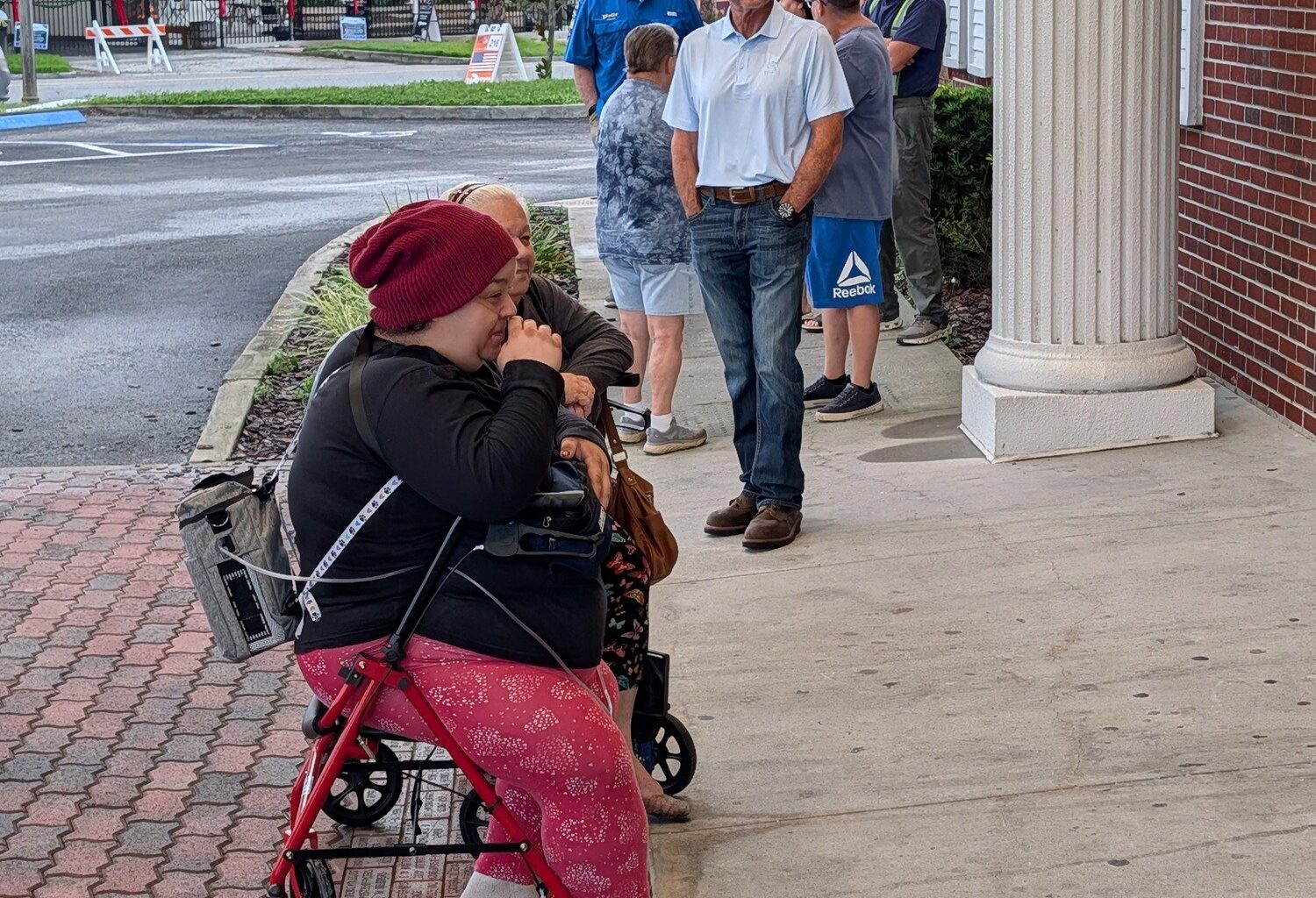
We’ll be providing live Election Day updates throughout the day and night from across Central Florida, the state and nation.
Orange County already showing 43% turnout | 9:49 a.m.
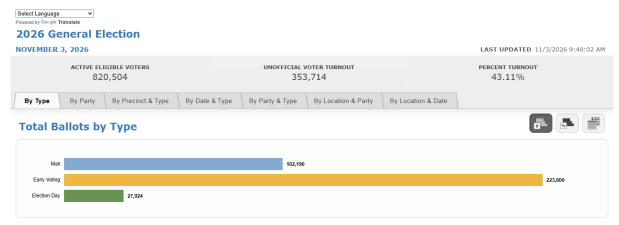
The Orange County Supervisor of Elections reported early Tuesday that the county had already exceeded 43% turnout for the election.
In an update at 9:40 a.m., the office showed that of 820,504 eligible voters, 353,714 had already cast ballots. The breakdown: 102,190 came from mail, 225,600 came from early voting, and 27,924 were from election day in-person voting.
Roger Simmons
Heavy rain, flooding impacting some Florida polling locations | 9:32 a.m.
Flooding caused by this week’s heavy rains prompted Florida to change some polling locations in eight counties, the Florida Division of Elections says.
Brevard and St. Lucie counties are the most impacted, with a half dozen or more polling locations shifted in each county to make sure residents can still vote.
The other counties are Broward, Highlands, Indian River, Martin, Okeechobee and Palm Beach.
Leslie Postal
More on Florida flooding and its impact on the vote | 9:00 a.m.
TALLAHASSEE – Torrential rain along Florida’s central eastern coastline and in some inland counties has flooded roads and led to the shutdown of schools in some counties, and election officials are attempting to find alternative polling places in affected areas.
Gov. Ron DeSantis on Monday afternoon issued an executive order declaring a state of emergency in Brevard, DeSoto, Hardee, Highlands, Indian River, Martin and St. Lucie counties.
Included in the order is a provision allowing local supervisors of elections in affected areas to designate new polling places for sites that are unsafe or where voters can’t get to them because the roads are blocked due to flooding. State law requires election officials to “designate a new polling place which shall be accessible to the public on election day” when under a state of emergency, and post notice at the old polling place telling voters about the alternative precinct.
“The Division of Elections is in contact with the counties impacted and will respond pursuant to state law, as necessary,” Department of State director of communications Gretl Plessinger stated in an email.
Brevard County canceled schools Monday and Tuesday, and several roads were closed for part of the day as heavy rains inundated large swathes of the county.
Brevard Supervisor of Elections Tim Bobanic was hopeful the waters would recede by Tuesday but was still looking for alternative polling places if the original sites weren’t accessible.
“Yes, we are conducting an election tomorrow,” Bobanic told the News Service of Florida. “Actually, a majority of my sites are already set up and ready to go. We’re still evaluating – I’m having conversations with city and town management with the (emergency operations center).”
Some of Bobanic’s offices in Titusville, Melbourne and Palm Bay were closed Monday due to the weather conditions, but its Viera site was open, according to the Brevard elections website. A canvassing board meeting originally set for Monday afternoon, however, was cancelled.
Hurricane-prone Florida has dealt with storm-related disruptions to its elections before. In 2018, when Hurricane Michael swept through the Panhandle as a Category 5, then-Gov. Rick Scott issued an order setting up alternative polling sites in the affected areas.
But Michael made landfall on Oct. 10, leaving more time for residents to know where the new polling sites would be. The sudden nature of the latest weather disruption means officials will be scrambling to tell voters where to cast their ballots on Tuesday if new polling places are deemed necessary.
“We will get the word out the best we can,” Bobanic said.
Gray Rohrer, News Service of Florida
Apopka voters arrive early at the polls | 8:50 a.m.
At the Apopka Community Center on South Central Avenue voters started lining up long before the sun had risen.
Becky Collazo and her daughter, Desiree Espinosa, were sitting at the front of the line waiting for the doors of Precinct 216 to open at 6:45 a.m. They said they’d been sitting there since 5:30 a.m.
Both had the same reason for wanting to be first: “So we can go back home early and sleep,” Espinosa said as they both laughed.
The mother and daughter said they are regular voters and believe doing so is important.
“It’s our duty to make a difference,” Collazo said.
As Republicans, they said they planned to cast their ballots for Byron Donalds in the gubernatorial race. Donalds would be the state’s first Black governor.
“To give everybody an opportunity, yes, I think that’s important,” Collazo said. But her daughter said race is irrelevant as long as he does a good job.
Bryson Reed, who arrived right before doors opened, said he didn’t align with either major party and said he’s only been a regular voter for the last couple of years.
“I think it’s important to vote because our rights are important and our wishes need to be heard,” the 33-year-old said.
He said he’d done research on the issues and candidates but remained undecided heading into the precinct. He did say he liked David Jolly — the Democratic candidate for governor — where he comes from, the way he speaks and his professionalism.
But with the information overload that leads to Election Day, Reed said he’s been looking at both sides to sort through it all.
“I’m just trying to understand and kind of go with my gut when I get there,” he said.
Brian Bell
Amendment 3, Nixon brings these voters to the polls | 8:39 a.m.
Jess and Michael D’Amico walked over to their Colonialtown precinct with their young daughter early Tuesday morning. The Orlando couple said they vote in every election but this one is particularly important, in part because of Amendment 3, the property tax cutting proposal, which they oppose.
“Things that are really important to us are community infrastructure and being able to have community resources and amenities, and that comes from all of us contributing,” Jess D’Amico said, pointing to a nearby public swimming pool. “We’re worried this pool’s going to close if Amendment 3 passes. We moved here because of this pool.”
They were also enthusiastic about voting for Democrat Angie Nixon for U.S. Senate.
“I had a friend in Indiana that just texted men, she’s like ‘how excited are you to vote for Angie Nixon?’ And I can tell you, very, very excited,” Jess D’Amico said. “We’re down and things feel dark right now with leadership. We feel like we’re being run by bullies, and we’re very excited to flip and have a big blue wave.”
Michael Cuglietta
Election Day arrives after a surge in early voting, with observers keeping close watch at the polls | 8:15 a.m.
WASHINGTON — The first polling sites have opened in a handful of states — Connecticut, Indiana, Kentucky, Louisiana, Maine, Missouri, New Jersey, New York and Virginia.
Heavy rains and flash flooding in the Southwest are expected to make it harder for some midterm election voters to reach polling places Tuesday in parts of Colorado, Arizona, Utah and New Mexico. In Utah’s rural San Juan County, voters are being allowed to vote electronically.
The final day of voting in this year’s midterm elections arrives against a backdrop of uncertainty after a year in which President Donald Trump has tried to interfere in how states run their elections and sown doubts about the outcome should Republicans lose.
Associated Press
What to expect in Florida on election day | 8:10 a.m.
WASHINGTON — Florida Republicans will try to extend their dominance in statewide elections as voters decide races for Senate, governor and other state and legislative offices. The election will mark the first under a new congressional map adopted by Republicans to boost the party’s chances of keeping control of the closely divided House.
Once the nation’s most evenly divided swing state, Florida has shifted steadily to the right in the last quarter century. At the time of the 2000 presidential election, Democrats had held a voter registration advantage over Republicans for decades. That advantage would erode until 2021 when registered Republicans overtook registered Democrats. Today, there are 1.5 million more Republicans in Florida than Democrats.
In the race for governor, Democrats have nominated a former Republican to lead them out of the electoral doldrums. Former Rep. David Jolly defeated five other candidates in the Aug. 18 primary with 61% of the vote. Jolly took an unlikely path to running for governor as a Democrat, joining the party in 2025 after leaving the GOP in 2018.
He has tapped former Democratic Rep. Gwen Graham as his running mate. Graham is the daughter of the late Bob Graham, the longtime Democratic senator and governor.
The Republican nominee is Rep. Byron Donalds, who won the 11-candidate primary with the help of an endorsement from President Donald Trump. Donalds received about 48% of the primary vote, almost double that of the runner-up, Lt. Gov. Jay Collins. Donalds backed Trump over Republican Gov. Ron DeSantis in the 2024 presidential primaries and was considered as a possible Trump running mate that year. Trump and Vice President JD Vance have each campaigned for Donalds in Florida since the president launched his midterm campaign push last month.
Six other independent or third-party candidates are also on the ballot.
In this year’s Senate race, Republican Sen. Ashley Moody defends her seat against Democratic state Rep. Angie Nixon as well as an independent candidate.
Moody was state attorney general in January 2025 when DeSantis appointed her to fill the seat vacated by Marco Rubio, who was tapped by Trump to be secretary of state. She is now running to complete the final two years of Rubio’s term.
Nixon, a democratic socialist, received 56% of the August primary vote against retired Army Lt. Col. Alex Vindman, who received about 44%. Vindman, a former National Security Council staff member, was a key witness in Trump’s first impeachment in 2019. His brother, Eugene, was elected to Congress from Virginia’s 7th District in 2024.
If elected, Donalds would become Florida’s first Black governor and the nation’s first elected Black Republican governor. Nixon would become the state’s first Black U.S. senator.
Florida Democrats have faced a drought in statewide elections, particularly for governor. A Democrat last won the governorship more than 30 years ago. DeSantis was reelected in 2022 with a 19-point margin over former Gov. Charlie Crist, another former Republican-turned-independent-turned-Democrat. Democrats last won a Florida U.S. Senate seat in 2012.
The new congressional boundaries Republicans enacted in May essentially eliminate four congressional districts most recently represented by Democrats. Three Democratic incumbents face tough challenges in newly drawn districts: Kathy Castor in the 14th District around Tampa, Darren Soto in the 9th District near Orlando and Jared Moskowitz in the 25th District in South Florida along the Gold Coast.
The redrawn 22nd Congressional District in South Florida also has a competitive race. It contains almost all of the current majority-Black 20th Congressional District, which had been represented by Democrat Sheila Cherfilus-McCormick before she resigned in April. It also includes large portions of the current 26th and 18th Congressional Districts, which are both heavily Republican.
In statewide elections, Democrats usually perform best in the Orlando and Tallahassee areas and in South Florida along the Gold Coast. Republicans usually post their strongest numbers in North Florida and the panhandle. They also do well in Central Florida and along the Gulf of Mexico.
Hillsborough and Pinellas counties around Tampa Bay are key state battlegrounds. Trump narrowly won both counties in 2024, while Democrat Joe Biden narrowly carried both in 2020. Trump and Democrat Hillary Clinton split the counties in 2016.
Duval County, home to Jacksonville, is another swing area. Trump narrowly carried it in 2024 and 2016, while Biden carried it narrowly in 2020.
Miami-Dade County in South Florida will also be a key county to watch. In 2024, Trump made significant inroads with Latino voters and became the first Republican presidential candidate to win the county since George H.W. Bush in 1988.
Associated Press
Key facts to know about Florida’s election today | 8:05 a.m.
Here are some of the key facts about the election and data points the AP Decision Team will monitor as the votes are tallied:
When do polls close?
Polls close at 7 p.m. local time, which is 7 p.m. and 8 p.m. ET. Most of the state is in Eastern time, and polls there close at 7 p.m. ET. A few counties are in Central time, and polls there close at 8 p.m. ET.
How many people actually vote?
About 7.8 million votes were cast in Florida’s 2022 Senate election.
How much of the vote is cast early or by absentee ballot?
About 65% of the vote in the 2022 Senate election was cast early in-person or by mail.
The latest advance vote totals for Florida can be found in the AP’s advance vote tracker.
When are early and absentee votes released?
Florida counties are expected to release all or almost all of their results from early in-person and mail voting in their first vote updates of the night, almost always before releasing any results from in-person Election Day voting. Only three counties are expected to release any in-person Election Day results in their first vote update.
How long does vote-counting usually take?
In the 2024 general election, the AP first reported results at 7 p.m. ET as polls closed in most of the state. The vote count reached the halfway mark at about 7:16 p.m. ET. About 99% of total votes counted had been counted by 10:51 p.m. ET.
When will the AP declare a winner?
The AP does not make projections and will declare a winner only when it’s determined there is no scenario that would allow a trailing candidate to close the gap. If a race has not been called, the AP will continue to cover any newsworthy developments, such as candidate concessions or declarations of victory. In doing so, the AP will make clear that it has not yet declared a winner and explain why.
How do recounts work?
Florida requires a machine recount in races where the vote margin is 0.5% or less of the total votes cast. A manual recount of overvotes and undervotes is then required if the machine recount results in a vote margin of 0.25% or less of the total votes cast. The AP may declare a winner in a race that is subject to a recount if it can determine the lead is too large for a recount or legal challenge to change the outcome
Associated Press