
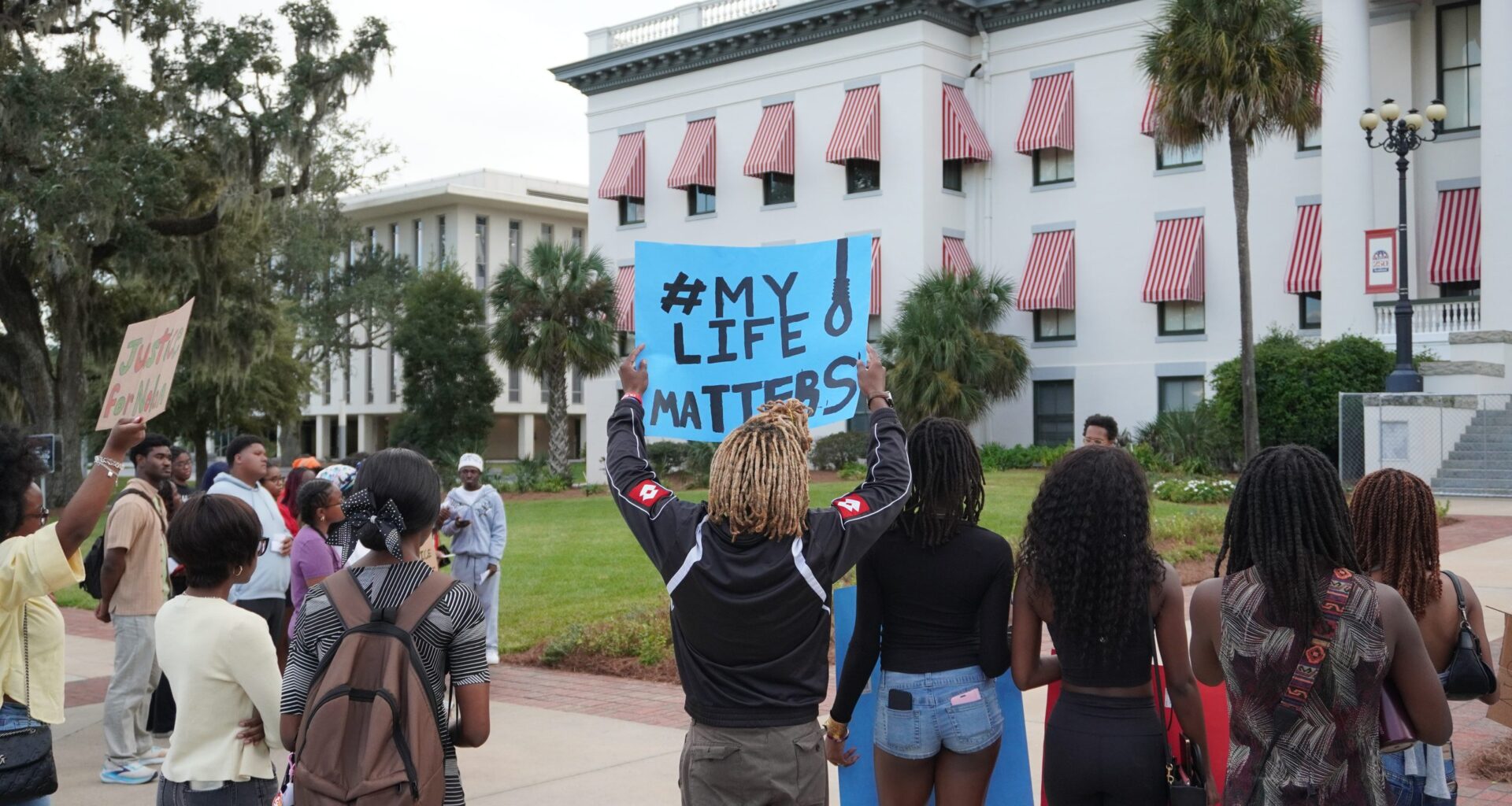
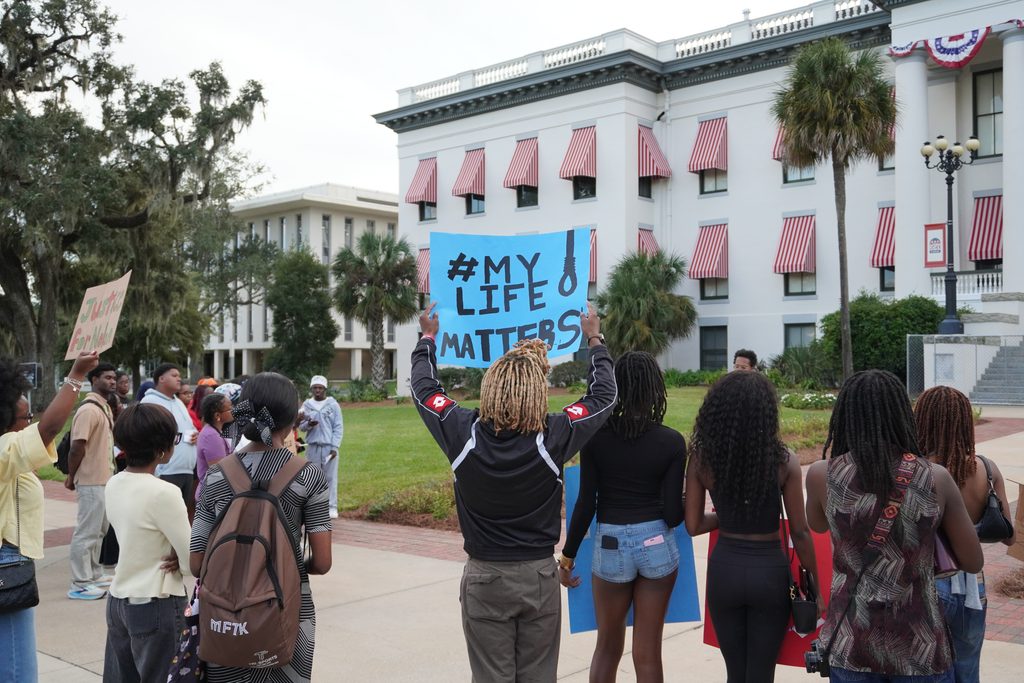
A student holds a sign reading “#My Life Matters” during protest at the Florida State Capitol on Oct. 16 (Justin Jordan / FAMUAN)
Passion erupted on the campus of Florida A&M University and on the front lawn of the Florida State Capitol as FAMU students joined a nation-wide series of protests that began after a Mississippi grand jury stated there was no evidence to support criminal indictments in the case of 18-year-old Nolan Wells.
“Too many Black children are being lost to this system,” said Jayla Jones, the president of the Florida A&M chapter of Students for a Democratic Society, to a crowd of Capitol protestors. “I’m angry.”
The demonstration was organized after a FAMU student reached out to the school’s chapter of SDS, asking if anything would be planned for Wells.
Shortly after, FAMU SDS organized the protest with the help of the Tallahassee Immigrant Rights Alliance and the Tallahassee Alliance Against Racist and Political Repression.
Jones, along with several college students and Tallahassee organizations, stood outside of Florida’s Historic Capitol building on the evening of Friday, Oct. 16, holding handmade signs and a megaphone.
“Our children deserve justice; we will remember all of their names who have been lost to this racist system,” said Jones between call-and-response chants.
Pushback from FAMU students and other college students across the country came shortly after an official report from the Jackson County grand jury in Mississippi stated there would be no criminal indictments for Nolan Wells’ case. A decision officially known as a No True Bill.
One student, Josiah Cousins, a freshman at FAMU who attended the Capitol protest, said the report did not surprise him.
“I was disappointed, but I wasn’t surprised,” said Cousins. “After doing major research on this country’s history and our criminal justice system, I wasn’t surprised.”
Nolan Wells was found dead on the shoreline of Horn Island, Mississippi, after visiting the island with a group of friends for the 4th of July holiday, according to a timeline released by SunHerald. After Wells did not return home with his friends, he was reported missing, leading authorities to conduct a two-day search before his body was recovered on the morning of July 6.
Since the news of his death was first made public, it garnered much attention, invoking conversations surrounding racism, prejudice and how racial bias has impacted the outcomes of legal cases involving Black people in the United States.
Another FAMU student in attendance, Ivy Laster, said she felt an obligation to show up and felt emotional after seeing a student holding a sign that read, “Is my brother next?”
“If I see a family grieving, I’m grieving as well even if I don’t know them,” said Laster. “I have two older brothers, and I have a younger brother, so it’s like you never really know.”
Much of the public criticism online and from attendees of the protest came from what many feel were unanswered questions about the events leading up to Wells’ death.
The confusion was further fueled after the digital forensic expert hired by Wells’ family recently released Snapchat messages sent by some of Wells’ friends, in which they appeared to discuss his disappearance.
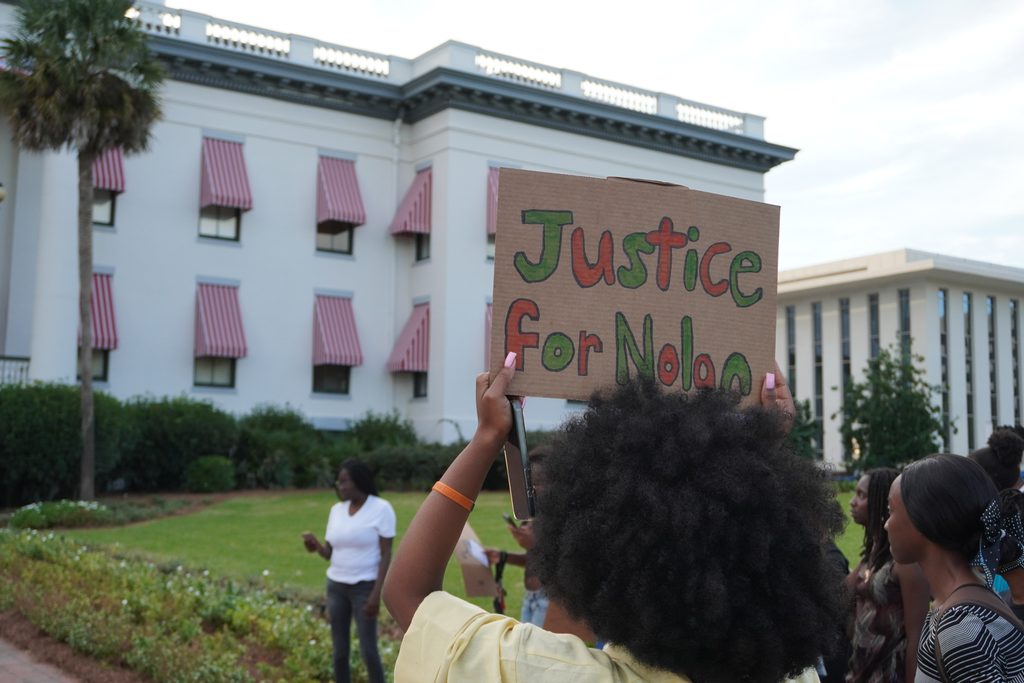
A protestor holds a sign reading “Justice for Nolan” during protest at the Florida State Capitol on Oct. 16 (Justin Jordan / The FAMUAN)
Almost two weeks after the Capitol protest, FAMU’s Student Government along with RISE Tallahassee, FAMU’s chapter of the NAACP and FAMU’s chapter of HBCU Incorporated, organized a walk-out on campus.
The walk took place on Oct. 28, beginning at Polkinghorne Village dorms and ending at the eternal flame in front of Lee Hall Auditorium.
Devin Nobles Jr., a local community organizer who spoke at the walk, said he felt angry as he was delivering his speech, but concluded with a call to action encouraging those listening to vote and hold people in power accountable.
“It’s our job to actively create the world we want to live in,” said Nobles. “If you do nothing to create the reality that you experience, then you will forever be tied to somebody else’s vision of the world.”
A few hours north of Florida A&M’s Campus, Spelman College organized a walkout of their own with other Atlanta institutions, Morehouse College and Clark Atlanta University.
Vice president of Spelman College’s NAACP, Akina Ma’at, said they looked inward when it came to planning the walk. She asked herself what they could do and how they could bring attention to the case to show they cared.
“When I was speaking at the march, I spoke of an African proverb that has been instilled in me, and it’s, ‘if you want to go fast, go alone, but if you want to go far, go together,’” said Ma’at when describing the message she hoped to send out.
Similar sentiments were shared by Harvard University student Sandra Smith-Johnson, the vice president of the Generational African American Students association at her school. Smith-Johnson said they collaborated with several organizations to carry out a walk on campus.
“There’s been, obviously, this legacy of violence against the Black community, the African American community, for generations,” said Smith-Johnson. “And a lot of times, under the guise of acquittals or no true bills, the Black life is deemed inconsequential and unworthy of proper investigation.”
“I mean, it’s not a shock, but something needs to change is sort of where my mind was,” she continued.
These institutions were some of several that held protests or walk-outs in response to the grand jury’s decision and the official investigation process, which was made public throughout the months leading up to the no true bill.
Of the schools that hosted these demonstrations, many included a call to action at the end, encouraging attendees to vote and speak to representatives.
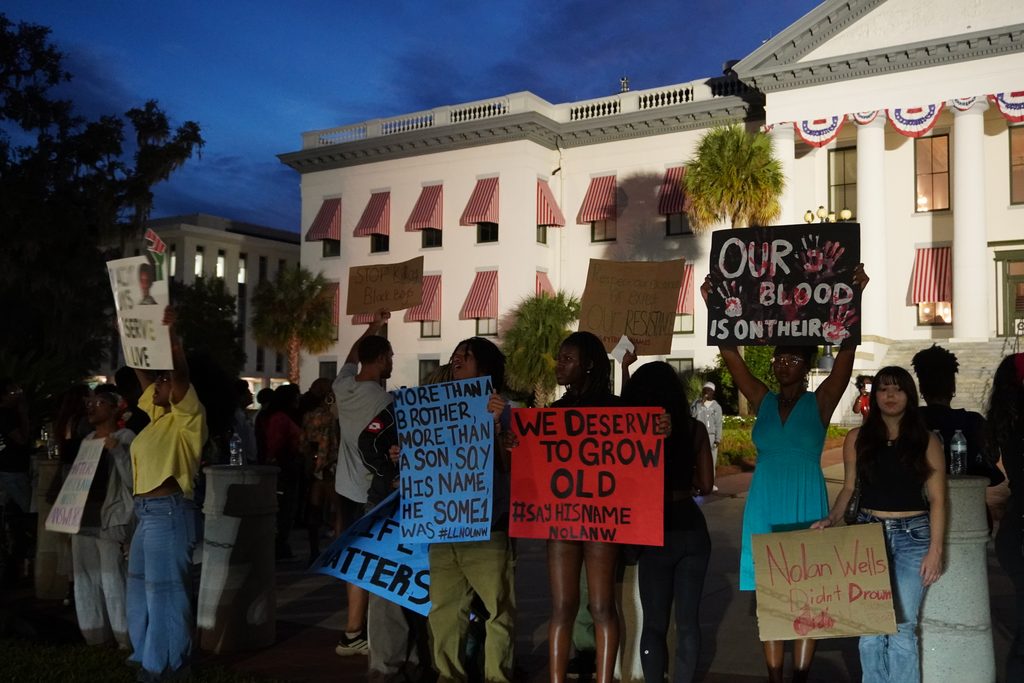
Protestors show passing cars a variety of signs during Oct. 16 protest at Florida Capitol (Justin Jordan / FAMUAN).
Jeloni Doyle, a junior at Illinois State University and vice president of ISU’s NAACP, said that in addition to the protest, they wanted to do something called “Beyond the Headlines”.
This included showing students how to write letters to their representatives, helping people get registered to vote and inviting journalists from local news outlets to talk to students about what they discovered when reporting on Wells’ case.
“Think about it, we’re all on one accord at a protest, and we’re all asking ourselves, what can we do? What can we do? What can we do? What should we do?” said Doyle.
In Mississippi, Jakari Holland, a community organizer and student at Jackson State University, organized a protest that received strong support from students and local community members.
Holland said the protest wasn’t just for Nolan, but also for other members of the Black community who recently lost their lives in the state of Mississippi.
He listed Kohen Wiley, Trey Reed, Jaylen Lewis and Tasia Fortune as specific individuals they marched for, but called attention to the treatment of the Mississippi Black community as a whole.
“Mississippi has a long history that shapes how Black communities experience and understand institutions, especially when it comes to justice,” said Holland. “For me, this was about more than one decision. It was about whether families can trust the institutions responsible for giving them answers.”
The series of student protests across the country calls into question the impact of public demonstrations on court case outcomes in the US.
Annie Thompson, a criminal justice professor at FAMU, said she’s worked in law enforcement and criminal justice for over 38 years and now teaches her experiences in the classroom.
Thompson shared she did not personally feel the case was handled completely, “Typically when you do an investigation of that type, you want to cover everything so that you don’t have more questions coming out than you had going in.”
Thompson also said that she believes public pushback can greatly impact the outcome of a case, but that efforts must remain consistent.
“You can’t have the pushback strong for two weeks, and then it just stops. It’s got to be a continual thing. The pressure has to be relentless,” said Thompson.
As students continue to walk, protest and voice their concerns about the handling of the case, the family of Nolan Wells and their legal representative, Benjamin Crump, continue pushing for more answers.
Crump, a prominent civil rights attorney, recently released a statement regarding their pursuit of answers in response to a public comment made by President Donald Trump.
“Sunday will mark 100 days since we have been looking into the death of Nolan Wells, so when President Trump responds to news reporters that ‘we’re looking into it,’ we believe that carries more weight than the response given by the FBI,” said Crump on his official website. “Our team stands ready to work with the federal government to ensure Nolan’s death is investigated to the fullest extent.”
A common sentiment expressed by students from these institutions emphasized follow-up steps once the demonstrations were over that encouraged students to become civically engaged.
“A protest should not be the end of a conversation about injustice,” said Holland, who organized his school’s protest. “It should be the beginning of what we are willing to do to change it.”