
Donna Miller spent years searching for a home she could afford before finally finding one in south Miami-Dade. Buying it meant leaving Coconut Grove, where she had lived near her hotel job for about two decades.
Now, the 53-year-old leaves home around 4:40 a.m. to arrive at work by her 5:30 a.m. start time. The commute is longer, but she has something she has always wanted: a house with a backyard.
“I always wanted my own home, and in my head I said if I’m gonna buy a home, I wanted it with a yard,” Miller told The Miami Times.

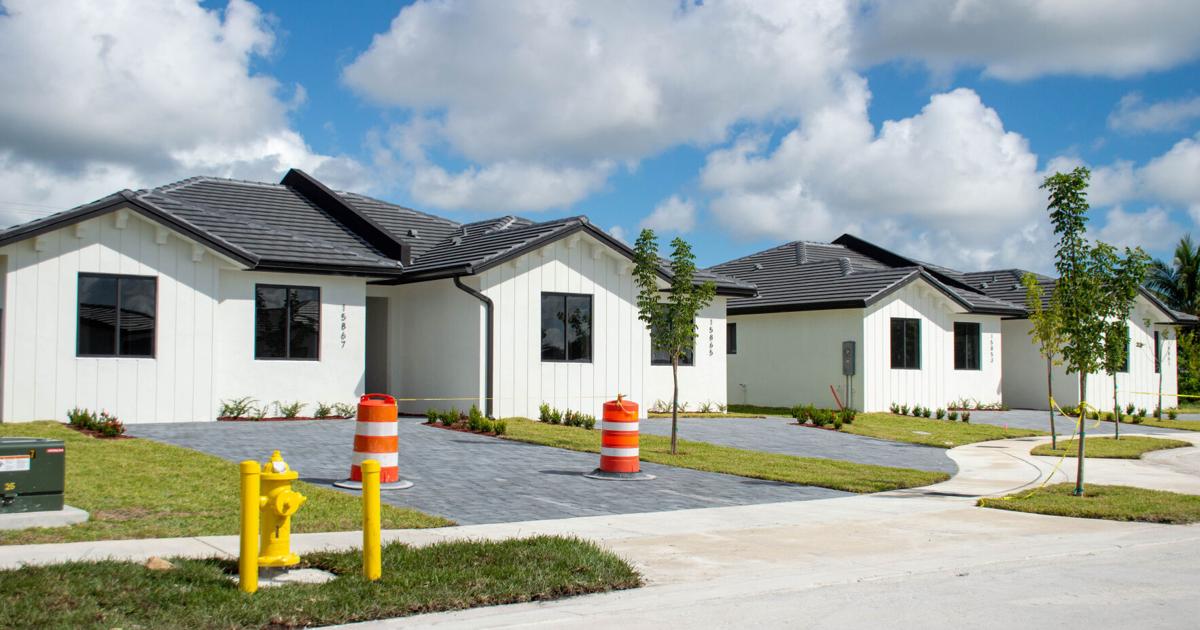
Palm Villas homes in Homestead.
(Amelia Orjuela Da Silva for The Miami Times)
Her experience illustrates the trade-offs facing working families heading south for homeownership. Bluenest, the developer that built Miller’s home, celebrated the opening of Palm Villas on Oct. 29, introducing another community marketed toward buyers struggling to purchase elsewhere in Miami-Dade.
The development near Southwest 159th Avenue and Southwest 304th Street includes 32 twin homes and one single-family residence, starting at $479,900. About 40% were under contract at the opening, according to Alicia Ale, Bluenest’s vice president of sales.
Making the purchase possible
Founded by CEO Salim Chraibi in 2018, Bluenest builds move-in-ready homes for working families. It handles construction in-house to control costs and aims to keep qualified buyers’ total monthly housing payments below $3,000.
Homes include stainless steel appliances and in-unit laundry. Ale said providing durable materials and a fully equipped home helps buyers avoid additional expenses after moving in.
“If you put in a very cheap carpet, it’s not going to last probably a year, and then you have to replace it,” Ale said. “Those are burdens that are transferred over to homeowners; they shouldn’t have that burden. Once you move in, you don’t have to go to Home Depot to add more to your home because it’s a move-in-ready home.”
Affordability also depends on taxes, community charges and other monthly expenses, Ale said. Palm Villas has no conventional homeowners association or community development district assessment, a charge used to pay for infrastructure and services.
“You not only have to look at the price, but also what’s your price tag for that monthly payment,” Ale said.
Qualifying buyers can purchase with a 1% down payment, Ale said — $4,799 at Palm Villas’ starting price.
Four Palm Villas homes are committed to buyers using assistance administered by Miami-Dade County’s Department of Housing and Community Development, Ale said. Eligible buyers can combine that assistance with $30,000 to $40,000 in closing-cost credits from Bluenest, bringing total offered assistance to about $183,000. Eligibility depends on household income and size. Palm Villas does not impose an income limit on all buyers.
Looking south for ownership
Available land helps explain Bluenest’s concentration in south Dade, where its communities stretch from Richmond Heights through Homestead and Florida City.
“There’s land scarcity in Miami-Dade County,” Ale said. “There’s not much availability to be able to build communities like this any longer.”
The company seeks residential sites where development costs allow it to meet its price targets. Ale said Bluenest also has acquired land in Miami Gardens.
Many buyers already live in Miami-Dade, including West Kendall and Doral, where Ale said purchasing has become unaffordable for them. She estimated eight in 10 Bluenest buyers are purchasing their first home.
A recent snapshot of listings illustrates south Dade’s role in new construction. Of the 63 new-construction listings added in Miami-Dade from Oct. 14–27, 37 — or about 59% — were in south Dade ZIP codes, including Homestead, Florida City and unincorporated areas south of Cutler Bay, according toMomentum Realty’s analysis.
Newly constructed homes in this sector are listed at a median price of $430,000 to $625,000. The median pricefor a newly constructed home in Miami-Dade County is approximately $1.075 million.
The area also has grown rapidly. Homestead’s population rose by a third between 2010 and 2020, reaching about 80,700. Neighboring Princeton grew by nearly 80%.
These communities have substantial Black and Hispanic populations. Census figures show Black residents account for about one in five people in Homestead and two in five people in Florida City. Hispanic residents make up about 67% of Homestead, 56% of Florida City, 73% of Princeton and 82% of Leisure City.
But household incomes and homeownership rates vary widely. Census Bureau estimatesfor 2020–2024 put median household income at about $83,400 in Princeton, compared with $65,400 in Homestead, $47,500 in Florida City and $42,000 in Leisure City.
About seven in 10 occupied homes in Princeton were owner-occupied, compared with roughly three in 10 in Florida City.
A longer road home

Donna Miller, homeowner at Bluenest Development Communities.
(Bluenest Development)
Miller searched for eight to 10 years before her real estate agent introduced her to a Bluenest home.
She initially resisted looking in areas far away from her job in Coconut Grove, but her brother-in-law encouraged her to visit homes down south. They found a house under construction with the space and backyard she wanted.
“We went, and we saw this house,” Miller said. “And I didn’t regret it.”
Miller earns about $45,000 annually and has worked at a Coconut Grove hotel for about 20 years. While renting near work, she watched her monthly rent rise from $690 to about $1,400.
Savings, her credit history, a bank loan and county assistance helped her buy the three-bedroom, two-bathroom home. She now pays about $2,200 a month and expects to mark two years of ownership in December.
Buying in Coconut Grove was beyond her budget, she said. The neighborhood’s median home sale price was $1.89 million over the last three months, up 9.3% from the same period a year earlier, according to Redfin.
Moving south offered her more space and ownership, but meant giving up the convenience of living across from work.
“I kind of got used to it, so I try not to let it bother me because at the end of the day, it’s my home,” Miller said.
‘Keeping Miami home’
Bluenest’s focus on local buyers comes as Miami-Dade loses residents to other parts of the country.
Miami-Dade County saw a net loss of about 72,300 residents to other U.S. communities between July 2024 and July 2025, according to data from the University of Florida Shimberg Center for Housing Studies.
The county’s overall population change also includes international migration, births and deaths. Its total population fell by about 10,100 during the same period.
Ale said the company hears from families whose relatives have moved to Cape Coral, Lehigh Acres and Ocala.
“We want to keep Miami home,” she said.
Bluenest works with lenders and credit repair agencies and is organizing seminars to explain financing and the responsibilities of ownership, she said.
“Some people just think that they cannot be a homeowner,” Ale said. “They think that they have bad credit. They think they don’t have enough savings.”
For Miller, ownership has brought more space, a backyard and stability after years of searching.
“Well, it’s a good feeling. I can tell you that,” she said. “It’s long-term, and it’s here.”