
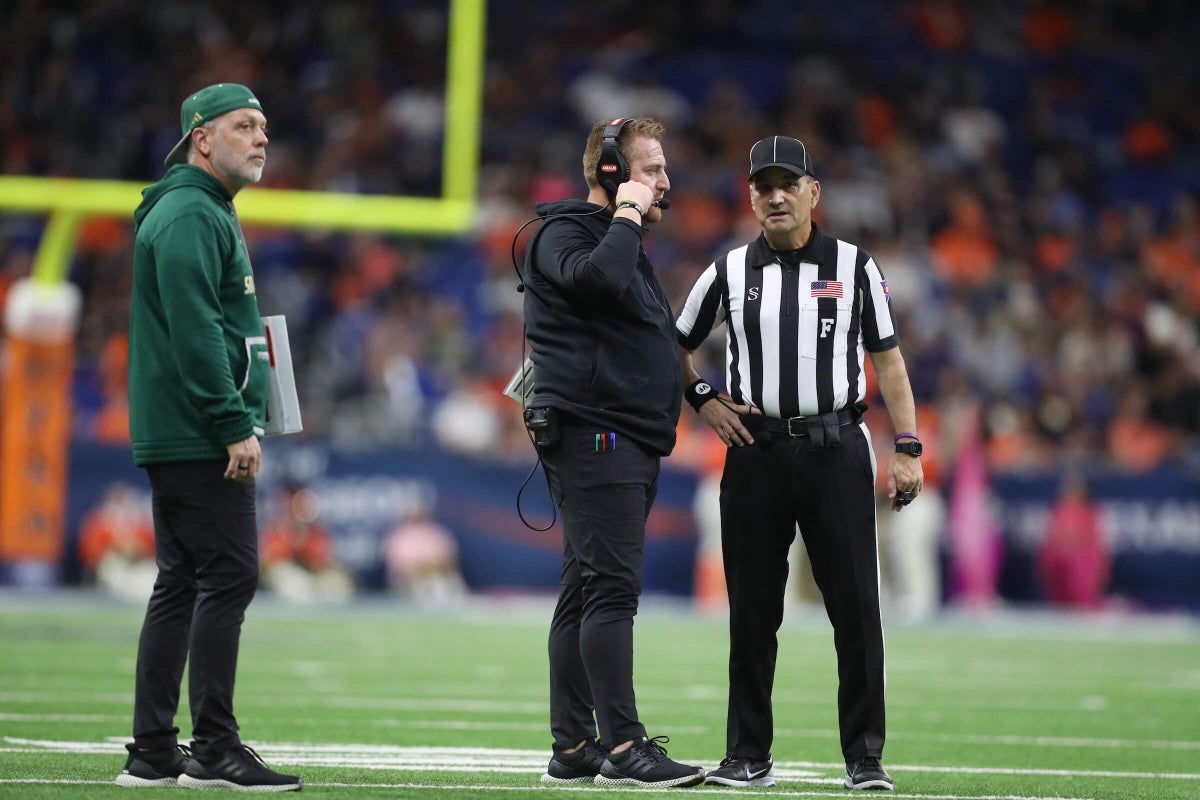
South Florida coach Alex Golesh likes to use the word “knucklehead,” especially when talking about the youthful version of himself. He has made the reference countless times, a way of relating to players who encounter tough choices and don’t always make the right ones.
“But he never really goes into detail on that,” USF senior center Cole Best said. “Probably a smart move.”
The answer is in the building, though. It can be found in the office of the director of player development, Jeff Jones, the office where, for three seasons, players have spent hours opening up about issues in their personal lives, learning about leadership or just hanging out. Jones, 56, a high school principal for most of his career and, in Golesh’s words, “the key to our program,” can specify because he was there. He taught Golesh in chemistry, coached him in football and spent hours talking about life with him on his front porch in Dublin, Ohio.
“It was more a goober type of thing,” Jones said of Golesh’s brand of knucklehead. “Alex was a typical teenage boy. Nothing malicious. Just things that would make you say, ‘Man, that ain’t it.’”
Not doing homework, for example. This was an issue for Golesh, who was born in 1984 in Moscow, Russia, moved with his family to New York in 1991 as the Soviet Union collapsed, and began to acquire a love for American football after moving to Ohio in 1996. A love for completing academic assignments took longer to locate.
“But then he’d ace all the tests,” said Jones, who was the offensive coordinator at Dublin Scioto High School back then, when Golesh was mostly a backup on both lines. “I couldn’t fail him, and it would tick off my colleagues, but I’m like, ‘The dude gets an A on every test. What do you want me to do to him, man?’”
Now Golesh, 41, is one of college football’s rising young head coaches, 21-14 in his third season at a program that was 4-29 in the three seasons before his arrival. The Bulls (7-2, 4-1 American) have the inside track to the Group of 5 spot in the College Football Playoff entering Saturday’s showdown at Navy (7-2, 5-1).
Golesh’s energy helped him earn a gig as a student assistant at Ohio State during his undergraduate days. It helped shoot him up the coaching ladder, where he found record-breaking success as Josh Heupel’s offensive coordinator at Tennessee. And that energy is in constant view on the sideline in his current gig. So is Jones.
He trails Golesh closely at all times, hat turned backward, ready to counsel on whatever may come up — accepting or declining penalties, go-for-it decisions and rules interpretations. During a 48-13 win over Florida Atlantic on Oct. 18, Jones drifted away a bit on the sideline and Golesh loudly implored him to reattach himself to the head coach’s hip.
“I like when you yell at me,” Jones told Golesh at the time. “Keeps me humble.”
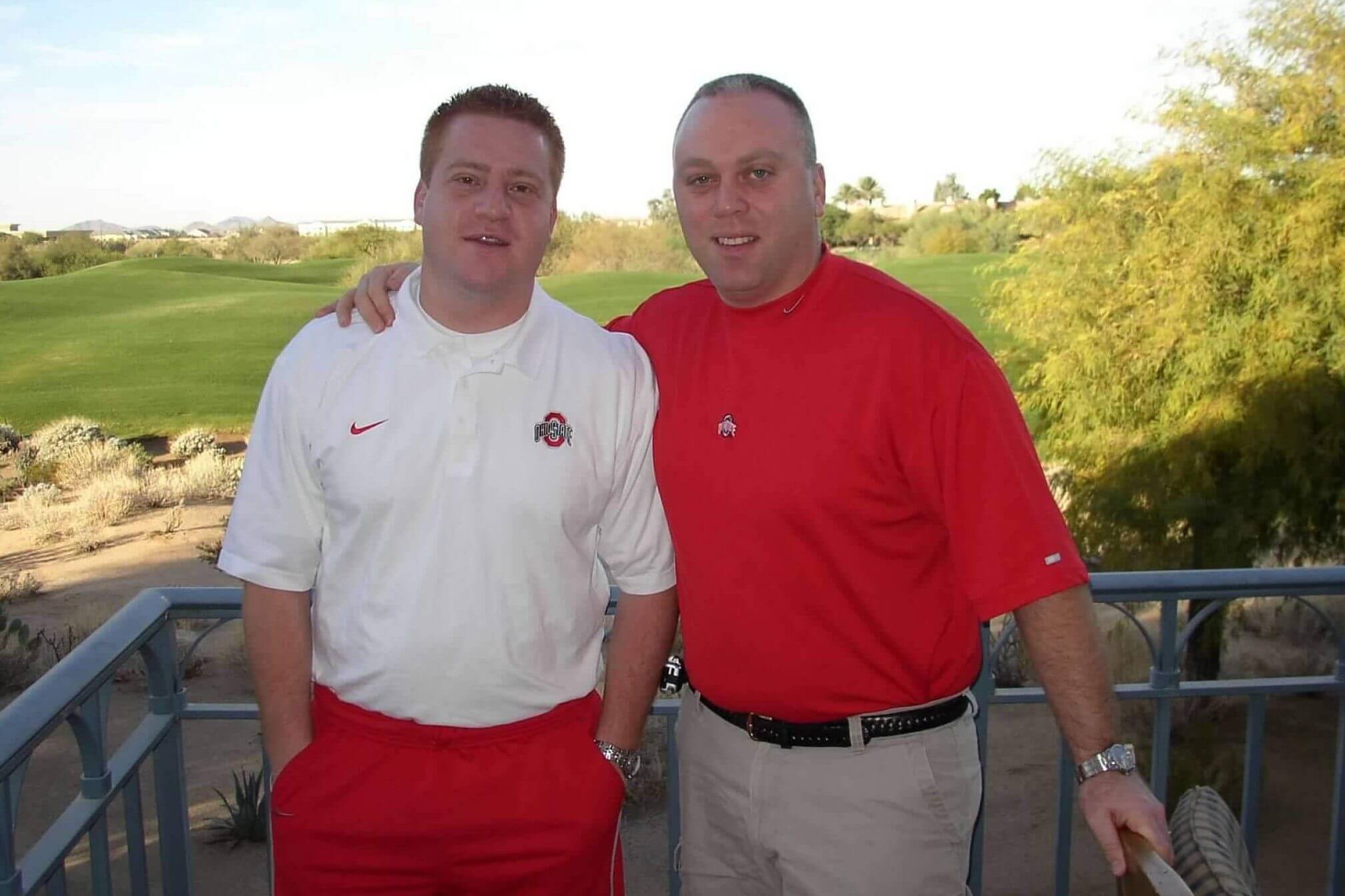
Jeff Jones routinely visited Alex Golesh during his former player’s climb up the coaching ladder. Golesh was a student assistant at Ohio State from 2004-05. (Jeff Jones)
(Though Jones acknowledged the backward hat may “subconsciously” be a casual fashion response to 29 years as a necktie-wearing educator, he said it’s always been his “get to work” look while coaching offensive linemen, his primary football trade. Also, he played catcher in baseball.)
But advising during games is not why Jones retired early from a fulfilling career to join Golesh in Tampa. It was really to continue that work in a different way while helping one of his favorite students and experiencing the college football world that he had eschewed many years ago.
Jones and his wife, Christy, met in 1995 as science teachers in Hilliard, Ohio. It was not an instant connection.
“She didn’t like me at all — she thought I was just a dumb old football coach until she realized I could actually teach,” he said.
“I played in the band in high school,” Christy said. “I went to every game, but it’s not like I paid any attention to the sport.”
She was much more into it by the time they got married, and 12 of her husband’s former players served as ushers.
Shortly after that day, Jones had two opportunities to go the graduate assistant route, under two coaches he had come to know on the high school circuit — John Cooper at Ohio State and Walt Harris at Pittsburgh. This meant signing up for a vast reduction in income for an extended period of time, in order to work toward the eventual rewards of coaching big-time college football.
“He said, ‘Is this something we can do? Or does it make you nervous financially?’” Christy recalled. “I said, ‘I don’t want to tell you no. But am I comfortable with it? No.’”
Jones turned both down. Coaching high school football continued — Jones was named Ohio Division I Coach of the Year as head coach of Westland High in 2006. Teaching continued. The plan to have kids was not disrupted. When the oldest of their two children, son Jordan, came home from the hospital in 2002, neighbor kid Alex Golesh was waiting on the porch for the family.
“It wasn’t meant to be,” Jones said of college coaching. “And I wouldn’t be sitting here if I made a different decision back then.”
As Golesh’s career advanced, from grad assistant stints at Northern Illinois and Oklahoma State to full-time gigs at Toledo, Illinois, Iowa State, UCF and Tennessee, the Joneses kept up with him. They visited him for games at all but UCF because the kids were so busy at the time — Jordan now builds engines for racing cars in North Carolina, and daughter Alyssa is a USF senior finishing up her degree in social work.
Jones switched from teaching and coaching to administration so he could coach his own kids in sports. Not that being a principal is a breeze — Jones estimated he had an evening event on 140 of the 180 school days one academic year.
Through those years, Golesh told Jones to be ready for when he got his own program. Sounds great, Jones would say, chuckling to himself. But Golesh was never kidding. The role he had in mind was one similar to that of Stan Jefferson when Golesh was a student in Jim Tressel’s Ohio State program, a counselor to players first and foremost — a role that eventually led Jefferson to become superintendent of Mansfield (Ohio) City Schools.
The only person he had in mind was Jones.

Jeff and Christy Jones were guests at Alex and Alexis Golesh’s wedding. (Jeff Jones)
“He was the first guy who showed me what it is to truly give more of yourself than take,” Golesh said of Jones. “He poured so much into me back then.”
South Florida came for Golesh after the 2022 season. Then Golesh made the call to Jones. It was Dec. 1, 2022.
Golesh told Jones about the offer. He told him he was going to take it. Jones asked if Golesh’s wife, Alexis, was on board. Confirmed. Golesh asked Jones if he was coming.
“Oh, you were serious about that?” Jones said. “What will I be doing?”
Golesh told him they’d figure it out when he got to Tampa.
“Hold on,” Jones responded. “Let me pop some popcorn, I’ll let you tell Christy that, and I’ll just have a great time listening to that conversation.”
Then Golesh got serious and said: “Coach, just come here and give these guys the same experience you gave me.”
It got a little misty on the call. It got a little misty nearly three years later as Jones recounted the call.
He was in Tampa before 2022 ended. The Joneses retired from their careers to start a new adventure with a family they consider an extension of their own — almost as if they are Golesh’s aunt and uncle, Christy said.
At the 2023 spring game, Christy sat with Golesh’s parents, Vladimir and Bella, along with Alexis and the Golesh children, Corbin and Barrett. Upon departing, Bella implored Jones to “take care of my son.”
“Life Jeff was a guardian angel,” Christy said.
Christy’s last 21 years in education were spent as an elementary school librarian, the one person in the school who essentially talks to everyone — which is a lot like Jones’ role in the USF football building.
“Coach Jones” to the players and “Jonesy” to the staffers, he said he does the job with the same mindset he had in nearly 30 years as a public educator.
“I can only be who I am, but I know what I am and who I am,” he said. “There are things I don’t do well, but when it comes to kids? Man, there’s no greater resource in this world, and if you’re pouring into them, you’re giving this place a shot.”
That means “figuring out what makes each one of them tick and giving them an opportunity to make mistakes without killing them for it,” he said. It also means earning trust to the extent that players will tell him things that he’ll keep confidential. Even from Golesh in some cases.
“Any possible situation you can think of, anything a player might be going through, you can go to coach Jones and he’s going to help you figure out a way to get it taken care of,” USF senior linebacker Mac Harris said.
“Being a principal or a teacher, that’s not an easy job, and I don’t think those people get enough credit,” Best said. “It takes a special kind of person to do those jobs. (Jones) is literally everywhere we are, every meeting, every practice, and he knows everyone so well. … From buddies I have at other programs, I don’t think anyone else has someone doing what he does.”
So far, Jones hasn’t found anyone, and he’s talked to people who share his title at programs all over the country.
USF has gone all in on football, opening a $22 million football building in 2022 and starting construction on a $349 million on-campus stadium that is set to open in 2027. Golesh has had his pay bumped to $2.5 million per year, while resources for his assistants and to chase and retain players have increased. Harris, Best and star quarterback Byrum Brown are among many Bulls who could be playing at many different places. The Athletic’s Sam Khan, citing three conference sources, reported USF’s roster budget between $8 million and $10 million, tops in the American Conference.
Competitors sometimes lament their relative lack of resources — such as conference foe UTSA’s Jeff Traylor, who noted the difference before the teams’ Nov. 6 meeting. It came off more as a push to his own people for more investment, but Golesh bristled after USF’s 55-23 romp, saying it “discredits the fact that there’s recruiting, that there’s relationships being built, that there’s development and coaching going on.”
That struck some as overly sensitive in an era in which compensation is open and directly related to roster quality. But the people at USF believe their relationships, leadership and internal accountability are more the story than their speed, strength and skill.
“I don’t care if you’re Georgia, Ohio State or Alabama, I’ll put what we do with young people against anybody — anybody,” Jones said.
“Coach Golesh is not like other coaches,” Harris said. “He cares about us and he wants us to know how everything works. He’s not like the coach who’s too cool for school, sits in his office, comes out when it’s time for practice, yells at people and then goes back to his office. You can go sit in there with him any time and chop it up. He wants you to be a part of this with him.”
And that means experiencing what Jones can do for a young person. Harris was not a leader when Jones arrived. Nor did he care to be one. Jones saw it in him, though.
Hours of office time later, talking about different kinds of personalities, about different ways to lead, about the courage it takes to have uncomfortable conversations, and about life in general, Harris said, “I figured out my worth and what my voice can do.”
That brings to mind Dublin Scioto High in the early 2000s. Jones had a student who never did his chemistry homework but knew the material and aced his tests. He wondered if the student might be able to help others in the class who were struggling to grasp the material. As it turns out — homework or not — the student was a very good teacher.
One day, close to graduation, he asked the student if he had ever considered coaching. If so, he knew of some camps that needed help.
Alex Golesh looked at Coach Jones and smiled.
“That’s what you were doing all along, isn’t it?”