
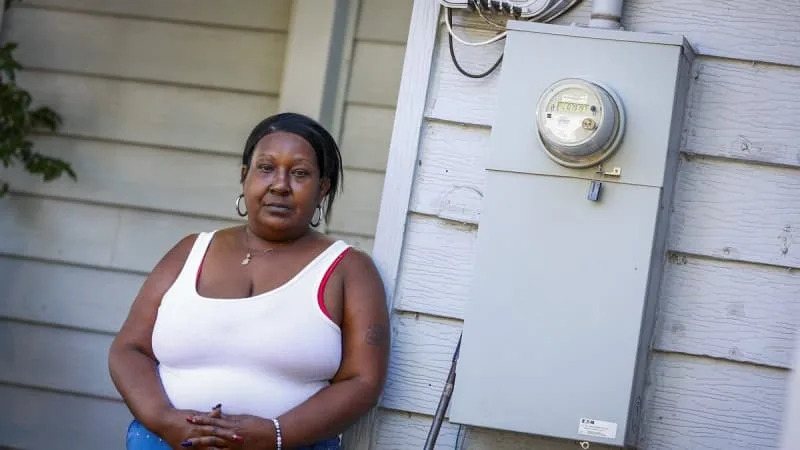
Rose Singleton, 82, rarely cooks, uses her dryer sparingly and keeps her hot water heater off. Still, her monthly Tampa Electric bill climbed to its highest ever this summer at around $200.
“What can I cut back?” asked Singleton, who lives with her Jack Russell terriers in a 1955 bungalow. “I haven’t seen a piece of steak in a long time.”
Chrystal Shiver has a much newer home in Land O’ Lakes and just replaced her air conditioner and roof. But she got a $529 bill in July from Duke Energy.
“It feels like a scam,” Shiver said.
That was less than the bill sent to Rayne DeJesus, a local hip-hop musician who got a $845 bill in October for his Tampa townhouse, where he lives with his wife and three kids.
“There’s no reason for this bill to be almost 900 f—ing dollars,” he said, “excuse my language.”
Around Tampa Bay and beyond, residents were stunned by their electricity bills this year, particularly during the hottest months. Across housing types, income levels andneighborhoods, many Floridians questioned why their bills had risen to new heights despite no change to their daily routines.
The answer lies in a combination of recently imposed hurricane recovery charges, record heat and hikes to base rates that coalesced into big increases, experts told the Tampa Bay Times. As bills soared along with temperatures this summer, the cost of electricity became a frequent topic of conversation among neighbors and a source of commiseration on social apps like NextDoor.
“Electricity prices go in one direction — and that’s up,” said Pavel Molchanov, managing director specializing in renewable energy and clean technology for Raymond James & Associates.
Some residents decided to speak out.
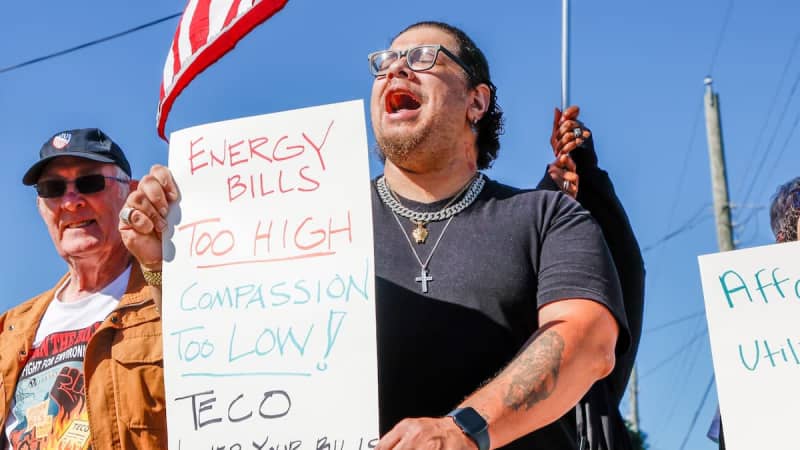
On Nov. 1, about a dozen local politicians, environmentalists and activists gathered on a residential street in Tampa for a symbolic burning of their electric bills, days before state regulators met in Tallahassee to decide adjustments to next year’s rates.
“Burn the bill!” theprotesters chanted in front of local TV news cameras.

Then they tossed their bills, some crumpled and ripped, into a chrome trash can, as a fog machine billowed smoke into the air. (A woman joked that the environmentalists preferred not to light a real fire.)
Three days later, utility regulators met in Tallahassee and greenlit the start of thenext phase of Tampa Electric’s previously approved rate hike. It will raise a typical household’s bills by another $5.50 per month.
Floridians are not alone in feeling the squeeze from electric bills. Nationwide, electric prices in recent yearsroseat a faster rate than usual, Molchanov said, driven in part by upgrades to aging grid infrastructure and rising demand.
Since 2022, electricity costs have increased faster than inflation, according to theU.S. Energy Information Administration, an agency within the U.S. Department of Energy. Officials expect the increases will continue into 2026.
But Florida has another big cost driver: hurricanes.
Researchers at Lawrence Berkeley National Laboratory recentlyexamined electricity prices across the U.S. and used Florida as a case study. Storm recovery inflated costs, they found. So did efforts to make the grid more resilient to extreme weather.
Likely the biggest reason forthe noticeable jump in bills this year was the fees imposed after the historically destructive 2024 hurricane season. Duke Energy and Tampa Electric deployed thousands of workers to restore power in the wake of hurricanes Helene and Milton. The millions of dollars in unanticipated costs incurred by the energy companieswere passed on to customers.
For homeowners using 1,000 kilowatt-hours, a common benchmark just below the average household bill,Tampa Electric customers have paid about $20 more per month because of the storm charges. That additional expense will remain on bills until September 2026 — a longer period than usual after regulators voted to spread costs to avoid even higher monthly bills.
“This summer’s higher bills are not the new normal. While summer bills are always higher in Florida because of air-conditioning use, the biggest reason bills rose more than usual this year was the temporary storm surcharge from the historic 2024 hurricane season,” Tampa Electric spokesperson Cherie Jacobs saidin a statement. “Even with these temporary storm-related costs, Tampa Electric’s rates remain below the national average.”
Duke customers have been paying an even higher storm charge, at $32 monthly for 1,000 kilowatt-hours, although they may not have noticed an increase that size. That’s because $10 has been offset by an unrelated seasonal adjustment that lasts through November. Duke customers will pay the full fee from December through February, after which the storm charge is scheduled to fall off their bills.
“The most important takeaway for customers to know moving forward is that Duke Energy Florida is delivering on our commitment and removing the storm cost recovery charge in March 2026,” said company spokesperson Ana Gibbs.
There’s no limit to what utility companies can spend on emergency storm response, though this year’s charges sparked a discussion among some Florida regulators that maybe that should change.
This summer’s record heat also fueled higher bills. Even if residents kept thermostats at their usual temps, sweltering heat meant units had to work harder.
In late July, temperatures blistered, flirting with triple digits for days. Tampa hit 100 degrees for the first time in recorded history.
Warming has been on the rise for years. Nine out of the 10 warmest years on record in Tampa have occurred in the past decade.
Additionally, hikes to both Duke‘s and Tampa Electric’s base rates took effect early this year, increasing how much customers pay for the power they use. Duke Energy’s hikes mean that its customers will cumulatively pay about $727 million more over two years, while Tampa Electric customers will pay more than $450 million more, records show. (The state’s other large investor-owned utility, Florida Power & Light, is asking regulators to increase its customers’ base rates starting next year.)
“If you drop a frog into a boiling pot of water, it’s gonna jump out, but if you put it in the water and then slowly turn up the heat, it’ll boil to death,” said Brooke Ward, senior Florida organizer with Food & Water Watch, an environmental group that advocates for clean energy.
“That is what the utilities are doing to us, little by little, until you’re like, ‘Dang it, I can’t pay my bills. I can’t afford my medicine. I can’t keep my lights on.’”
Suprina Byrd’s monthly energy bills this summer ballooned to a figurehigher than her home’s square footage. In August, Duke Energy billed her $881 for the 860-square-foot St. Petersburg home she rents.
Built in 1956, the house lacks many modern energy efficiencies that would help keep cool air inside. Byrd usually sets her thermostat to 75, but leaky attic ducts mean temperatures can climb as high as 91 inside her home by late afternoon.
Byrd, 58, lives on a fixed income. She was recently notified by the federal government that it had overpaid her by more than $100 each month. Her disability checks will soon shrink to what she said is an unendurable monthly income to support herself, her mother and her 36-year-old son, who cares for them both.
“I can’t live off $848 with my utilities matching that amount,” she said. “I have other bills to pay besides lights and water, so it’s really hard for me, and I’m the only one with income.”
When the cost for a necessity like electricity goes up, it’s the people with less who are hurt the most, said Forest Bradley-Wright, who leads the state and utility team at the American Council for an Energy-Efficient Economy, a Washington research group. That’s not only because they have less padding in their bank accounts — it’s also because their housing tends to be less energy-efficient.
Florida has fairly robust energy efficiency standards in its building codes that have improved over time, Bradley-Wright said. But homes that were built before 1979 weren’t subject to them, and lots of leaky properties haven’t been updated.
“Low-income housing … tends to be less efficient. So you’re using even more electricity to just maintain an acceptable level of comfort,” he said.
Mobile and manufactured homes can be among the worst for efficiency, headded, using about 50% more electricity on average than standard homes because of their poor insulation. Florida has more manufactured homes than most states, and they often house people with tighter budgets.
An interactive map published by the Department of Energy shows that some of the lowest-income parts of St. Petersburg, like where Byrd lives in Childs Park, pay nearly the same amount that residents in some of the wealthiest parts of South Tampa pay. That’s because even though the Childs Park homes are likely smaller, they’re also older and less efficient, resulting in energy costs totaling roughly $2,300 per year.
That also means that a higher percentage of paychecks in poorer households go toward energy than their wealthier neighbors.
State regulators can require utilities to help customers make their homes more efficient by setting mandatory energy-savings targets for the companies, Bradley-Wright said. Twenty-six states plus the District of Columbia have taken this step and helped residents save.
But Florida has not done so. That fact alone, Bradley-Wright estimated, has likely cost Floridians billions over the years.
This is a turbulent time for energy costs. Therise of energy-guzzling data centers and the rollback of federal clean energy tax credits have left utility experts uncertain about what the future holds.
Florida has not yet become a hotspot for data centers, which power artificial intelligence and other programs — although tech companies are starting to eye it.
When these large centers are constructed, their high energy demand can require utilities to build more power plants, which can result in additional costs to all utility consumers. But even if regulations are in place to prevent that, it’s possible that Floridians could be affected in other ways.
David Cranston, Florida energy policy manager for the Environmental Defense Fund, said the rise of these centers could jack up the price of fuel used by Florida power plants.
“There’s obviously a lot of new data centers coming online,” Cranston said. “Because there’s a lot of demand popping up around the Southeast … it could help inflate natural gas prices further because there’s more competition for supply.”
Florida’s reliance on natural gas to produce three-quarters of its power makes it highly vulnerable to fuel price swings, a fact that Floridians already painfully learned in 2022. That year, Russia invaded Ukraine, straining the worldwide supply of natural gas and resulting in a dramatic price spike. Florida electric bills skyrocketed until those global markets settled.
Regardless of shorter-term trends, though, natural gas prices are generally expected to rise in the coming years. Florida utilities pass the cost of fuel directly to customers.
The Environmental Defense Fund, which advocates for cleaner energy sources like solar, commissioned a study to research how much the state’s reliance on natural gas could cost consumers.
The report found that if natural gas prices increase at the high end of the range of federal government projections,residents could pay about $21 billion more through 2034 — even with Florida utilities’ planned construction of more solar plants.
Sue Lewis, a retired insurance claims adjuster who lives in Gulfport, has already sacrificed the one thing most Floridians value most: air conditioning. Her old home’s jalousie windows leak too much cool air, she said, and a remodel doesn’t make financial sense.
Her bill has doubled anyway.
“Everything is for the benefit of the big porks and their money,” she said.
• • •
The Tampa Bay Times launched the Environment Hub in 2025 to focus on some of Florida’s most urgent and enduring challenges. You can contribute through our journalism fund by clicking here.