
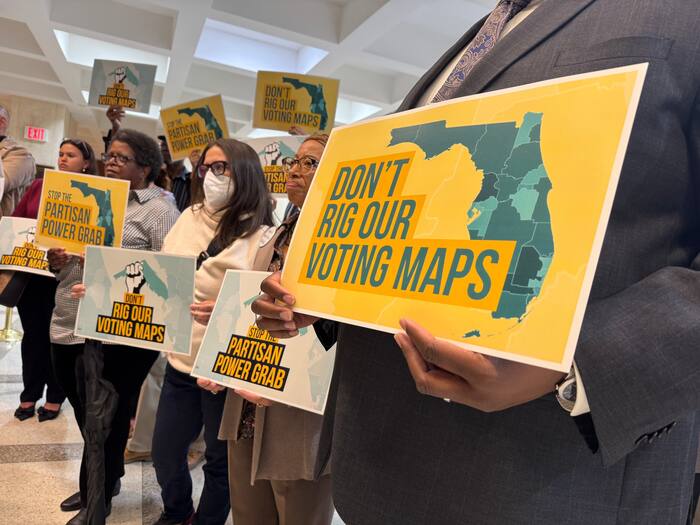
Florida was supposed to be a quiet night for Republicans. It wasn’t.
As midterm election results rolled in Tuesday, Nov. 3, it quickly became clear that GOP gerrymandering in the Sunshine State had seriously backfired — and a sweeping property tax amendment had passed with enough support to shake up municipal budgets from Pensacola to Miami.
Democrats flipped or held key seats in congressional districts that Republicans had specifically redrawn to favor their party. And Florida Amendment 3 passed with 62% of the vote, triggering what could be the most significant overhaul of Florida’s property tax system in decades.
It was a night that few political observers saw coming.
How Republican redistricting backfired
Redistricting — the process of redrawing the boundaries of congressional districts, typically to reflect population changes or, in some cases, to benefit one political party — became a central story in Florida’s 2026 midterms.
Earlier this year, Gov. Ron DeSantis and the Republican-controlled state legislature redrew Florida’s congressional map in a process critics called gerrymandering — deliberately shaping district lines to give one party a built-in electoral advantage.
Four new districts were created — the 9th, 14th, 22nd and 25th — each designed to favor Republican candidates.
Based on 2024 voting patterns, former President Donald Trump would have carried all but one of those districts by double digits. He would have won the remaining district by roughly nine points.
But on Election Night, the strategy didn’t hold. Democrats won three of those four seats — and were leading in the fourth.
District by district: What happened
Florida’s 14th congressional district Democrat Kathy Castor held her seat, fending off Republican challenger Mike Beltran. Republicans had redrawn this district to include far less of Tampa and far more of the city’s surrounding rural counties — territory Trump carried by 11 points in 2024.
The theory was simple: fewer Tampa Democrats, more rural Republicans. It didn’t work.
Florida’s 22nd congressional district Democrat Pia Dandiya defeated Republican Casey Askar. DeSantis’s redistricting had created what Republicans believed would be an open-seat opportunity after Democratic incumbent Lois Frankel chose to run in the newly drawn 23rd district instead.
Florida’s 25th congressional district Democrat Jared Moskowitz won his race, holding a seat Republicans had drawn with confidence.
Florida’s 9th congressional district Democrat Darren Soto was leading as results continued to come in — a fourth district where the redrawn map had not yet delivered for Republicans.
What the experts are saying
Craig Agranoff, a political science professor at Florida Atlantic University, told Newsweek on Tuesday that the results exposed the real limits of relying on map-drawing alone as a political strategy.
“These House wins show the limits of the new map. Moskowitz, Castor, and Dandiya all held or took seats that Republicans expected to improve under the mid-decade redistricting.”
Agranoff explained that drawing favorable lines is only part of the equation:
“The lines shifted some districts toward the GOP, but local candidates, turnout, and the broader midterm environment still decided the outcomes. Moody’s Senate win fits the statewide pattern. She held the seat by a narrow margin over Nixon, consistent with Florida’s recent Republican lean. The House results are more mixed. Democrats kept several competitive districts even after the map changes. That does not erase the structural advantage Republicans built, but it shows redistricting alone does not lock in every race. Florida remains a state where the map sets the boundaries and the voters still fill them in.”
Nicholas Stephanopoulos, an election law professor at Harvard, urged caution about drawing the wrong conclusions from Democratic wins in the redrawn districts — specifically warning that the national political environment matters as much as the map itself.
“Gerrymandering isn’t yielding the gains GOP hoped … IN A BLUE WAVE ENVIRONMENT. In a NEUTRAL environment, they’d be gaining around nine seats net. Even in this environment, their new maps will perform better than their old maps would have.”
Senate race closer than anyone expected
In the race for Florida’s U.S. Senate seat, Republican incumbent Ashley Moody defeated Democratic challenger Angie Nixon — a progressive candidate who ran to the left of the traditional Democratic mainstream.
But the margin told its own story. When the race was called at 84.3% of votes reported, Moody led by just 0.7 percentage points.
For a state Trump carried by double digits just two years ago — and where DeSantis won the governorship by nearly 20 points in 2022 — a razor-thin Senate margin was a striking signal.
Republican Byron Donalds also narrowly won the gubernatorial race — a contest that few observers initially expected to be competitive.
Florida’s redistricting fight in national context
Florida’s map battle wasn’t happening in isolation. Redistricting is a process that happens in every state, typically following the U.S. Census, but states can also redraw maps mid-decade — which is what happened here.
Roughly one-third of the nation’s congressional districts were redrawn to some extent this cycle, with Republicans securing favorable new maps in seven states — including Florida — after Trump seemingly led a broader effort that began with a push for additional Republican-friendly seats in Texas.
The results in Florida suggest that while gerrymandering can tilt the playing field, it cannot fully override candidate quality, local dynamics and the broader national environment — at least not in a midterm cycle that favors the opposing party.
Amendment 3 financial fallout begins
While the congressional races grabbed headlines, Florida voters also approved Amendment 3 with 62% of the vote — clearing the 60% supermajority threshold Florida requires before any measure can become part of the state constitution.
This amendment focuses on property taxes — specifically the taxes homeowners and property owners pay to local governments based on the assessed value of their land and buildings.
Right now, Florida homeowners who live in their primary residence — called a “homestead” — already receive a tax exemption, meaning a portion of their home’s value isn’t taxed. Amendment 3 makes that exemption significantly larger.
Homestead exemptions will increase to $150,000 in 2027 and $250,000 in 2028. For individual homeowners, that’s a meaningful reduction in their annual tax bill.
For cities and counties, which rely heavily on property tax revenue to fund public services, it’s the beginning of a very difficult budget conversation.
What else Amendment 3 changes
Beyond expanding the homestead exemption, Amendment 3 makes several other significant changes:
Lowers the assessment cap for non-homestead properties: Right now, the assessed value of rental properties, commercial real estate and second homes can increase by up to 10% per year for tax purposes — even if the actual market value rises faster. Amendment 3 cuts that cap to 5%. That means slower growth in taxable value for landlords and commercial property owners — but also slower growth in tax revenue for local governments.
Places new spending restrictions on local revenues: Local governments — cities, counties and special districts — will face new limits on how they can use property tax revenue, restricting their flexibility to respond to budget shortfalls.
Restructures how exemptions can be adjusted: The process by which tax exemption amounts can be changed going forward is being revised, shifting some control away from local governments.
Billions in projected revenue losses
Property taxes in Florida are divided into two broad categories: taxes that fund public schools and taxes that fund everything else — roads, emergency services, parks, water systems and local government operations. Amendment 3 affects that second category.
According to Florida TaxWatch, statewide non-school property tax collections are projected to drop by an estimated $4.9 billion in the first year, rising to $8.7 billion in 2028 and reaching a recurring annual loss of $11.8 billion by fiscal year 2031-32. Over five years, the total projected reduction hits $45.8 billion.
Those numbers aren’t abstract. They represent the funding streams that pay for roads, parks, libraries, after-school programs and public transit systems across every county in the state.
What it means for our area — and beyond
The budget pressure is already coming into focus at the local level. A city’s general fund is essentially its main operating account — the money used to pay for day-to-day services like police, fire, sanitation and parks.
In Jacksonville, the city council auditor projects a $200 million shortfall in next year’s general fund budget — out of a total $2 billion budget — with cumulative cuts reaching $1.5 billion over five years.
St. Johns County is staring down more than $700 million in projected impacts over the same period.
Public safety groups were among the loudest voices opposing the measure before the vote, warning that law enforcement and emergency services budgets would face real pressure as a result.
To bridge funding gaps, local governments are expected to raise municipal fees, service assessments and secondary taxes where permitted by law — meaning taxpayers could feel the impact in ways that go beyond their property tax bills.
Hospitals, water districts face steep shortfalls
Beyond city and county governments, Florida relies on a network of special taxing districts — independent government entities created to manage specific services like hospitals, water systems and conservation lands.
These districts have their own taxing authority and their own budgets. And under Amendment 3, many of them are facing serious funding shortfalls.
The Florida Policy Institute warns that public hospital districts — which operate public hospitals and clinics that serve uninsured and low-income patients — could lose hundreds of millions of dollars in funding.
Water management and infrastructure districts, which oversee flood control, conservation land and water treatment operations across the state, face multi-billion dollar constraints.
In a state where water management is already a high-stakes issue — particularly in South Florida, where flooding, algae blooms and aging infrastructure are persistent concerns — those budget constraints carry consequences that go far beyond a line item.
Could renters end up paying more?
Here’s the part that surprises most people. Amendment 3 is designed to cut taxes for homeowners — but renters may not benefit at all. In fact, they could end up paying more.
Here’s how that works: Rental properties — apartments, single-family rentals, commercial spaces — are classified as non-homestead properties.
If local governments raise property tax rates on those properties to offset lost revenue from the expanded homestead exemption, landlords face a higher tax bill. And landlords, in most cases, pass higher costs along to tenants in the form of rent increases.
The Florida Housing Coalition has warned that apartment and single-family rental costs could climb significantly as a result. In a state already grappling with a housing affordability crisis, that’s a scenario worth watching closely.
What happens next
A constitutional amendment doesn’t automatically write itself into law.
Before Amendment 3 can take effect, the Florida Legislature must pass new statutes that define exactly how the expanded exemptions will be calculated, administered and applied across the state’s 67 counties.
That’s why Gov. DeSantis has announced plans for a special legislative session — a called session outside the regular legislative calendar — to rewrite and implement state property tax laws before the amendment takes effect on Jan. 1, 2027.
Lawmakers will face competing pressures — homeowners eager to see tax relief, local officials scrambling to protect essential services, public safety advocates warning of budget shortfalls and housing groups tracking rental cost spillover.
Florida’s political landscape just got a lot more complicated, and the 2026 midterms made sure of it.
Summary
Florida’s 2026 midterm elections delivered a double surprise. Republican gerrymandering — which reshaped four congressional districts with the expectation of GOP gains — backfired as Democrats won or led in three of the four newly drawn seats.
At the same time, Florida Amendment 3 passed with 62% of the vote, launching a sweeping property tax overhaul that will benefit homeowners while projecting tens of billions of dollars in revenue losses for cities, counties and special taxing districts.
Gov. DeSantis has called for a special legislative session ahead of the amendment’s Jan. 1, 2027, effective date, as Florida braces for the financial and political consequences of one of its most consequential election nights in years.
Key Points
Democrats won or led in three of four congressional districts Republicans redrawn specifically to favor the GOP.
Kathy Castor held Florida’s 14th district; Pia Dandiya won the 22nd; Jared Moskowitz won the 25th; Darren Soto was leading in the 9th.
Republican Ashley Moody won the U.S. Senate race over Democrat Angie Nixon by just 0.7 percentage points.
Republican Byron Donalds narrowly won the gubernatorial race.
Amendment 3 passed with 62%, clearing the 60% supermajority threshold required to amend the Florida Constitution.
Florida TaxWatch projects $4.9B in Year 1 revenue losses, growing to $11.8B annually and totaling $45.8B over five years.
Jacksonville faces a projected $200M budget shortfall next year; St. Johns County faces $700M+ in impacts over five years.
Public hospital districts and water management districts face significant funding shortfalls.
The Florida Housing Coalition warns renters could face higher costs if landlords pass along tax increases.
A special legislative session is planned before Amendment 3 takes effect Jan. 1, 2027.
Our conversation
Government law attorney Chris Hand joins me on this week’s Politics & Power to discuss how Democrats flipped key seats in redrawn districts, a property tax amendment passed with 62% of the vote, and how Florida’s political future just got a lot more complicated.
We’ll also discuss:
For voters: Did the redrawn district lines affect how you thought about your vote — or did local issues matter more?
For homeowners: When will you actually see the property tax savings from Amendment 3, and how significant will they be for your household budget?
For renters: If landlords face higher effective tax rates on non-homestead properties, how soon could that show up in your lease renewal?
For local government watchers: With billions in projected revenue losses, which services in your community are most at risk — and who decides what gets cut first?
For political observers: Does Florida’s midterm result signal a genuine shift in the state’s political competitiveness, or is it a one-cycle effect driven by a favorable national environment?
For healthcare advocates: What does a funding shortfall mean for public hospital districts in your region — and who fills the gap if those budgets shrink?
For environmental watchers: How do water management budget constraints affect Florida’s ability to address flooding, algae blooms and aging infrastructure needs?
For national politics watchers: If gerrymandering can’t deliver results even in favorable states during a wave environment, what does that mean for the GOP’s congressional strategy heading into 2028?
Watch Politics & Power streaming live on News4JAX+ at 10:30 a.m. Tuesday and again at 9 p.m. on Tuesdays. Or watch On Demand anytime on the News4JAX YouTube Channel, NewsJAX+ or News4JAX.com.
Copyright 2026 by WJXT News4JAX – All rights reserved.