
CAPE CANAVERAL — Bad weather on Earth was blamed for the first launch scrub of Blue Origin’s New Glenn rocket Sunday, while bad space weather was the reason behind a scrub for a planned Wednesday attempt.
Jeff Bezos’ rocket company called off any attempt to send up the rocket on its second-ever launch citing the solar storms currently bathing the planet in nightly blankets of aurora borealis.
The decision was to protect its payload, a pair of Mars-bound satellites being launched for NASA on the ESCAPADE mission, which stands for Escape and Plasma Acceleration and Dynamics Explorers.
“New Glenn is ready to launch. However, due to highly elevated solar activity and its potential effects on the ESCAPADE spacecraft, NASA is postponing launch until space weather conditions improve,” Blue Origin posted to X Wednesday morning about five hours ahead of the planned opening of the launch window. “We are currently assessing opportunities to establish our next launch window based on forecasted space weather and range availability.”
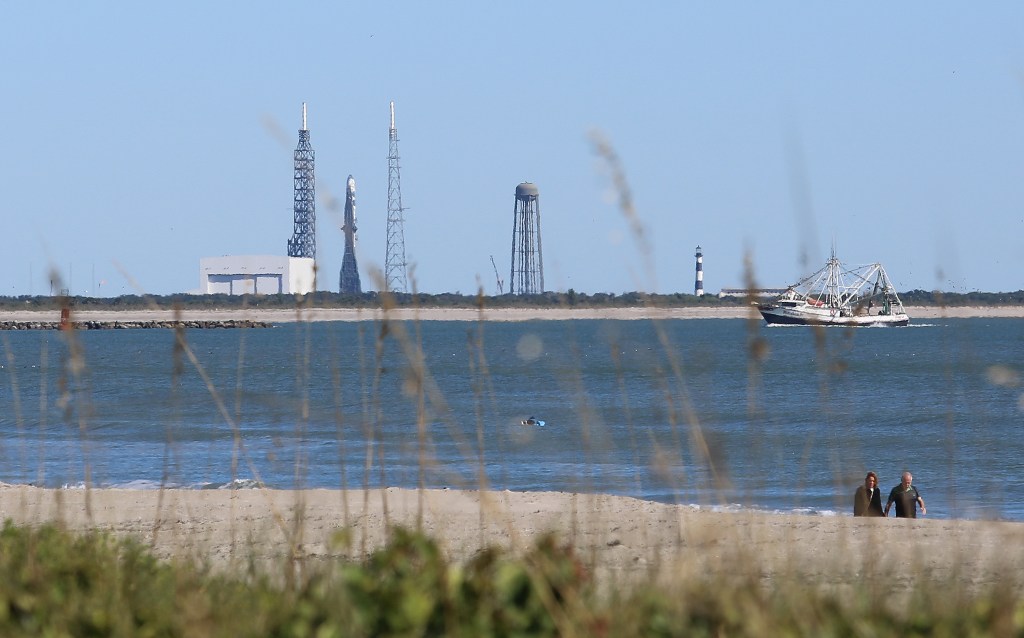
As of Wednesday, the rocket remained standing at Cape Canaveral Space Force Station’s Launch Complex 36, just north of Port Canaveral. Late Wednesday, Blue Origin announced it would try again for a launch Thursday, with a window from 2:57-4:25 p.m.
Space weather isn’t just a concern for Blue Origin. Space Launch Delta 45’s weather squadron has posted launch forecasts for three more launches coming in the next two days.
First up is a planned United Launch Alliance Atlas V launch from Canaveral’s Space Launch Complex 41 on Thursday at 10:04 p.m. during a 44-minute window. SpaceX has a pair of Falcon 9 rockets lined up for launches Friday night, one from Kennedy Space Center’s Launch Pad 39-A and one from Canaveral’s Space Launch Complex 40 after 10 p.m.
All three have better than 95% chance for good weather conditions at the pad for launch, but all could prompt their launch service providers to beg off their attempts because of high “solar activity” risk criteria for launch.
The NOAA’s Space Weather Prediction Center on Wednesday said geomagnetic storm conditions remain strong, and are expected to increase to severe levels over the next two days.
The solar winds are increased because of a series of coronal mass ejections, which then travel the 93 million miles from the sun to the Earth. They can disrupt GPS service and damage infrastructure such as electrical lines, but also can expand how far south the northern lights can be seen.
Aurora / Northern Lights from the Space Coast / Central Florida = 🤯
This is a 10-sec exposure from Satellite Beach looking NNE toward Blue Origin’s launch pad where the New Glenn rocket stands brightly lit, waiting for launch (hopefully) tomorrow. pic.twitter.com/n9M1hR7F9u
— Michael Seeley (@Mike_Seeley) November 12, 2025
Images as far south as Central Florida showed some levels of the colorful glow Tuesday night, and that could keep occurring this week as the flares continue to splash their way past the planet.
Rocket fans who had come out Sunday needed raincoats for the attempt that ultimately scrubbed because of weather.
Shore birds fly past the New Glenn NG-2 sits in the pad at Launch Complex 36A at Cape Canaveral Space Force Station, as the launch is scrubbed, on Sunday, Nov. 9, 2025. (Ricardo Ramirez Buxeda/Orlando Sentinel)
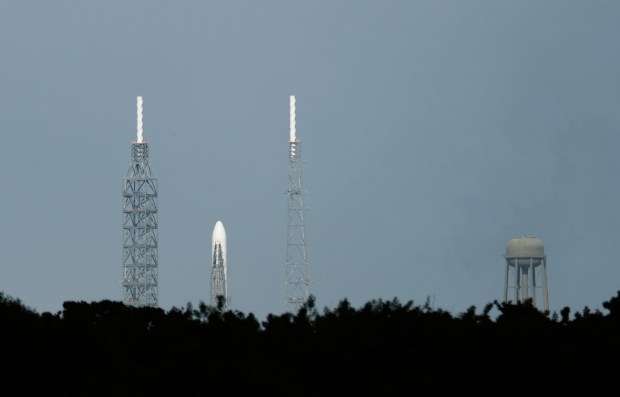
New Glenn NG-2 sits in the pad at Launch Complex 36A at Cape Canaveral Space Force Station, as the launch is scrubbed, on Sunday, Nov. 9, 2025. (Ricardo Ramirez Buxeda/Orlando Sentinel)
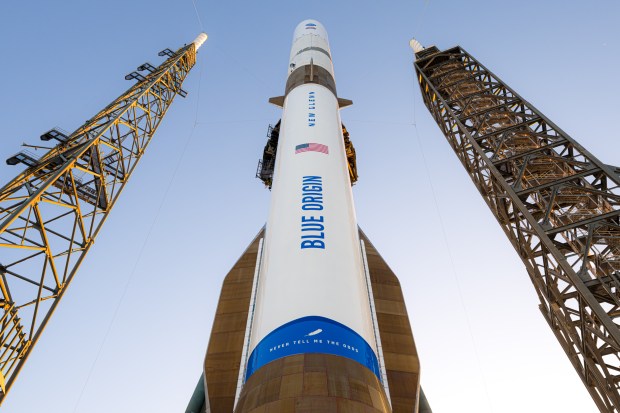
Blue Origin’s New Glenn sits on the pad at Cape Canaveral Space Force Station’s Launch Complex 36 ahead of the planned NG-2 launch. (Courtesy/Blue Origin)
Show Caption
1 of 3
Shore birds fly past the New Glenn NG-2 sits in the pad at Launch Complex 36A at Cape Canaveral Space Force Station, as the launch is scrubbed, on Sunday, Nov. 9, 2025. (Ricardo Ramirez Buxeda/Orlando Sentinel)
Sunday’s window saw a series of issues that thwarted the attempt, including problems with ground systems at the launch pad, a cruise ship that ventured into the danger zone downrange and lots of rain.
Despite the rain, it was a typically warm Florida day with temperatures in the upper 80s.
Similar to how SpaceX Falcon 9 rocket boosters are recovered, Blue Origin has designed its New Glenn rocket boosters to land downrange in the Atlantic, aiming for recovery on board the vessel Jacklyn, named after company founder Bezos’ mother. The first flight in January successfully made it to orbit, but the booster was not able to stick the landing.
The booster landing, though, is secondary to the primary purpose of the mission, which is to get a pair of satellites on their way to Mars.
The twin spacecraft are dubbed Blue and Gold. They were built by fellow aerospace company Rocket Lab for NASA and the University of California Berkeley’s Space Science Laboratory,
They were originally aiming to launch in late 2024 and would have had an 11-month trip to Mars. Now, though, they’re heading up to what’s essentially a parking spot in space called Lagrange Point 2 about 1 million miles away that allows them to sit and wait for Earth and Mars to get back to a reasonable distance apart before heading on their interplanetary way next year.
Once they get there, they will orbit Mars and observe plasma and magnetic fields around the planet to help understand what processes strip atoms from Mars’ magnetosphere and upper atmosphere. That could help explain why Mars’ atmosphere is so thin, and how it may have evolved over time.
“Our number one objective is to deliver ESCAPADE safely and successfully on its way to (Lagrange Point 2) and then eventually on to Mars,” said Laura Maginnis, Blue Origin New Glenn vice president of mission management. “We also are planning — wanting to land our booster. If we don’t land the booster, that’s OK. We have several more vehicles in production.”
Thousands made their way out to the beach Sunday south of Port Canaveral to catch a close-up view of the rocket.
“I just wanted to come here to just see what it was all about,” said Daniel Arthur Bashaw of Essex, Vermont, who along with his wife Jennifer were planning to later visit Kennedy Space Center. “Been told from friends and people that have come to it that it’s a real nice spot to come visit.”
They found out about the launch and found their way to a parking space at Cherie Down Park in Cape Canaveral about 5 miles south of the launch pad.
“We’ve been here for how long? Three hours,” Jennifer said. “We just randomly pulled in and there was a spot, and then we decided we better stay.”
Parking spots were full up two hours before the opening of the launch window, with a line of eager rocket viewers queued up to take any spots that opened. When the skies opened up, some beachgoers gave up on any launch plans, but many more hoping for a launch remained.
The beach all the way up to Jetty Park was filled with thousands who braved squalls that put the launch into a hold.
Many were Blue Origin employees, but most also brought alternatives in case the rocket didn’t launch, walking their dogs, bringing the kids, toting surfboards or casting a fishing line into the surf.
“Wanted to watch the launch. Got to see the night launch last time,” said Jay Jacobs who was walking along the surf with his family who drove a short way from Viera.
Son Bradley, 11, had reserved praise for the first one he got to see.
“It was cool,” he said. “A little better than most rockets.”
Jay said he thought the beach was a great option to see it.
“My first rocket launch was in 2011 it was Launch Complex 14. It was a Delta 2. So that was the closest I’ve really ever been to a rocket. That was really cool. But this is a good viewing from the beach. A lot of the other ones, like SpaceX pads, are a lot further north.
“I’d say choose the beach. If you go Jetty Park, there’s a little bit of a hill there, so you can’t really see launch pad until it lifts off,” he continued. “But the beach here, the way it curves out to the east, you can see it pretty good on the pad and for liftoff and trajectory.”
Blue Origin’s New Glenn rockets are manufactured at nearby Merritt Island, then rolled over to LC-36, which underwent a multiyear, $1 billion dollar revamp. It held up well after the first launch, Maginnis said.
“The pad actually looked really good. We didn’t see any significant issues. We’ve got a great water suppression system out there, acoustic suppression system and overall facility looks good,” she said. “Everything was pretty smooth, so it wasn’t a significant amount of work to do there.”
She said the company plans to increase its launch rate in 2026, but didn’t say when the next launch would be.
“Looking forward to demonstrating that a key element of that, of course, it’ll be the turnaround of our GS-1 (the first stage) booster, as well as a number of other boosters that we’re bringing online,” she said. “So those will be supporting higher cadence in 2026 and beyond.”