
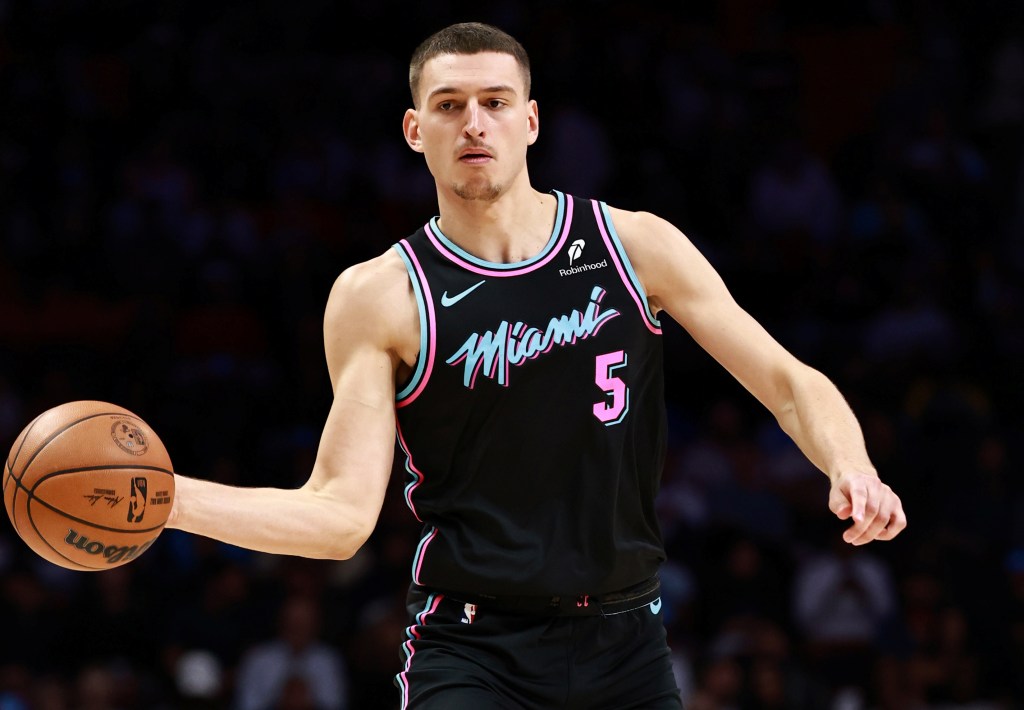
MIAMI — As he sat at the postgame media session on Saturday night, Heat forward Nikola Jovic was apologetic for the uneven play that had delivered him to that moment, vowing that the night’s victory and his career-high 29-point performance was the start of something better.
It wasn’t.
While he did have the game-winning assist in overtime two nights later against the Cleveland Cavaliers, most of his moments, save for that final moment, were uneven in that game, his play non-descript, in a foul-filled performance.
Then came Wednesday night’s 130-116 loss to the shorthanded Cavaliers, when it got worse.
This time two points on 1-of-6 shooting, four turnovers, and something bordering between languid and listless.
It’s almost as if coach Erik Spoelstra saw it coming.
Actually, he did.
Asked pregame about Jovic’s uneven season, when there has been little outside of the 29-point performance against the Trail Blazers and a 20-point outing earlier against the Memphis Grizzlies, Spoelstra did not hold back.
It was as if a message was being sent.
Asked if the Heat’s high-octane, read-and-react offense perhaps had Jovic off his game, Spoelstra used the question as a takeoff point.
“That’s not why. Let’s not do that,” he said, with Jovic now eight times this season scoring in single digits in a system seemingly designed to bring out the strengths in the 2022 first-round pick out of Serbia. “No. It’s about an intention, a maturity, a professionalism all the time. That’s what we’ve always been on him about.
“It’s not about his confidence. We bump him with confidence. But that’s what it is for young players. It’s not the new offense. That’s ridiculous.”
That’s when Spoelstra turned to the Heat’s culture, without specifically mentioning the culture.
“When he plays with a force of will and an intention, it’s always starting with him, and an approach every day, to approach a practice day and a shootaround and a film session like it’s really important,” Spoelstra continued. “He’s made improvements with that. It’s still not where it needs to be, because he’s young and doesn’t see that it’s always important. But he’s getting there.
“And then it’s a matter of consistency. But you can see the possibilities when he has that intention and things are important to him.”
The consistency clearly has been lacking, the shooting wildly erratic from game to game, as have been the turnovers, with it all coming in the wake of the Heat last month signing Jovic to four-year, $62.4 million extension that kicks in next season.
So when asked about Jovic’s pinpoint sideline inbounds pass to Andrew Wiggins for Monday night’s dramatic game-winning dunk, Spoelstra pointed to the possibilities. And then, a game later, four turnovers against the same opponent, Jovic, 22, essentially playing himself off the court.
“He has the size, he has the vision. He can deliver passes,” Spoelstra said. “He has this laissez faire, ‘Oh whatever.’ Well, that’s where sometimes it’s frustrated his head coach at a shootaround as if he’s like going through the motions. But it’s that mentality that also gives him that fearlessness to make plays in the clutch, because he’s not afraid of making the play.
“But he’s got all of those gifts.”
And then there are nights such as Wednesday, when there also are all those gaffes.
Not that he stood alone.
“We didn’t have our normal energy,” Spoelstra said of the Heat’s first home loss of the season. “There were pockets of the game where you saw the energy. But it was really more of a grind to get the running out in transition, the cuts, the swings, the catch-and-go drives, everything was just a little bit late.
“This will be a lesson not for this weekend, having that maturity to be on edge, to really treat it with the same urgency as the other night.”
Up next are the New York Knicks on Friday night at Madison Square Garden in an NBA Cup game, the first of consecutive games against the Knicks. The teams then also meet Monday night at Kaseya Center.
On a night that began with Spoelstra focusing on Jovic, it ended with Spoelstra focusing on a team that fouled too often and committed too many turnovers, a message sent to more than a single player.
“And when you don’t take care of the game when you can in those areas,” Spoelstra said, “then it’s tough to get it back sometimes.”