
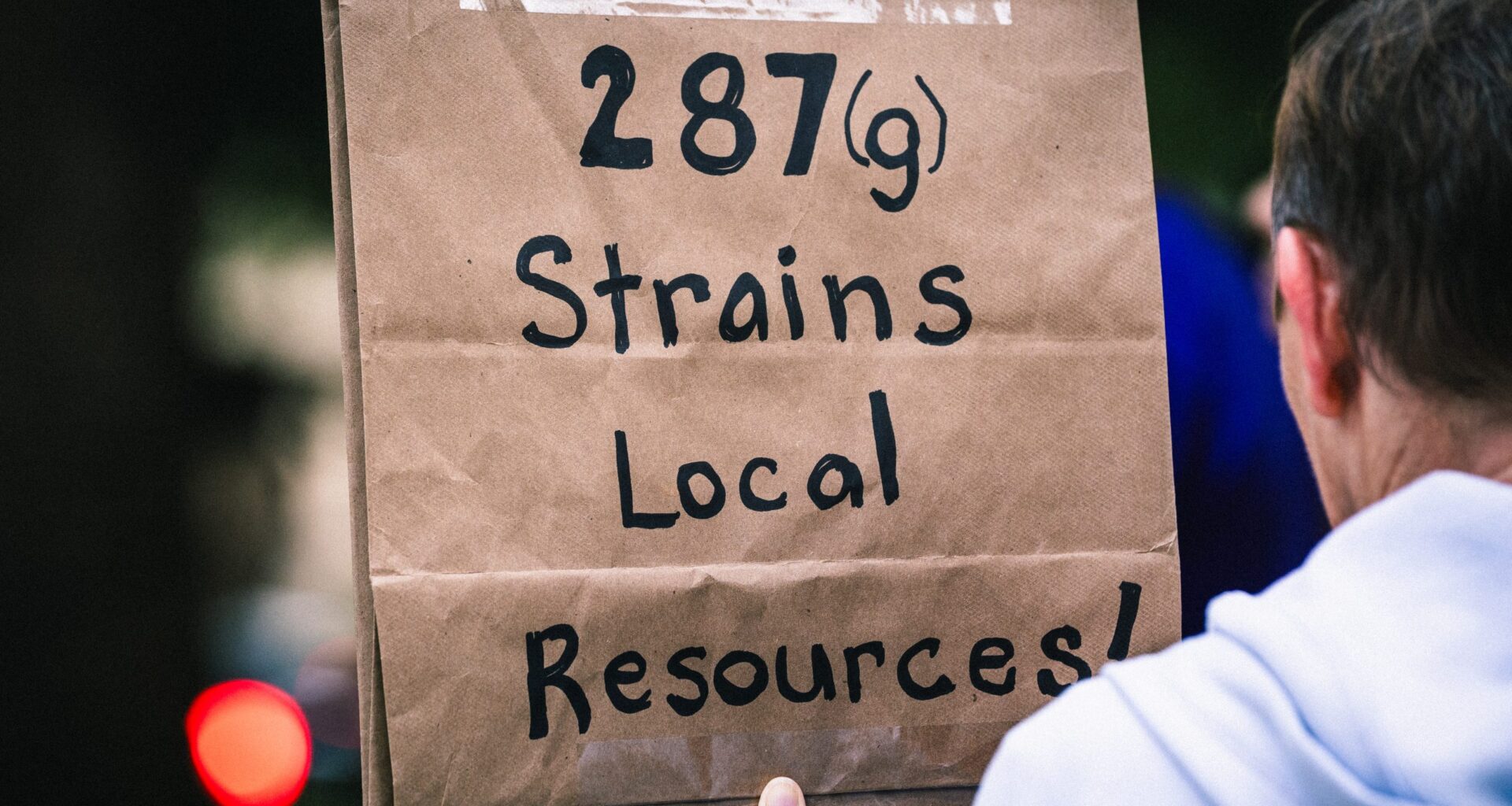
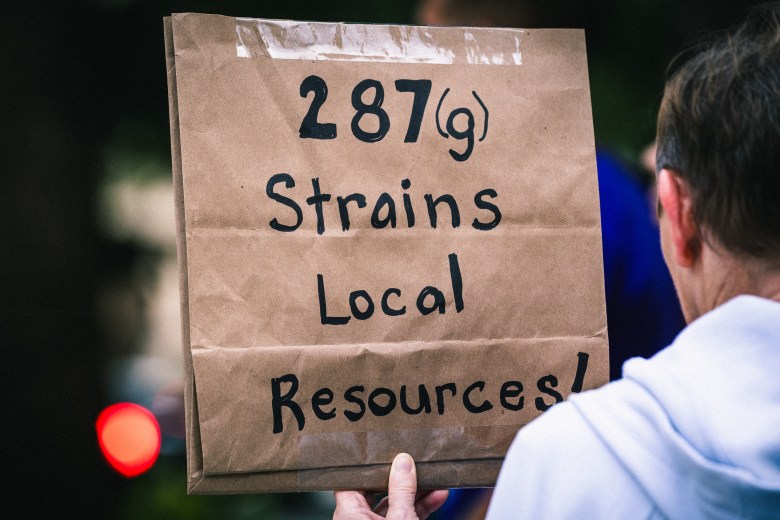
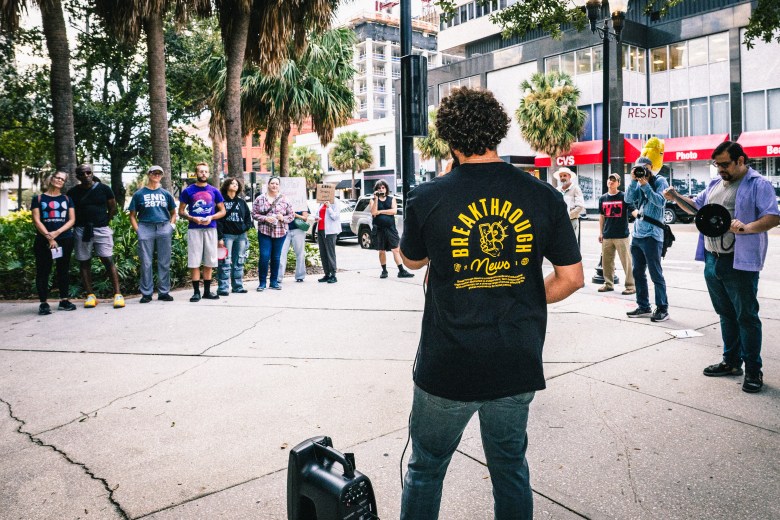
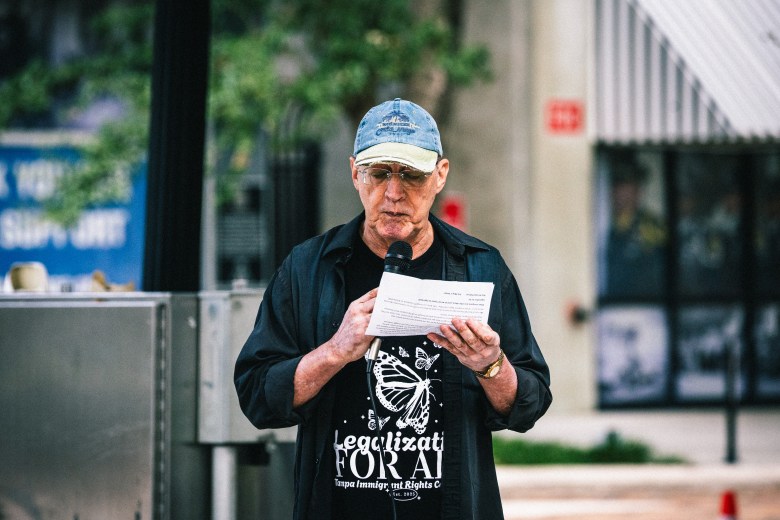
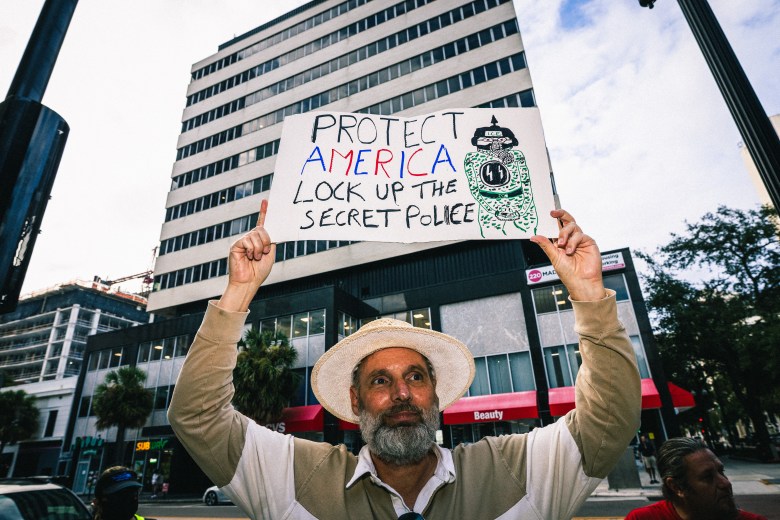
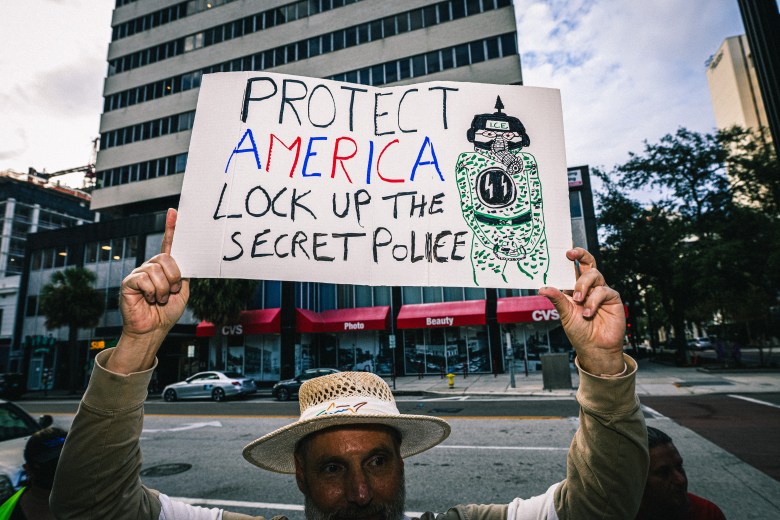
 Protestors outside Tampa Police headquarters in Tampa, Florida on Nov. 2, 2025. Credit: Dave Decker / Creative Loafing Tampa Bay
The Tampa Police Department (TPD) is set to receive $430,000 it requested from the Florida Board of Immigration Enforcement to fund collaboration with U.S. Immigration and Customs Enforcement. While some money will go to training and bonuses, $293,000 will be spent on overtime for 18 police officers who are expected to participate in undefined “immigration enforcement activities.”
TPD, like many other Tampa Bay law enforcement agencies, signed a 287(g) agreement with ICE even though it didn’t have to, empowering police officers who receive training to act as immigration enforcement agents. Specifically, all local agencies in the area have signed on to the Task Force Model—a form of 287(g) agreement that allows for street-level enforcement—enabling local officers to question individuals about their immigration status. The Task Force Model was practically eliminated under the Obama administration after it resulted in what the American Immigration Council said was widespread racial profiling. It was reintroduced earlier this year under the Trump administration and is now the most common form of 287(g) agreement in the state of Florida as of publishing, per ICE documentation.
Concerns over eroding community trust have kept some local law enforcement wary of acting in this capacity despite signing agreements to do so.
Over the summer, Mayor Jane Castor previously warned that deputizing local police as immigration agents can lead to lack of trust among immigrant communities, making it harder for officers to do their jobs.
“Was that raid in the restaurant focused on making our country safer, or was it focused on sowing fear in that community? Those are the things that we as Americans need to pay attention to,” added Castor.
St. Petersburg and Gulfport’s police departments both said they would only work with ICE to the extent required by state and federal law, including by running individuals encountered during normal police work (such as through a traffic stop) through a database and holding them for one hour if ICE has flagged them for immigration enforcement actions, or up to 48 hours upon ICE’s request.
TPD appears to be quietly making plans to increase its collaboration with ICE beyond that of other local municipal police departments.
Documents show that TPD plans to begin allocating overtime funding for officers to work with ICE.
A spokesperson for Mayor Castor declined to comment on whether or not Castor has been made aware, or has a reaction to, this new round of ICE-related funding for TPD.
Florida’s Board of Immigration Enforcement recently began a Local Law Enforcement Immigration Grant Program (IGP) to grant municipal law enforcement agencies funding to support ICE operations.
TPD sent in a request for $430,000, of which $118,000 will fund training and $19,000 will fund bonuses for the officers who participate. The remaining $293,000 was requested under the “IGP-H: other costs related to immigration enforcement” category, an undefined category with no listed restrictions or reporting requirements beyond what is required to be eligible for IGP funding in the first place, and the requirement that overtime is used for the police officers who join the program. An example expense tracking sheet provided by the board didn’t include a category for tracking IGP-H expenses.
TPD’s IGP-H request asked for overtime funding for 18 officers “assigned to conduct operations and broader immigration enforcement efforts.” It does not mention the six officers already trained for the program. The request says that task force duties extend beyond normal working hours, making overtime funding “essential to ensure adequate coverage and continuity of operations is effective for immigration efforts.” TPD did not answer questions from CL about whether or not they will track what the overtime is used for.
State law enforcement agencies like Florida Highway Patrol have carried out operations resulting in hundreds of immigration arrests, including that of Rosa Patishtan-Gomez, a breastfeeding mother who was separated from her children and eventually deported. TPD’s overtime funding request does not attempt to predict what the department’s immigration enforcement operations might look like.
TPD issued the following statement to CL:
“The recently approved federal funding ensures our clearly defined responsibilities under the 287(g) agreement, which outlines how we support federal immigration processes, when necessary, are properly reimbursed.
Only a small group of specially trained officers, currently six, are authorized to carry out a specific and limited set of duties delegated by U.S. Immigration and Customs Enforcement. These duties are narrowly focused and immigration status inquiries shall only be conducted during lawful enforcement actions.”
TPD’s statement says that the way they will collaborate with ICE is “clearly defined” in their MOA (memorandum of agreement) with ICE that outlines immigration enforcement powers given to police officers trained under the 287(g) program. Per the MOA, TPD officers have “The power and authority to interrogate any alien or person believed to be an alien as to his right to be or remain in the United States.” However, TPD’s statement also says that immigration status will only be questioned during “lawful enforcement actions.” They did not respond to further requests from CL to clarify what constitutes such an action.
TPD also did not respond to inquiries from CL about whether or not there are other areas where internal TPD policy deviates from the MOA. The IGP-H category allows for 260 hours of overtime, to be divided as-needed between all 287(g)-trained officers per month for nine months. It does not specify what this overtime will be used for, and TPD did not respond to requests from CL for further clarification. They only said that the six officers currently trained under the program “have not been tasked to do any immigration functions at this time.”
In Florida, 287(g) arrests include an increasing number of people with no other criminal history
In August, Police Executive Research Forum interviewed Pinellas County Sheriff Bob Gualtieri, who is also a member of the Florida Immigration Enforcement Council that advises the Board of Immigration Enforcement. In the interview, Gualtieri said that he believes local law enforcement is keeping ICE from getting more involved in Florida: “While it’s happened a little bit, in Florida we generally don’t have immigration enforcement doing these massive roundups in apartment complexes and out on the street, where they make collateral arrests. The reason is because we are keeping them very, very busy from the jails.”
Gualtieri said that ICE often arrests people who have not committed any crimes beyond entering the country illegally, who he frames as longtime, churchgoing residents who “have assimilated into their communities.” He said that limiting enforcement to jails and police encounters means there are fewer “collateral” arrests than in raids.
However, data collected by the Deportation Data Project and analyzed by CL shows a dramatic recent increase in the percentage of people arrested through the 287(g) program who have no criminal history.
ICE’s Miami field office has jurisdiction over Florida, Puerto Rico, and the U.S. Virgin Islands. Of people arrested through 287(g) programs within that jurisdiction, only three (about 3%) had no criminal history in January of this year. That number jumped to 60 in July (as of July 29, which is when the data stops), which is more than 10 times the percentage of noncriminal arrests as was seen in January. July arrests not listed as 287(g) show roughly 23% as noncriminal, less than the 30% made through 287(g). The data does not show which local agency initiated the arrest, and it is not clear whether transfers from county detention facilities to ICE are counted as 287(g) in the data.
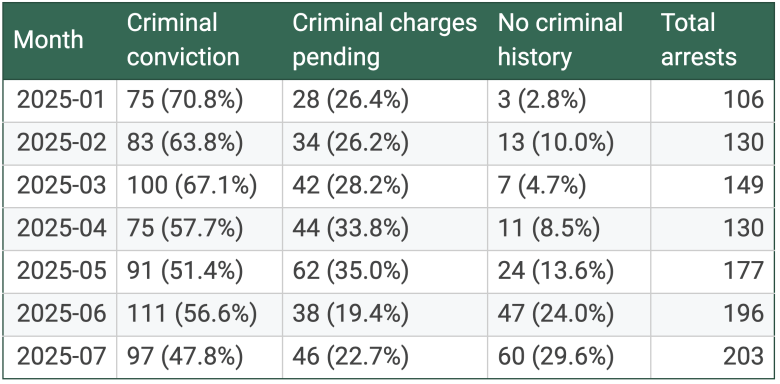 Data from Deportation Data Project via FOIA requests, compiled July 29, 2025 Credit: Valerie Smith / Creative Loafing Tampa Bay
 Credit: Dave Decker / Creative Loafing Tampa Bay
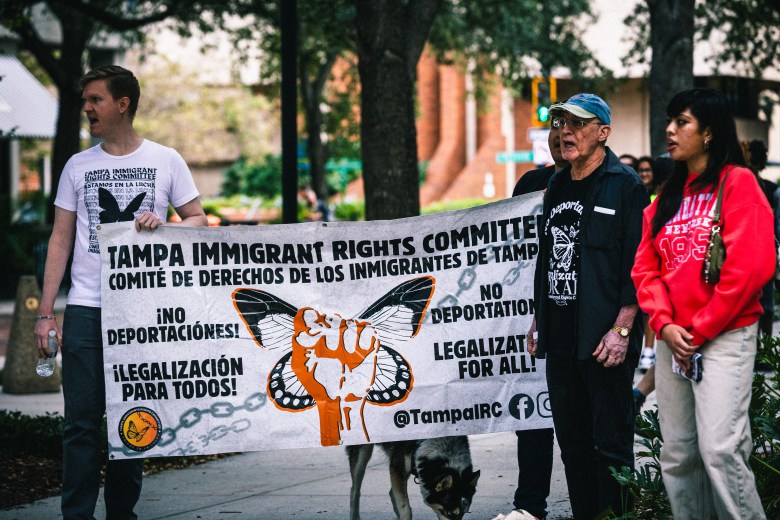 Credit: Dave Decker / Creative Loafing Tampa Bay
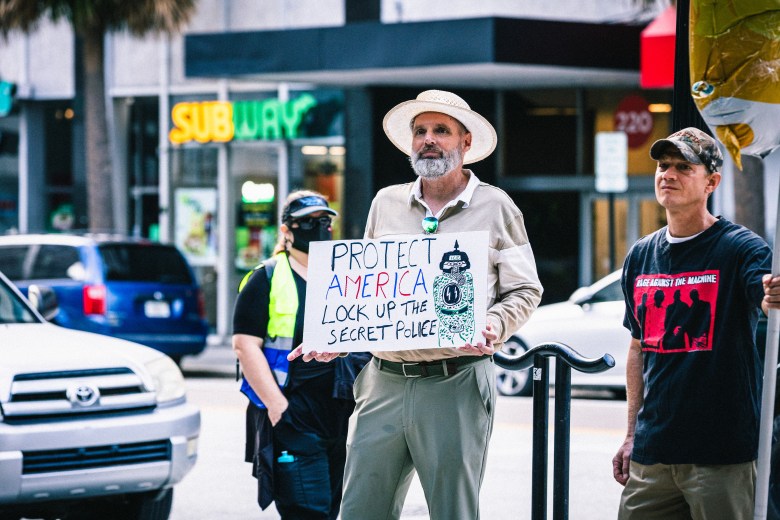 Credit: Dave Decker / Creative Loafing Tampa Bay
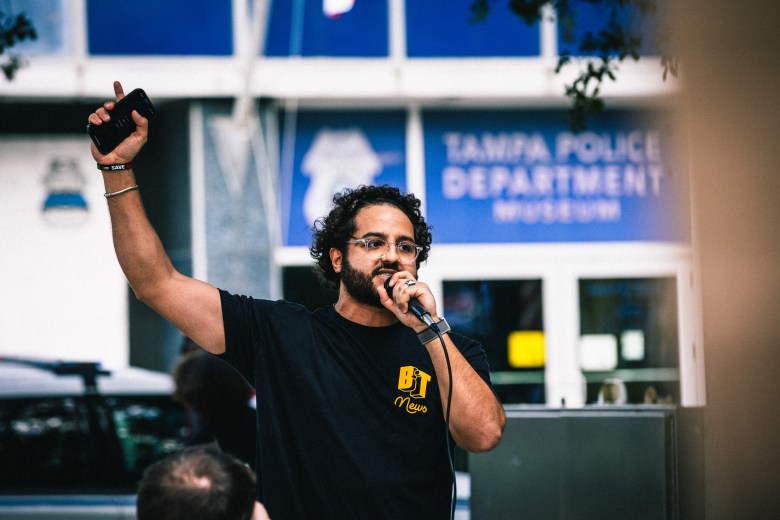 Credit: Dave Decker / Creative Loafing Tampa Bay
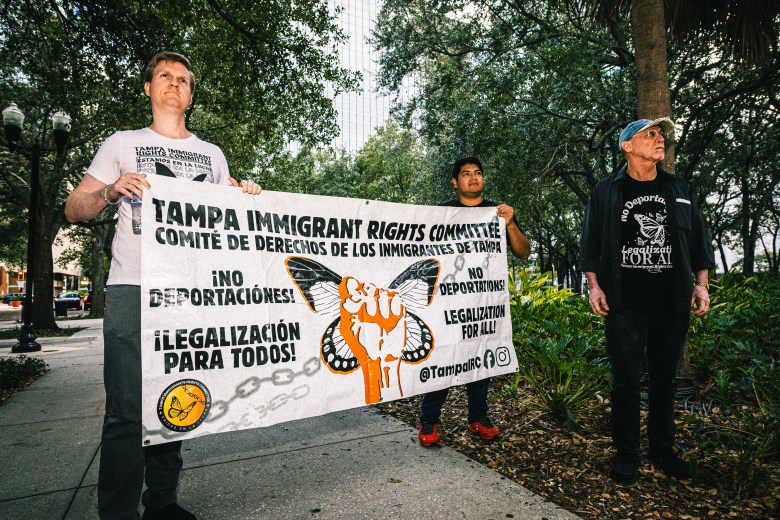 Credit: Dave Decker / Creative Loafing Tampa Bay
 Credit: Dave Decker / Creative Loafing Tampa Bay
 Credit: Dave Decker / Creative Loafing Tampa Bay
 Credit: Dave Decker / Creative Loafing Tampa Bay
 Credit: Dave Decker / Creative Loafing Tampa Bay
Subscribe to Creative Loafing newsletters.
Follow us: Google News | NewsBreak | Reddit | Instagram | Facebook | BlueSky
This article appears in Nov. 13 – 19, 2025.
Related