
There’s something especially depressing about looking at the college football landscape in the Sunshine State this season and realizing that USF — yes, that USF — is carrying the torch for our once-proud pigskin peninsula.
Those words don’t even look right on the page. Yet here we are, staring at a world where the Bulls have the state’s strongest College Football Playoff hopes while the three traditional giants of Florida football stumble around like they’ve misplaced the map to relevance.
It’s the kind of revelation that hits you hard — like stepping outside earlier this week on one of those surprising early-winter Florida mornings when a biting breeze catches you off guard. Except this breeze doesn’t invigorate. It doesn’t make me reach for my favorite sweatshirt or remind me that Thanksgiving and Christmas are near. No, this breeze feels like a sigh — a long, collective exhale from a state that used to own college football but now can’t remember what dominance even feels like.
Just look around.
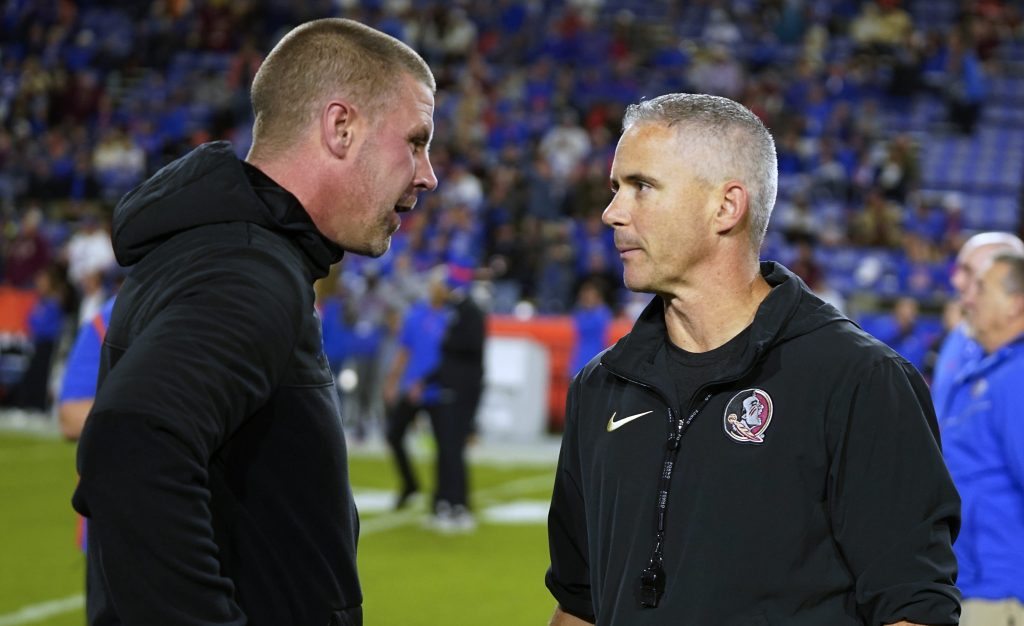
The Florida Gators have already fired Billy Napier, dispatching yet another would-be savior into the swamp of ex-Gator coaches who arrived full of hope and left full of buyout money. Over in Tallahassee, Mike Norvell may be next, poised to perhaps complete the first season in history in which both Florida and Florida State fire their head coaches.
UCF hasn’t brought much joy either. The first year of Scott Frost’s return always seemed destined to be more sentimental than successful, and sure enough, the Knights entered Saturday’s game with No. 8 Texas Tech with a 1-5 conference record and little chance of making a bowl game.
And Miami? Oh, Miami. The Hurricanes have teased us — gave us a whiff of swagger, a dash of promise, a taste of “maybe the U is finally back.” Then they promptly lost two ACC games to double-digit underdogs (Louisville and SMU) and plummeted to a 6 percent chance of winning a conference they haven’t won since joining it 20 years ago.
I know, I know, No. 15 Miami is ranked higher than No. 24 USF, but the Bulls will almost certainly get into the playoff as the Group of 5 representative if they win out. The ‘Canes, even if they win out, still need a lot of help to get in with an at-large bid.
So that’s your Florida football landscape heading into the weekend.
USF thriving. Florida flailing. FSU wobbling. Miami teasing. UCF rebuilding from rubble.
If you’re a lifelong Florida college football fan like I am, that’s not a season. That’s Florida Man, but with cleats and shoulder pads.
Where have you gone, Bobby Bowden, Steve Spurrier and Howard Schnellenberger?
Hell, where have you gone Urban Meyer, Jimbo Fisher and Dennis Erickson?
Those men helped make this state the center of the college football universe. Today, the programs they built look like abandoned beachfront hotels — once iconic, now gutted and graffiti-marred with a broken neon sign dangling from a wire out front.
How did this happen?
It’s tempting to blame the usual modern villains: NIL, the transfer portal, the pay-for-play world that’s transformed recruiting into an auction. But the truth is more uncomfortable:
Our programs didn’t fall apart suddenly.
We faded.
We eroded.
We decayed.
This decline began long before NIL existed. It began with arrogance.
Manny Diaz warned us. And he was right.
When Diaz became the head coach at Miami in 2019, he told me something that stuck with me, something that feels prophetic now. He said the Big Three — Florida, Florida State, Miami — believed the success of the 1980s and 1990s would last forever. They believed the recruits would always come. They believed that palm trees and sunshine were enough to build dynasties.
And because of that belief, they fell disastrously behind in the facilities arms race that now defines college football.
Look at the evidence:
It always amazed me that UCF — UCF! — was the first program in the entire state to build an indoor practice facility, a full decade before Florida, Florida State or Miami bothered to start catching up. And this was way before the Knights were cashing Big 12 TV checks.
That’s not a fun fact. That’s a flashing warning light.
And Diaz — now the head coach at Duke — knew it.
“Florida, Florida State and Miami all had such success without upgrading facilities,” he told me back then, “that we became very arrogant to a point where the world passed us by. Kids now take more unofficial visits, they’re exposed to more programs, and staying current is everything. You can’t say you want to be a first-class program when your facilities don’t match those ambitions.”
Diaz’s prophecy was one of the major reasons Jimbo Fisher bailed on Florida State for Texas A&M. Fans painted him as the villain. But he saw the lack of investment. He saw the writing etched onto the brick walls of Doak Campbell Stadium. And he made his exit.
Florida, Florida State and Miami have been playing catch-up for years. And it’s been made much more difficult because the landscape has changed.
Back in the heyday of Florida football, the state didn’t have UCF, USF, FAU and FIU siphoning off the under-the-radar recruits who used to fill out the rosters of the Big Three. The state wasn’t oversaturated. The talent pool was deep — and the top programs drank from it freely.
And the TV landscape was different, too. Miami’s independent status in the late ’80s let the Hurricanes schedule marquee matchups whenever they wanted. They lived on national TV before everyone did. They could dangle bright, prime-time lights in front of recruits like bait.
Former Miami coach Jimmy Johnson told me several years ago: “We had a half-a-dozen games every year against marquee-type teams —– Florida, Florida State, Oklahoma, Notre Dame, Michigan. And back then you only played 11 games, which meant half of our games were on prime-time national TV every year. And that’s when it meant something to be on TV. Hell, these days, everybody’s on TV every week.”
And in today’s pay-for-play world, simply being located in Florida doesn’t guarantee you’ll secure the state’s top talent anymore. Just look at Texas Tech — a program that has likely spent more on its roster than Florida, Florida State and Miami and now is reaping the rewards in the rankings.
So what does this season tell college football fans in the state?
Are you feeling like I am?
Honestly, for the first time in my life, I’ve found myself drifting away and losing interest in Florida college football. Not out of anger, but out of apathy. Out of a realization that the sport I grew up with — the sport that shaped my Saturdays — isn’t the same anymore.
In the end, it wasn’t a storm that took down Florida football. It was the slow, steady tide.
Sadly, all we can do now is hope the tide turns soon.
Until then …
Let’s Go, Bulls!
Email me at mbianchi@orlandosentinel.com. Hit me up on social media @BianchiWrites and listen to my new radio show “Game On” every weekday from 3 to 6 p.m. on FM 96.9, AM 740 and 969TheGame.com/listen