
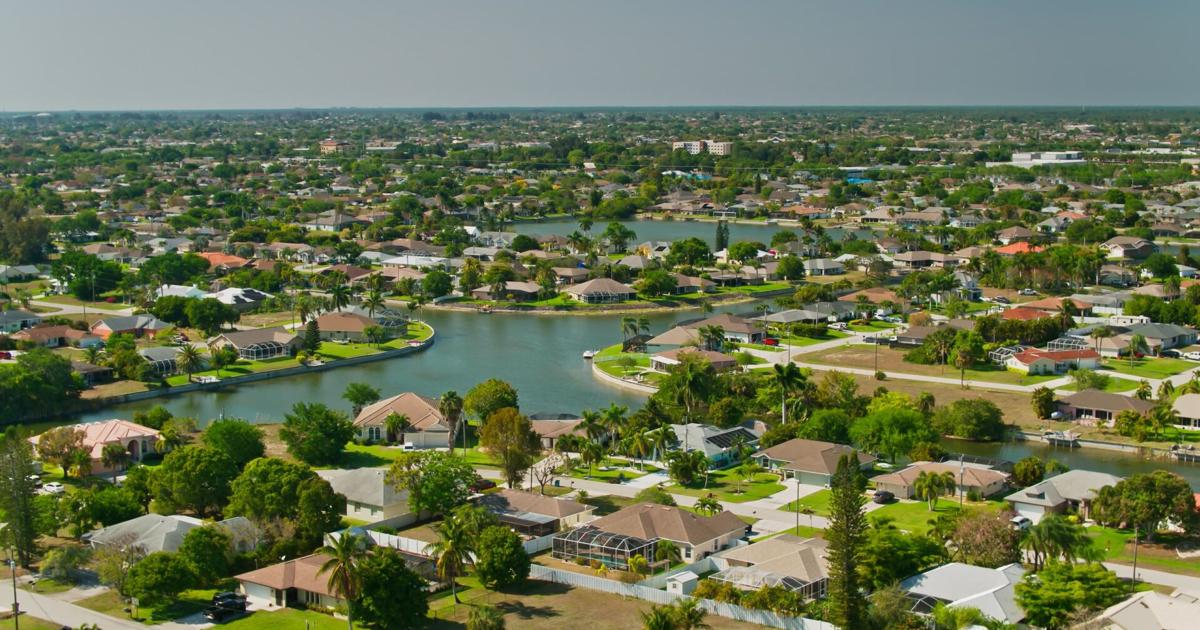
Cape Coral continues to rank among the nation’s preferred destinations for international home shoppers even as foreign demand for U.S. real estate shows signs of cooling, according to Realtor.com’s latest International Demand report.
The Cape Coral-Fort Myers metro placed 13th nationally, with 1.4% of all international U.S. home-search traffic, and remained heavily favored by Canadian homebuyers, who accounted for 61.4% of the area’s foreign search activity. International shoppers in the region also tended to view higher-priced listings, with a median price of $410,483, about 2.8% more than the median viewed by domestic shoppers.
The strong global interest comes at a moment when national foreign demand is slipping. International shoppers made up 1.5% of U.S. online home-search traffic in the third quarter of 2025, down modestly from 1.6% one year earlier. The level remains above the 1.2% pre-pandemic share recorded in 2019, suggesting that even with slowing activity, global engagement in U.S. housing markets remains comparatively elevated.
Economists point to a mix of geopolitical and financial pressures shaping the shift. “Global economic uncertainty, policy shifts, and the resulting exchange rate fluctuations are creating mixed conditions for international buyers,” said Danielle Hale, chief economist at Realtor.com. “These factors have led to some moderation in foreign demand for U.S. homes compared to last year. Still, interest remains above pre-pandemic levels, reflecting ongoing engagement from global home shoppers in key U.S. markets.”

An aerial view of Cape Coral shows the waterfront neighborhoods that continue to draw international home shoppers, who drove 61.4% of the city’s foreign search activity in Realtor.com’s latest demand report.
Getty Images
Canada remains the top source of international traffic to the U.S. but its share has declined sharply — from 36.6% in the third quarter of 2024 to 32.1% this year. The drop coincided with U.S. tariffs on Canadian goods and significant exchange-rate volatility, adding financial friction for cross-border buyers. Still, Canadians remained dominant in several markets, including Phoenix (61%), North Port (58.8%) and Detroit (51.4%).
The report also found that international shoppers continue to favor pricier homes. Across the 20 most popular U.S. metros, the median home viewed by international buyers was 29.8% more expensive than those viewed by domestic shoppers, though that gap has narrowed from the 34.2% average between 2022 and 2024. Markets like Los Angeles, New York, San Francisco and Boston posted the largest disparities, underscoring their position as global luxury hubs.
Miami remained the leading destination for international shoppers, drawing 8.4% of foreign online views, followed by New York (5.6%) and Los Angeles (4.8%).
Looking ahead, economists say U.S. immigration policy will play a major role in shaping future demand. “Proposed ‘gold’ and ‘platinum visa’ programs may draw more high-net-worth buyers to luxury markets, while restrictions on H-1B visas could weigh on demand in innovation-driven metros such as Austin and San Jose,” said Jiayi Xu, senior economist at Realtor.com.
Top 20 Markets Loved by International Home Shoppers (2025 Q3)
Rank
Market
Traffic Share
Median Viewed (International)
Median Viewed (Domestic)
Price Difference (%) 2025 Q3
Price Difference (%) 2022–24
1
Miami–Fort Lauderdale–West Palm Beach, FL
8.4%
$546,633
$566,167
-3.5%
-3.1%
2
New York–Newark–Jersey City, NY-NJ
5.6%
$1,029,333
$690,000
49.2%
49.3%
3
Los Angeles–Long Beach–Anaheim, CA
4.8%
$3,276,317
$1,197,667
173.6%
200.4%
4
Orlando–Kissimmee–Sanford, FL
2.7%
$454,967
$454,633
0.1%
2.1%
5
Dallas–Fort Worth–Arlington, TX
2.7%
$543,667
$484,933
12.1%
14.7%
6
Houston–Pasadena–The Woodlands, TX
2.3%
$405,000
$362,667
11.7%
15.1%
7
Tampa–St. Petersburg–Clearwater, FL
2.3%
$414,467
$417,497
-0.7%
3.3%
8
Chicago–Naperville–Elgin, IL-IN
1.9%
$431,300
$392,967
9.8%
11.3%
9
Phoenix–Mesa–Chandler, AZ
1.9%
$588,000
$540,330
8.8%
5.4%
10
Atlanta–Sandy Springs–Roswell, GA
1.5%
$481,666
$448,300
7.4%
14.4%
11
Detroit–Warren–Dearborn, MI
1.5%
$342,717
$351,600
-2.5%
4.3%
12
Riverside–San Bernardino–Ontario, CA
1.4%
$647,967
$596,933
8.5%
15.3%
13
Cape Coral–Fort Myers, FL
1.4%
$410,483
$399,300
2.8%
5.6%
14
North Port–Bradenton–Sarasota, FL
1.3%
$461,667
$486,633
-5.1%
-1.7%
15
Boston–Cambridge–Newton, MA-NH
1.2%
$891,000
$719,933
23.8%
26.1%
16
Washington–Arlington–Alexandria, DC-VA-MD-WV
1.2%
$712,100
$631,967
12.7%
18.5%
17
Austin–Round Rock–San Marcos, TX
1.1%
$648,317
$546,667
18.6%
20.7%
18
Philadelphia–Camden–Wilmington, PA-NJ-DE-MD
1.1%
$437,402
$443,300
-1.3%
6.6%
19
San Diego–Chula Vista–Carlsbad, CA
1.1%
$1,228,983
$1,044,663
17.6%
19.2%
20
San Francisco–Oakland–Fremont, CA
1.1%
$1,354,879
$1,015,933
33.4%
33.1%