
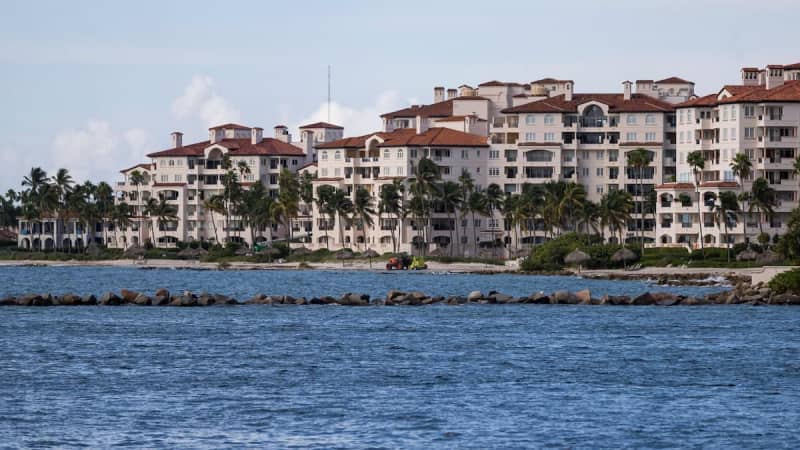
 A view of Fisher Island from South Pointe Park in Miami Beach is shown in this 2022 file photo. ©MATIAS J. OCNER
Just off the MacArthur Causeway, cars queue on an easily missed outlet between PortMiami and South Beach.
A Ferrari pulls in behind a Bentley, which idles behind a humble BMW. A uniformed attendant walks the line, checking IDs. Smiling, he waves the drivers ahead.
There’s no bridge to where they’re going. Instead, the cars pull onto what looks like a miniaturized aircraft carrier and embark across the port’s Main Channel, a minutes-long voyage that will disgorge them onto the United States’ most expensive, and exclusive, ZIP code: 33109, Fisher Island.
The median sale price for a home on the barrier island is $9.5 million, according to a recent report from real estate data provider PropertyShark, making it far and away the costliest ZIP code in the country.
Atherton, California, just south of San Francisco, came in second at $8.3 million, followed by Sagaponack, New York, at $5.9 million, PropertyShark reported. This is the first time a Florida ZIP code has topped the country’s most expensive list, according to the company.
The ultra-rich own more second homes in this Florida city than any other on earth
Jill Eber’s not surprised. One of Miami’s top movers of ultra-luxury real estate, and a Fisher Island resident herself, Eber says the island’s beauty — its verdant streets include a bird sanctuary — its isolation and its proximity to downtown Miami make it a prime location.
Its residents are more than willing to pay the $500,000 upfront membership fee plus nearly $40,000 a year to use the island’s amenities, which Eber notes include both pickleball and tennis courts, two deepwater marinas, a nine-hole golf course, a spa and a private primary school.
“You pretty much have your own oasis in the city of Miami,” she said.
Who’s buying new condos in Miami? How Latin American politics drives demand.
Security might be one of the island’s biggest selling points, especially to such wealthy buyers, said Ana Bozovic, a broker and founder of Analytics Miami. It’s practically a fortress, Bozovic mused — a functionally moated community that’s only accessible by boat, and where passage is invitation only.
“It’s a very unique spot,” she said. “You have this very hard-to-replicate level of security and privacy, but you’re not in some far-flung destination.”
Whatever’s drawing them, the wealthy are certainly more willing than ever to pay top dollar to live on Fisher Island. The median sale price of a home there jumped 65% from last year’s $5.75 million, according to PropertyShark.
This year, per the company’s report, Fisher Island’s cheapest home sold for $1.4 million, while its most expensive fetched nearly $24 million.
The island’s price surge follows a post-COVID pattern of demand for uber luxury within close proximity to Miami’s urban core, Bozovic said. Across the bay in Gables Estates, a similarly exclusive and urban-proximate community, Bloomberg found the typical house went for north of $21 million, making it the U.S.’s priciest neighborhood last year.
Drawn in part by Florida’s lax lockdown restrictions during the pandemic, many wealthy out-of-state transplants have stayed for the Sunshine State’s tax advantages and weather — and because more people in their social circles had moved here.
So many, in fact, that Miami’s population of millionaires nearly doubled in the decade to 2024. But their arrival has coincided with a spike in housing prices, which has squeezed many locals out of the market.
Per the Miami Association of Realtors, the average purchase price of single-family homes in Miami-Dade nearly doubled between mid-2020 and mid-2021 alone, jumping from $583,000 to over $1 million in just one year, while the number of cash transactions spiked by 174%. At the highest price points, like many of the sales on Fisher Island, deals are mostly done in cash, Bozovic noted.
She doesn’t see the trend of ballooning prices in Miami’s most exclusive communities stopping anytime soon.
“For that reality to change, the wealth migration would have to stop or reverse … back to high-tax states,” she said. “Why would that happen?”
This story was produced with financial support from supporters including The Green Family Foundation Trust and Ken O’Keefe, in partnership with Journalism Funding Partners. The Miami Herald maintains full editorial control of this work.