
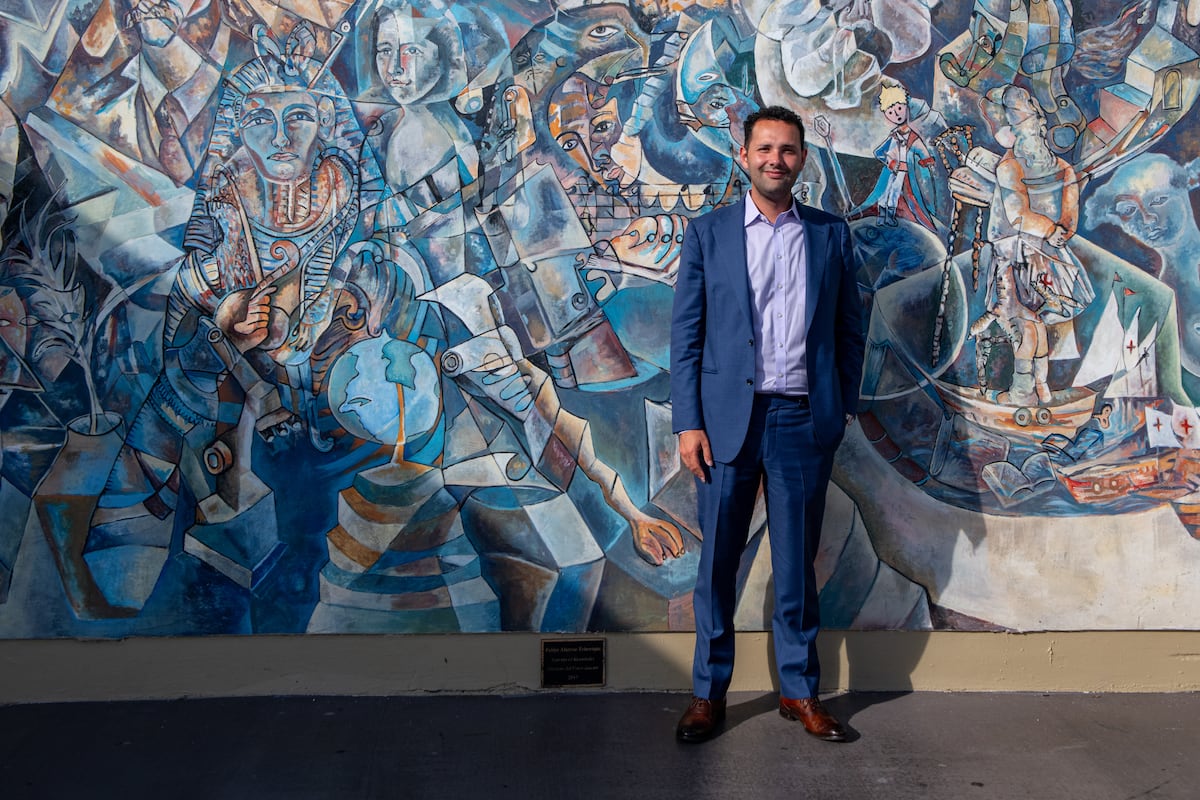
When the custodian of the John F. Kennedy Library in the city of Hialeah sees a tall young man with curly hair and an extremely earnest look on his face — almost as though trying not to look like a child — she looks at him and asks: “Bryan Calvo?” The young man extends his hand. There are still posters of him in the mythical Palacio de los Jugos on 49th Street, and in the gardens of low-ceilinged houses and doorways, announcing a “real change for Hialeah,” the second most populous city in Miami-Dade County and the most Hispanic municipality in the United States. On January 12, Calvo will become the mayor of this city. He will take office at just 27 years of age.
A staunch Trump supporter, Calvo is not only the youngest elected mayor in the State of Florida, he is also the youngest of any U.S. city of more than 100,000 inhabitants. On the other side of the political spectrum, there is also fresh blood in the shape of New York’s 34-year-old mayor-elect Zohran Mamdani and Detroit mayor-elect Mary Sheffield, 38. All three have managed to tap into the voters’ desire for something different from the traditional, aging establishment. “There is a rejection of how things are being done at the national level,” says Calvo. “There is no guarantee that a younger generation will do better, but there is great hope. Residents want something new.”
Calvo believes his age works in his favor: “What is most useful to me is youth,” he says. Others, however, see it as his Achilles’ heel. Raul L. Martinez, who was mayor of Hialeah for 24 years, believes Calvo’s biggest challenge “is age and inexperience, because Hialeah is different from other cities in the United States… The mayor here is an administrator, he makes the day-to-day decisions about the police, the firefighters, the library… and if you haven’t had that experience, it’s difficult,” he says.
Starting out in politics at the age of 23, Calvo was the youngest councilman in the history of Hialeah. He is in a rush because he is impatient to learn and drink everything in. As well as English and Spanish, he speaks Italian, plays the violin, practices spearfishing, was a salsa instructor, and got his pilot’s license 10 years ago. “Flying reminds me that concentration, preparation and responsibility are important; qualities that I have taken from the cockpit to public service and that I will bring to Hialeah as mayor,” he says.
On October 16, in the middle of his campaign, Calvo lost his father, a Cuban businessman who arrived in South Florida in 1980 in the historic Mariel exodus. It was a blow for the family and for him; he would have liked his father to see him enter the City Council. It was also hard on his mother, the Ecuadorian seamstress Edith Pardo, who had been at his side for 44 years.
The son of migrants, Calvo will now become a notable political figure in his hometown. He often says he is a “product” of Hialeah. Having adopted very little of his mother’s Ecuadorian culture, he defines himself as Cuban in a city where more than 75% of the residents are of Cuban origin. Calvo has no recollection of ever being taken to Cuba, however, though “maybe when I was little.” Significantly, he says that now, he would not set foot in Havana. “My politics are that of the historically exiled, of having no ties to the island until it is free.”
Calvo studied in Hialeah public schools, played soccer at Milander Park, enjoys Cuban food at the Molina restaurant, and his first language is Spanish, with the odd ‘so’ or ‘whatever’ thrown in from time to time. He studied at Harvard on a full scholarship and, in 2019, he graduated with a bachelor’s degree in Government. He then returned to Florida and completed a professional law degree at Florida International University. But a year earlier he had an experience that would change his life. In the summer of 2018, during Trump 1.0, he was selected for a prestigious White House internship program that, he says, taught him the importance of establishing a small, efficient government that is not regulating its citizens. “It’s one of the most frequent complaints,” he says, adding that he plans an entirely different approach.
Calvo is convinced that his stay in Washington helped him get elected mayor of Hialeah. During his campaign, flyers appeared with Calvo’s image next to the president, which read: “Supported and recognized by President Trump.” It was a message that resonated in a state where Trump won 56% of the vote in 2024. Although the Miami-Dade County Republican Party said it did not “endorse” any one candidate for mayor of Hialeah, Calvo insists that Trump has “supported and recognized” him.
An alternative to the establishment
In his light blue suit, Calvo walks among the shelves of the John F. Kennedy Library and grabs a book from the law section. He claims that his favorite volume, All Politics Is Local by former U.S. House Speaker Tip O’Neill, shaped the politician he has become. “In the entire political realm, there is nothing more powerful than looking a voter in the eye and saying: trust me,” he says.
Hence, Calvo focused on a door-to-door campaign. He was seen talking to elegant Hialeah ladies and visiting Félix Rodríguez, who was in charge of the operation to assassinate Che Guevara. With his Hialeah First platform, he promised to be an alternative to former Mayor Esteban Bovo, who resigned last April. He has promised to lower taxes and water fees, improve public transportation and work to eliminate property taxes for people over 65.
He has also pledged to investigate companies such as Cubamax, which offers travel and remittance services to Cuba – something that the Cuban-American Secretary of State Marco Rubio, also born in Miami, promised to address from the beginning of his tenure in the Trump administration. “We have many complaints that they are laundering money not only from the Cuban dictatorship, but from those of Venezuela and Nicaragua,” says Calvo. “I have said these things must be investigated; there are personnel within the police with the training to do so and my commitment is to create a team to tackle these problems.”
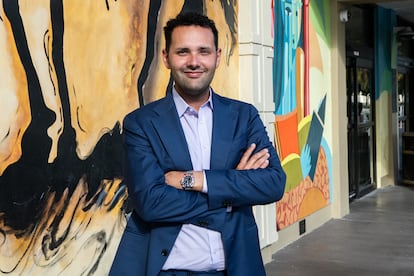 Bryan Calvo, mayor-elect of Hialeah.Klaus Galiano
According to the political advisor to Calvo’s campaign, Julio E. Ligorria, Calvo’s was different because “it was based on honesty, proximity… While others focus on propaganda, personal attacks and the traditional mechanisms of the establishment, this campaign tuned in to what people were asking for: transparency.” Ligorria also insists that Calvo won “without depending on political machines, without sponsorships, without contracts, without favors.” The biggest challenge, he says, was to “break with a system that had been trying to control everything for years, from the narrative to the city’s employees. Calvo does not come from the same political circle that has governed the city for decades.”
The 27-year-old won more than 52.9% of the vote, ahead of former commissioner Jesús Tundidor (21%) and interim mayor Jacqueline García-Roves (19%). “This victory belongs to all the families who have worked hard and refused to give up on this city,” Calvo said in his victory speech, adding that “Hialeah will not be a refuge for the interests of Castroism or for those who have benefited from the Cuban repressive system.”
In a city that’s more than 94% Latino and a large Cuban community affected by Trump’s immigration agenda, Calvo says he will not hinder ICE raids because immigration policy is a federal issue.
“I’m not a congressman, I’m not president, and those are the branches of government that decide our country’s immigration policy,” he says. “We have signed agreements with federal agencies. If they ask us to assist in an operation, we are under a legal and contractual obligation to do so. That does not mean that as mayor I would do something beyond what is already established by the federal government. I wouldn’t order the police to conduct a raid, but if there’s a raid that is initiated by the federal government, they can call the Hialeah police to assist.”
Things have already begun to get complicated for Calvo. After his election victory, the interim mayor stopped City Council employees from having any type of contact with him, thereby preventing him from accessing the necessary information for the transition. Others do not believe that Calvo can fulfill his promises.
But the young man is nothing if not confident. “If you asked someone a year ago if a 27-year-old could win the mayorship of Miami-Dade’s second most powerful city, they would probably tell you it was impossible,” he says. “No resident expects me to be able to do 100% of what was talked about, but if I could just do a part of it, it would make a radical change to this city that hasn’t seen any [change] in recent years.”
Sign up for our weekly newsletter to get more English-language news coverage from EL PAÍS USA Edition