
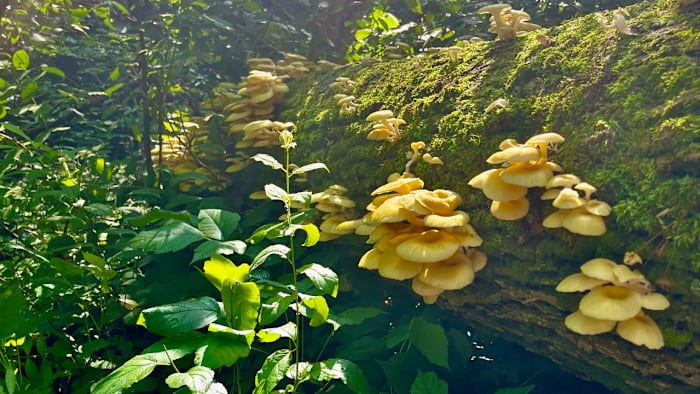
GAINESVILLE, Fla. – A popular mushroom could jeopardize the environment in the Sunshine State, according to experts with the University of Florida.
UF/IFAS associate professor Dr. Michelle Jusino spoke with News 6 about the fungus, which researchers have identified as the gold oyster mushroom.
The mushroom itself, Jusino explained, has been widely cultivated as a delicacy, being sold in grocery stores, gourmet markets, and even grow-it-yourself kits.
However, it’s recently been spotted in Florida markets. And that could have dire consequences for Florida’s environment it they somehow manage to get released into the wild.
Golden oyster mushrooms (Michelle Alice Jusino)
A recent field study Jusino worked on reveals that buying, growing and transporting these mushrooms can accidentally release invasive species into the environment.
Additional data shows that the golden oyster mushroom has spread to over 20 states so far after it first “escaped” into North American forests around 2010.
“It is slowly marching south, which is really terrifying,” Jusino said. “In 2016, the mushroom was found growing in the wild in just five states, all in the Midwest and Northeast, but today, I think fewer than 10 states east of the Mississippi River remain without records of golden oyster in the wild.”
Map by iNaturalist showing the reported sightings of golden oyster mushrooms in North America (iNatural/Google Maps)
So far, Jusino said, these mushrooms haven’t been found in any forests in Florida, but that could change if people aren’t careful.
“Because it is being grown in Florida, it has the potential to perhaps escape cultivation here, assuming that growing conditions are right and things like that,” she added.
One of the main problems is that golden oyster mushrooms can dominate native fungal communities, jeopardizing an otherwise healthy biodiversity.
More golden oyster mushrooms in the wild (Michelle Alice Jusino)
Now, why does this matter?
As Jusino explains, these mushrooms break down lignin — a polymer found in wood that helps keep it rigid — much more completely than native fungi, which can accelerate wood decay.
In short: it could be making trees rot faster.
Even aside from concerns over disruptions to the carbon cycle, you may not want these mushrooms attaching to a tree near your home.
“Because it’s a wood-decay fungus and it eats wood, trees that would stay dead and standing on the landscape for years, perhaps… when golden oyster mushrooms get in these trees, they fall relatively quickly,” Jusino said. “They snap. They fall. Big limbs break off.”
Golden oyster mushrooms seen in a forest (Michelle Alice Jusino)
Dead trees also act as important habitats for creatures like birds and squirrels with their many cavities and snags.
As such, the possibility of them coming down even quicker would have a more widespread impact on the environment.
“It cascades down from just the fungal biodiversity all the way through,” Jusino stated.
Dead trees can create homes for some animals in the environment, meaning these mushrooms could pose even bigger threats. (Manfred Antranias Zimmer from Pixabay)
But that’s not where it ends, either. According to Dr. Jusino, there’s also the possibility that these mushrooms could be killing living trees, as well.
“My lab is looking at that and researching,” she said. “There’s only one peer-reviewed paper out on golden oyster mushrooms, and it just came out in July. We’re really at the tip of the iceberg here with what we know and what we don’t know.”
Regardless, Jusino urges Florida residents and cultivators to use caution when growing non-native mushrooms to prevent them from escaping into the wild.
“If we start paying a little bit more attention to how we dispose of some of the spent grain and things like that, it may help us avoid the next one that might escape and take off into the woods,” she concluded.
Breaking News Alerts
Get breaking news alerts delivered to your inbox.
Copyright 2025 by WKMG ClickOrlando – All rights reserved.