
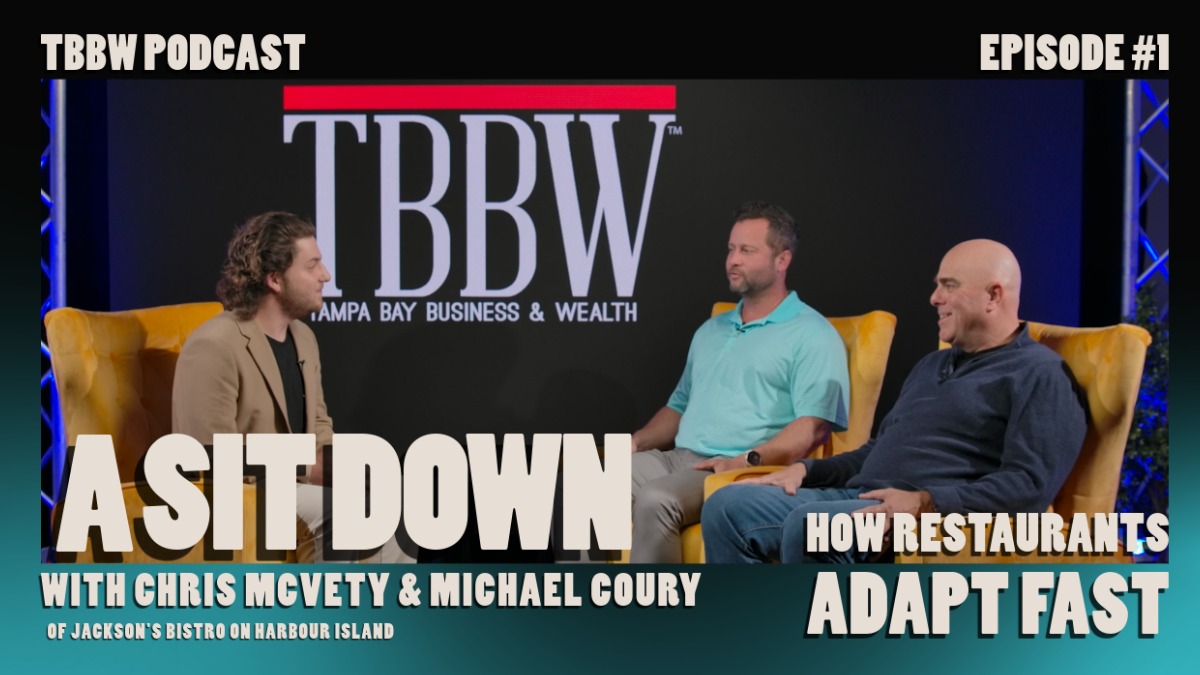
Tampa Bay Business and Wealth has launched its first podcast series, A Sit Down, and the debut episode goes straight to the waterfront.
The first conversation features Jackson’s Bistro Managing Partner Chris McVety and Chief Culinary Officer Michael Coury, who speak candidly about how Tampa’s diners have evolved, why the restaurant is revising its menu and what it means to run a legacy brand in a health-conscious city.
In the episode, they walk through everything from seed oils and tallow fryers to private barrel bourbon, vegan sushi and the actual cost of doing things the right way. For business leaders, it serves as a case study in how to rebuild a brand without losing its essence.
You can listen to the full episode on YouTube and on Spotify.
What happened
In the debut of A Sit Down, McVety starts by pushing back on the “restaurateur” label.
“I just think I’m a business guy that cares about providing a great service,” he says. He has been a partner at Jackson’s for more than ten years. Coury joined the team in August after more than three decades as a chef in fast food, fine dining and Michelin star kitchens.
The conversation begins with an examination of how much downtown Tampa has changed since Jackson’s opened in 1998. McVety describes a “metamorphosis” in the customer base and the expectations on a place that once relied on convention traffic.
“The customer we had six years ago is not the same customer we have now,” he says. “We had to change and evolve.”
SIGN UP FOR TBBW’S FREE NEWSLETTER
That evolution is first evident on the menu. Coury and his team are phasing out seed oils and testing alternatives, such as rice bran oil and sea moss oil. The fryers run on tallow. The goal is to balance texture and flavor with a cleaner ingredient list.
“At the end of the day, it is the responsible thing to do,” Coury says. “We don’t do it for to obtain anything. We do it out of responsibility and we go home at night, put our heads on the pillow and feel good about what we did.”
Alcohol is another pivot point. The old Jackson’s crowd drank more and asked fewer questions. Today’s guest is more likely to order low ABV cocktails, care about where spirits come from and pay a premium for quality.
McVety and Coury lean into that shift with a growing private label program. The team flies to Texas to pick single barrels from Garrison Brothers, partners with Angel’s Envy and is headed to Tennessee to select a Jack Daniel’s rye.
“That’s a source of pride because we think we’re picking out the very best single barrels,” McVety says. “Our bartenders are proud of it, too.”
The biggest changes are off the menu. After being caught up years ago in a Tampa Bay Times investigation about mislabeled fish, McVety says he went through the menu and vendor list line by line.
“I was embarrassed,” he says. “Tampa has been my home, and you don’t do business like that in this town.”
That moment pushed him to vet suppliers, move away from farm-raised fish, seek out cattle producers with lower carcass weights and rethink packaging. Jackson’s has shifted to compostable to keep trash out of the bay and river.
Inside the kitchen, Coury treats vendors like hires. He interviews them, tests products and cuts ties if they are not honest.
“If you do something like that, that’s not the first time you’ve done it,” he says. “That’s just the first time you got caught.”
On the plate, that work shows up in details like local seafood from long line fishermen, cleaner beef and a vegan sushi program that includes watermelon “tuna” and eggplant that eats like eel.
“I don’t want it to say, oh, well, it’s vegan,” Coury says. “No, it’s really good.”
Why this matters
For Tampa Bay executives, the first episode of A Sit Down is more than a restaurant story. It is a window into how a long-standing brand responds when its market, its customer and its own values move.
McVety draws a clear line between food supply and long-term health. He recalls a conversation with a neighbor who worked as a statistician at a major insurance company and observed life expectancy trends reversing.
“Without hesitation, he blurts out, food supply,” McVety says. “The laws here in America of what we can sell and grow versus Europe are wildly different.”
That concern reaches beyond Jackson’s. McVety is also a part-owner of two preschools in Tampa and advocates for home-cooked meals for children over processed options. He questions dairy subsidies and jokes about the missing “broccoli lobby,” but the point is serious. Someone still has to choose what kids eat.
READ: Look inside Saddlebrook’s $92M upgrade in Wesley Chapel
All of this comes at a cost.
“You’d be a ton more profitable if we didn’t care,” Coury says. Between better food, better packaging and more careful sourcing, McVety estimates the added cost in “multiple six figures.”
They see it as an investment in reputation, repeat business and a healthier community. For leaders across sectors, the lesson is simple. Doing the right thing will hurt margins in the short term, but it can differentiate a brand in a crowded, educated market.
What you should know
For TBBW readers, the episode offers a few clear takeaways:
Your customer is changing faster than your brand
Jackson’s moved from convention traffic to a base of young professionals, locals and educated diners. They drink less, know more and care about ingredients. Every business should ask if its product still fits who walks in the door today, not who came ten years ago.
Vendors are partners, not order takers
Coury treats suppliers like staff. He interviews them, demands transparency and cuts ties when they mislead. That approach applies in any industry where quality and trust matter.
Values have to show up in the P and L
Better cattle, local fish, compostable packaging and private barrels all cost more. McVety and Coury are clear that they spend real money to match their values on health and sustainability. If a company markets responsibility but will not budget for it, customers will eventually see the gap.
You do not have to shout to build trust
McVety says they have been “quietly rebuilding the business” and did not want to invite old guests back until the patio, service and menu were ready. Rather than sell the story before it is real, they focused on operations first.
What’s next
Jackson’s is not done. The team is planning a spritz bar featuring small Italian bites that will complement the main restaurant, offering guests an additional way to experience the brand. The menu will keep evolving as Coury researches new products, tests better snacks for the front cafe and refines vegan and pescatarian options.
READ: Whataburger kicks off Tampa expansion with $10K donation to Feeding Tampa Bay
For TBBW, A sit-down will continue to feature local owners and executives who are reshaping their sectors in Tampa Bay. Future episodes will stay rooted in the same kind of candid, practical conversations about risk, change and values that drive the debut with McVety and Coury.
Takeaway
The first episode of A Sit Down shows what happens when a well-known restaurant decides it is not enough to stay busy. McVety and Coury are rebuilding Jackson’s from the inside out, from oils and vendors to preschool lunch menus and compostable packaging. They accept higher costs in exchange for a cleaner plate and a stronger brand.
“You can’t teach caring,” McVety says near the end of the episode. In a city that is growing as fast as Tampa, that mindset may be the real competitive edge.
Stay Connected