
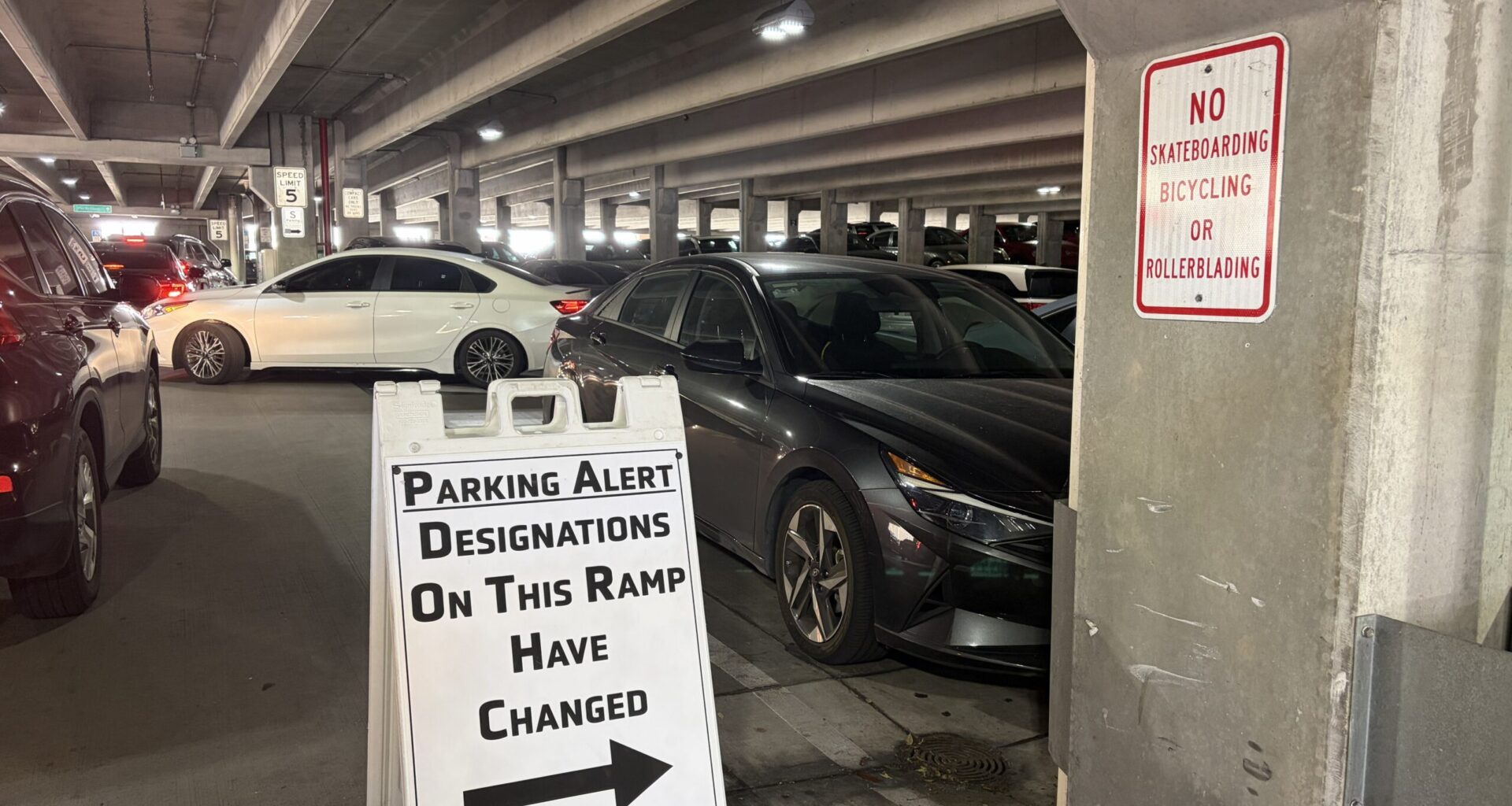
 USF’s Parking and Transportation Services converted 68 gold zone spots to non-resident student parking. ORACLE PHOTO/DELANEY TORRES
USF has converted almost 70 gold zone parking spots to non-resident student spots in the Collins Boulevard Parking Facility.
Scott Fox, the director of USF’s Parking and Transportation Services, said the expansion was finalized on Nov. 3 and took over the parking spaces on one ramp from the first to the second floor.
Gold zone permits are applicable to faculty and staff, while non-resident student permits are available to students who live off campus, according to PATS.
Fox said PATS did “occupancy counts” in the Collins Boulevard Parking Facility to measure the amount of space being used and by whom.
This count showed that more non-resident student permits were sold than gold zone permits this fall as compared to previous years, Fox said.
With gold zone permit sales down, spaces in the garage reserved for those holders were being “underutilized,” he said.
“Giving [commuters] an option in the Collins garage in that part of campus was something that we thought would be really desirable and well-received, and the purpose is to put our limited parking resources to the best use possible,” Fox said.
Still, while the Collins Boulevard Parking Facility now has more parking for students, Fox said the department is not currently exploring the conversion of space in other lots.
“This was one thing that stood out to us,” Fox said. “We said, ‘Well, we’d like to do this right away because we’d like to make this available for students right away.’”
Some USF students said adding more student parking in the Collins Boulevard Parking Facility was a necessary step toward solving parking issues on campus — but more space is still needed.
Related: USF employees split on end of remote, hybrid work schedules
Fox said the fall audits for permits and occupancy are a way for the university to measure and balance resources to better serve the student body.
“Our commitment is to do things like this, where it’s reasonable and practical, and to serve our students best,” Fox said.
Fox said the increase in non-resident student permit sales has been “subtle” over the last few years, but is not a new peak for the university — it’s a return to pre-COVID levels.
“We’re back to a higher rate of occupancy that we experienced back in 2019, so we are not looking at a parking crunch or parking shortage as a result of this bounce back,” Fox said.
Fox said the cost of the gold zone permit is $1,076 per year and has decreased in sales this year because people are opting for cheaper permits.
On the other hand, non-resident student permits, which cost $183 annually, have seen a “growth” because of the influx of new students, he said.
From 2021 to 2024, USF’s PATS collected around $25 million from parking permit sales.
Related: USF launches beta parking tracker that could expand campuswide
Joey Cannella, a first-year master’s student in film, said he feels there is not enough parking on campus to handle the number of students.
Cannella said students mostly park in the Yuengling Center lot — which often has “huge chunks” of parking blocked for events — or in the Richard A. Beard Parking Facility, which he said is not close to classes.
“People use smaller lots and there’s a lot of traffic there,” Cannella said. “USF isn’t keeping up with infrastructure while they expand, and we are in desperate need of a parking garage to mediate the parking situation before the stadium gets built.”
USF’s on-campus stadium is expected to be completed by 2027. Still, the university does not have plans to provide additional parking on campus, according to its FAQ.
Cannella said adding more student parking spots to the Collins Boulevard Parking Facility is a “good step” toward parking mediation.
Still, he said the university needs to make more efforts to solve parking issues on campus.
“Whether it’s a part of the Yuengling lot, near the Patel [Center of Global Sustainability] or next to Pizzo [K-8 School], a [parking] lot is needed,” Cannella said.
Casey Gonzalez, a senior civil engineering major, said this fall is her first semester commuting to campus.
“I was super scared [for parking] because I’ve been hearing it’s only gotten worse,” Gonzalez said. “I don’t think there’s enough space.”
Gonzalez said she lives in Clair-Mel, which is about a 25-minute drive from USF, but had previously lived in Horizon Hall and in the Holly Apartments.
As a resident, she used the Bull Runner, USF’s bus system, or walked around campus to get to her classes.
Gonzalez said there has been a “large push” from USF for faculty and staff to return to full-time in-person work, as ordered by President Rhea Law at the beginning of the fall semester, but said the university does not have the infrastructure to accommodate it.
“With more student housing and the stadium, it will just keep getting worse,” Gonzalez said. “Many [apartments] still house alumni, and so if the students stay and more keep coming, it puts strain on the surrounding area.”
Related: USF parking has cashed in over $25M in permit sales since 2021
While some students perceive parking as a persistent problem, others believe that parking on campus is easier than people think.
Trystan Cavitt, a senior cell and molecular biology major, said he feels parking is not an issue for USF students.
“There is always somewhere within a 10-minute walk to park on campus,” Cavitt said. “Beard parking garage literally always has spots, and usually parking can be found by the Library or the [Campus Recreation Center] if you are not pulling up at peak hours.”
He commutes to campus from Wesley Chapel, which is around a half-hour drive from USF, three to four days a week, and usually leaves his house about 45 minutes before his lectures.
When he arrives on campus, he goes “straight” to the Richard A. Beard Parking Facility because he knows there will be space and doesn’t mind walking to his classrooms.
Cavitt said his classes are mainly around the Chemistry Building, the Muma College of Business Building and the Campus Recreation Center, which are all within a 15-minute walk of each other.
“I feel like people complain way too much about [parking] because they want to park right in front of their lecture halls instead of walking five minutes,” Cavitt said.