

 Feeding Tampa Bay and The Bautista Project supported military families with a food distribution at MacDill Air Force Base. (Feeding Tampa Bay Facebook)
With the record-breaking 43-day government shutdown over, furloughed federal workers have returned to their jobs and SNAP (Supplemental Nutrition Assistance Program) benefit payments have resumed.
Recovering from the financial impacts will take time, particularly when higher prices already have one in four households living paycheck to paycheck . For that reason, regional nonprofit Feeding Tampa Bay will continue to stage emergency response food distribution events and push out more food to its 400 community partners, President and CEO Thomas Mantz says.
There are currently emergency food distributions scheduled in Hillsborough, Pinellas, Pasco, Polk, Manatee, Hardee, and Highlands counties. For an updated schedule, go to Feeding Tampa Bay.
Before the shutdown temporarily halted SNAP payments, Feeding Tampa was serving about 1.9 million meals a week and one million people on a regular basis, Mantz says. He says a “conservative” estimate is that the stop in SNAP benefits brought in another 500,000 people across the nonprofit’s 10-county service area.
“It’s up significantly because people on SNAP generally don’t have to come into food banks,” Mantz says. “One of the reasons SNAP is important is because it keeps people out of food banks. So suddenly those half million folks needed resources. Ours and every other organization that provides food has been trying to fill that gap.”
He says rising grocery prices and the federal worker furlough had already driven up need before the shutdown put SNAP benefits in limbo.
“We took care of federal workers in our area and still are,” Mantz says. “We’ll continue to provide support until their households get stabilized financially and don’t need us anymore. People have to catch up.”
He says the community has stepped up to help neighbors facing tough times.
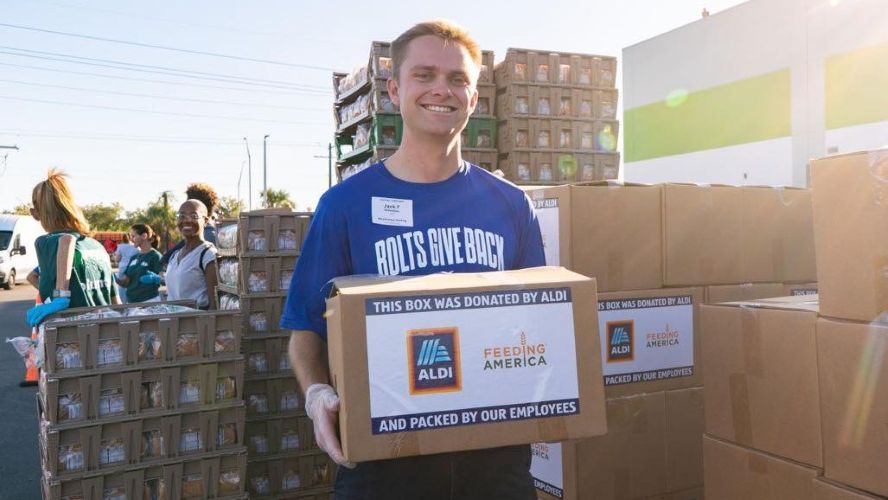 A volunteer from the Tampa Bay Lightning at an emergency food distribution. (Feeding Tampa Bay Facebook)
“Whenever there’s a crisis we have more volunteers, which we need,” Mantz says. “We’ve had some financial support, which underwrites some of our costs. We don’t really fund crises. We just have to respond when it happens. We rely on the community to step in at those moments.”
In early November, regional grantmaking nonprofit Community Foundation Tampa Bay activated its critical needs list as a tool for the community to provide financial support to nonprofits in Pinellas, Hillsborough, Citrus, Hernando, and Pasco counties serving those affected by the shutdown. Feeding Tampa Bay submitted a $250,000 request to the critical needs list and has, as of Nov. 17th, received $100,000 in funding.
The agreement to end the federal shutdown funds SNAP through September 2026. As benefit payments, millions more people across the country, including 181,217 in Florida according to the Department of Children and Families, must meet work or work-related activity requirements to remain eligible for SNAP for more than three months over a 36-month period.
Starting Nov. 1st, President Trump’s signature tax and domestic policy bill, the One Big Beautiful Bill Act of 2025, eliminated exemptions for veterans, the homeless, and individuals 24 and under who have aged out of foster care. The exemption for caregivers of children under 18 has been narrowed to caregivers of children under 14. The federal age limit to be exempt from the work or work-related activities requirement has been raised from 54 to 64 (Florida’s threshold was 59).
Looking ahead, another looming change at the federal level may mean a significant increase in the cost of living for millions. The Affordable Care Act tax credits that helped millions afford health care insurance are set to expire at year’s end if Congress doesn’t approve an extension. Asked about that possibility, Mantz says any substantial increase in health care costs may well drive more people to rely on emergency food assistance.
“If health care becomes markedly more expensive, we expect it will put more pressure on us,” he says. “Folks will seek our services as they try to figure out how to pay their health care costs.”