
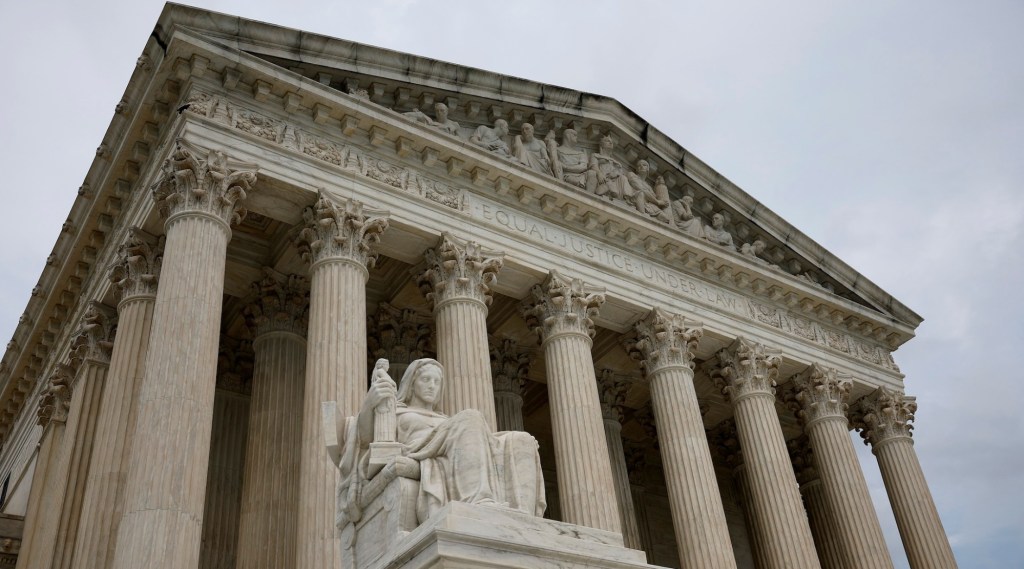
After a nine-year legal battle, the U.S. Supreme Court on Monday declined to take up an appeal by a Tampa Christian school that contended its speech rights were violated when it was prevented from offering a prayer over a stadium loudspeaker before a 2015 state championship football game in Orlando.
The Supreme Court, as is common in such proceedings, did not explain its reasons. But the decision indicated the court is not ready to dive back into the difficult intersection between faith and school sporting events, subject of a major ruling in 2022 that expanded religious expression in public places.
Monday’s decision, which let stand a ruling last year by a panel of the 11th U.S. Circuit Court of Appeals, handed a victory to the Florida High School Athletic Association, which had blocked the communal pre-game prayer. Its practical effect is more limited, however, because Florida subsequently passed legislation requiring the athletic association to allow opening remarks at games, including those with religious content.
Attorneys for Cambridge Christian School in June had filed a petition asking the Supreme Court to take up the case, which stemmed from a championship game between Cambridge Christian and Jacksonville’s University Christian School at Orlando’s Camping World Stadium.
The athletic association, a nonprofit governing body for high school sports, denied the use of the loudspeaker for a prayer. In response, the teams prayed on the field before and after the game. Those prayers could not be heard by people in the stands.
Cambridge Christian filed the lawsuit in 2016, and the dispute went to the Atlanta-based appeals court twice. In last year’s decision, a three-judge panel of the court concluded that announcements over the loudspeaker at the game were “government speech,” as they were scripted and controlled by the association. It said the association’s decision to block a prayer over the public-address system did not violate free-speech rights.
But the school’s petition filed at the Supreme Court described the appeals-court ruling as “egregiously wrong” and alleged potentially far-reaching effects if it was not overturned.
“If the Eleventh Circuit’s boundless version of government speech stands, state actors will be able to claim that virtually all private speech and religious exercise in a government setting lacks First Amendment protection,” the school’s attorneys wrote.
The association’s attorneys, however, argued in a brief last month that the appeals court correctly followed a 2022 U.S. Supreme Court decision involving the “framework for identifying government speech.” They also disputed the school’s contentions about far-reaching effects of the appeals court’s ruling.
The 2022 decision backed a high school football coach’s right to offer prayers on the field after games.
In addition, the association pointed to a 2023 state law that required allowing high schools to offer “brief opening remarks” — which could include prayers — before championship events.
The association said the “problem CCS (Cambridge Christian School) brought this case to address has thus been solved in the constitutionally preferred way — not through a uniform national policy handed down by a politically insulated court, but through a local policy crafted by a responsive legislature and an energetic executive.”
The appeals-court panel said the 2023 state law made moot parts of the lawsuit but that it needed to rule on the First Amendment issues because Cambridge Christian sought “nominal damages.” In addition, the school argued that despite the change in state law, the supreme court ought to step in to clarify limitations on the “government speech” defense, which otherwise could be used broadly.
U.S. District Judge Charlene Edwards Honeywell initially dismissed the case in 2017, but the appeals court in 2019 overturned the dismissal and sent the case back to Honeywell for further consideration. That led to Honeywell in 2022 ruling again in favor of the association, which prompted another appeal by Cambridge Christian.