
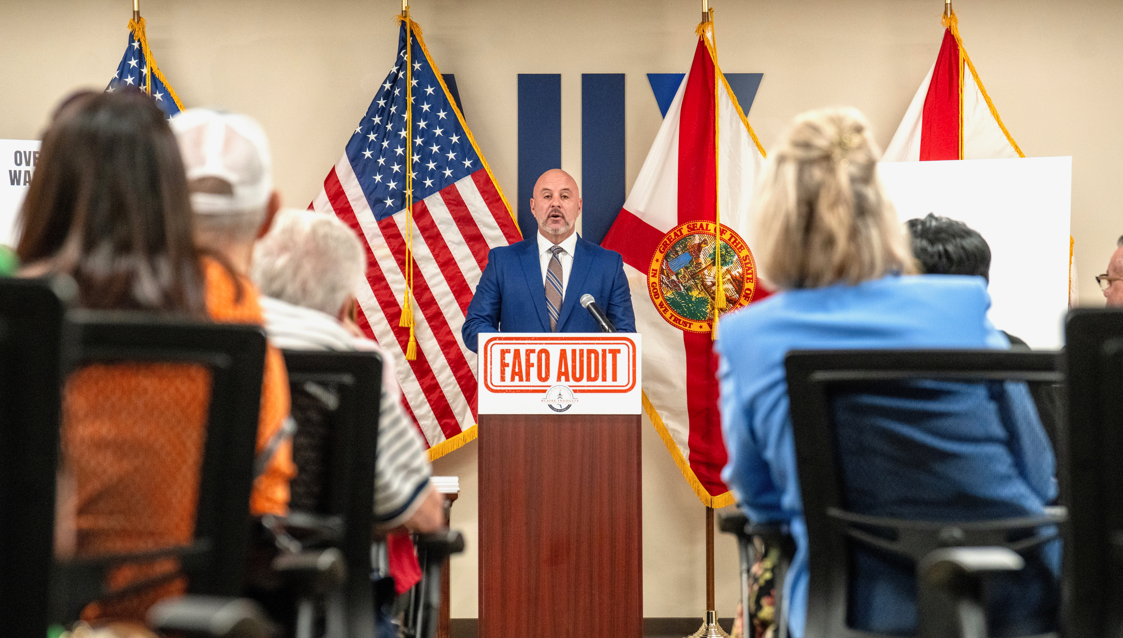
 Florida Chief Financial Officer Blaise Ingoglia at a press conference about “excessive spending” in Orlando. Credit: myfloridacfo.com
Gov. Ron DeSantis and CFO Blaise Ingoglia’s campaign to scale back or eliminate homesteaded property taxes drew a rebuke from a former Republican state lawmaker Wednesday night during a discussion with Ingoglia and tax policy experts.
“It’s not really a proposal, it’s a bumper sticker, right?” said Jeff Brandes, who served in the Florida Legislature representing parts of Pinellas County from 2010-2022.
“It’s a bumper sticker without any policy behind it. What we’ve seen so far is simply a statement without any explanation of how we’re going to pay for the government services beyond that, other than simply we’re going to cut them out.”
During the event at the University of South Florida in Tampa, Ingoglia called that “a false premise.”
“I think there is more than enough room to cut local budgets, probably by the amount of 15%, and not even worry about taking away any money for essential services,” he said.
The chief financial officer has made several high-profile visits to some of the state’s largest cities to allege that his team of auditors found local governments have engaged in hundreds of millions of dollars of what he has labeled “wasteful and excessive spending.”
DeSantis declared at the beginning of this year that he supports the idea of reducing, maybe outright eliminating, property taxes in Florida—which would make Florida the first state in the nation to do so. Since then, GOP lawmakers have offered proposals that would affect only homesteaded properties and does not touch funding for schools or law enforcement.
DeSantis’ dismissals
Last month, eight House Republicans filed legislation to achieve those goals, with seven of them offered as proposed constitutional amendments that would go before the voters in November 2026. DeSantis promptly dismissed the proposals, saying that placing more than one property tax measure on the ballot was simply an “attempt to kill anything on property taxes.”
The governor vetoed $1 million placed in the final state budget sent to him by lawmakers in June to study the consequences of eliminating property taxes. Brandes said that response shows DeSantis is not serious about what he’s calling for.
“Listen, if you went to the doctor and he said, ‘We’re planning to cut out this organ,’ we could do a study to figure out what would happen if we did that. But we’re not planning to do that, we’re just going to cut it out and see what happens. You would call that malpractice, right?” Brandes asked.
“But, at the end of the day, what do we have here in Florida? We have the governor who says, ‘We’re going to rip out the foundation of this house. We’re going to rip out this organ. But we’re not going to tell you what happens afterwards,’ and somehow that’s not malpractice? That is malpractice. This is policy malpractice, not medical malpractice, but that’s what we’re debating here.”
Brandes, who now heads a think tank called the Florida Policy Project, said his major objection is that there is “no explanation” about how the state could eliminate or substantially reduce homesteaded property taxes and continue to function effectively.
“Are we going to cut police and firefighters? No, they say we’re not going to do that,” he continued. “Are we going to double the sales tax? Maybe. Are we going to watch cities and counties bump up their millage on renters and small business owners? Likely, because most counties are not at the top of their millage.
“And so what we aren’t hearing is what comes next. You’re only hearing, ‘We’re only going to cut property taxes on homesteaded properties.’ They don’t want to tell you what comes next. And this is my problem. You deserve transparency. You deserve accountability. And what this plan does is, it removes transparency and it removes accountability.”
On that point, Ingoglia agreed.
“Sen. Brandes is right. There should be a plan,” he said, adding that the governor’s office as well as the House and Senate “were running numbers” to provide more information.
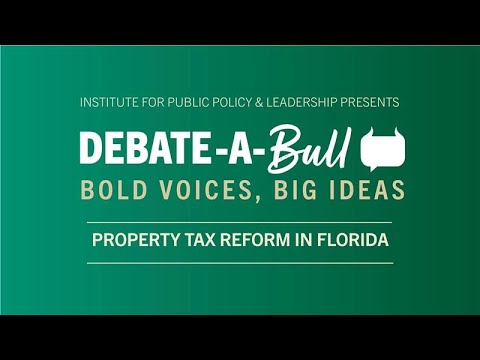
Brandi Gunder, vice president for research at Florida TaxWatch, and Dr. Esteban Santis, director of research with the Florida Policy Institute, also participated in the “Debate-a-Bull” forum hosted by the USF Institute for Public Policy & Leadership.
In 2024, the total amount of property taxes collected statewide in Florida was $55 billion, with counties taking in $19.6 billion and cities receiving $8.6 billion, according to a report from the Florida Chamber of Commerce. School districts, independent special districts and municipal service taxing units account for the remainder.
Disparity among neighbors on property taxes
Something all the speakers agreed about is that Florida homeowners generally get significantly larger property tax breaks than do new homebuyers. That’s due to the state’s Save Our Homes amendment, which caps the annual increase on the assessed values of primary residences to 3% (or the percentage change in the Consumer Price Index).
“If you’re a first-time homebuyer, if you’re in the market out there, you are going to be paying higher property taxes than your neighbor,” Santis said.
“The people who are angry about property taxes are not the people who have been living in their homes for 20 years,” Brandes added. “But if you bought during the pandemic and now you’re paying the full fare, those are the people who are up in arms.”
“Reducing the burden on your principal interests — your tax principal interests, taxes, and insurance payment that you’re paying out — is disproportionately hurting new homebuyers,” Ingoglia acknowledged.
Florida imposes a 6% sales tax. To fully offset elimination of all ad valorem taxes, that would have to increase to 14% to make up the difference, the Florida Chamber of Commerce white paper reported. If the state were to make up all homestead property taxes with sales taxes, it would only need to be increased to 8.85%. That doesn’t take into account that many counties have a 1% or 1.5% local sales tax which presumably would also have to be replaced.
Ingoglia questioned those numbers.
“They’re all deriving their numbers on the assumption that government needs all of the revenue that they’re taking in right now,” he said. “I’m telling you, they’re taking in way more money than they’re expected to.”
The CFO’s audits have included “reasonable” increases in inflation and population in determining how much a local government has been overspending, but Santis countered that government expenditures are different than for household goods, although they do overlap on items like energy and fuel costs.
“Typically, we don’t think of government going to the store to pick up eggs,” Santis said. “What they’re doing is, they’re paying for teachers. They’re paying for law enforcement. They’re paying for sanitation. They’re paying for emergency services and they’re paying the personnel costs, the fringe benefits to all of that.”
Ingoglia accurately noted that most popular opinion polls have indicated that the idea of eliminating property taxes on homesteaded properties is “overwhelmingly popular.”
Brandes wasn’t buying it.
“What question did we ask, right? If I just came out and said, ‘Hey listen. Who wants to cut their property taxes?’ Boy everybody would say, ‘Yeah, absolutely.’ But I don’t tell you the other half of the equation. ‘Oh, and we’re going to raise X. Oh, and we’re going to turn your cities and counties into dependents which have to go ask Tallahassee for money to hire police and firefighters. Or to fill potholes every year.’ Then maybe we get a different answer.”
Florida Phoenix is part of States Newsroom, a nonprofit news network supported by grants and a coalition of donors as a 501c(3) public charity. Florida Phoenix maintains editorial independence. Contact Editor Michael Moline for questions: info@floridaphoenix.com.
Subscribe to Creative Loafing newsletters.
Follow us: Google News | NewsBreak | Reddit | Instagram | Facebook | BlueSky
Recent Stories
The governor has previously said he wants one constitutional amendment on the ’26 ballot to reduce property taxes.
U.S. District Judge Mark Walker indicated that a decision about reinstating the fired employee could change if more information is provided.
The decision effectively was a victory for the Florida High School Athletic Association.
This article appears in Nov. 13 – 19, 2025.
Related