
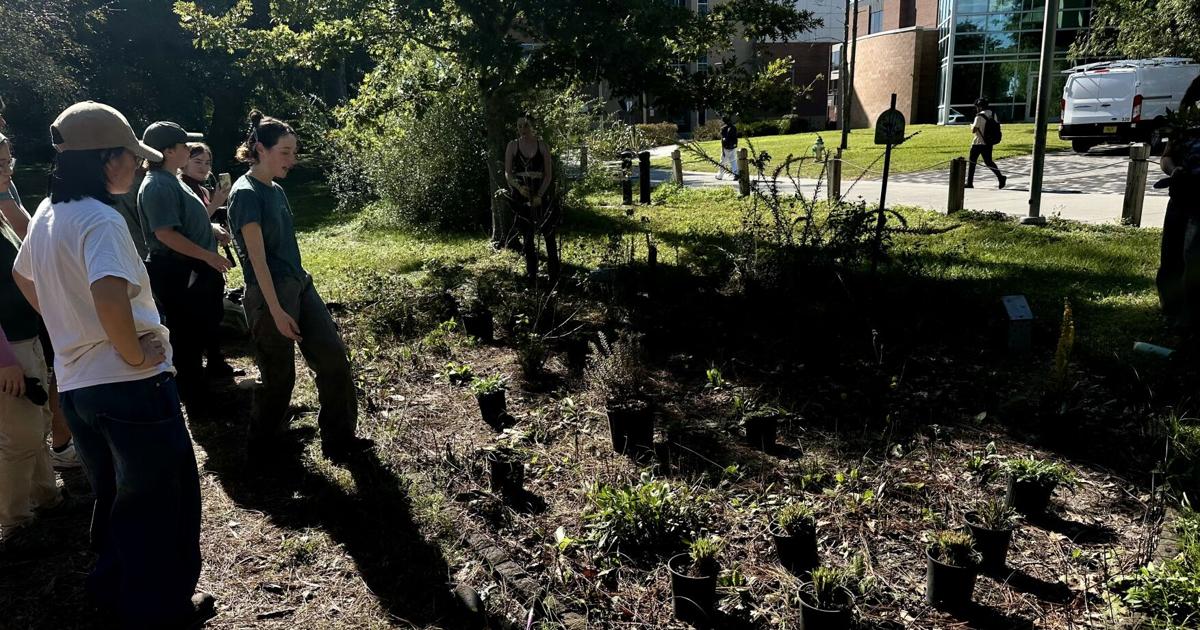

UCF students observe the UCF Arboretum’s Bird Garden in which they helped expand by planting native flowers during an environmental event on Friday.
Cristopher Ruiz
UCF students gathered Friday at the campus arboretum to plant native flowers and expand the Birds Garden as part of an event promoting environmental awareness by Knighthawk Audubon.
The Planting Day event at the Audubon Garden took place from 1 to 3 p.m. and allowed students to get directly involved with the UCF Arboretum’s public garden. Students learned about native species while contributing to the creation and maintenance of habitats for local birds on campus.
Si Zhang, vice president of Knighthawk Audubon and junior environmental science major, said that the event gave students a hands-on opportunity to learn about native plants and their importance to local wildlife.
“When students participate in maintaining these spaces, it not only provides habitats for birds to stop by but also gives seeds to survive the winter,” Zhang said. “So everyone needs to connect with nature.”
Zhang said that the initiative originated with a grant obtained by the club’s founder, and that the project seeks to establish ongoing volunteer work to maintain the Birds Garden.
Liam Devonport, freshman biomedical science major on the pre-med track, said he joined the Birds Garden expansion project because of his love for birds and his experience gardening at home, feeling it was a good fit for him.
“For the most part, I just really like birds, and it sounded like something I would enjoy, and I used to garden back when I was at home,” Devonport said. “So I thought it would be something I would be a pretty decent match.”
Devonport said that these types of events help students connect with the environment and their community.
“I think you can help bring people together and care more about the environment and, you know, not just beyond conservation, but just, you know, in our backyard, taking care of the birds that are living with us,” Devonport said.
Chloe Tomlinson, Knighthawk events coordinator and senior zoology major, talked about the importance of green spaces in the middle of the city.
“It’s important to protect the animals on campus,” Tomlinson said. “This is for not just birds, but also pollinators, providing a space like this and making sure they have food, that’s what these plants are for, we do them for the seeds. “So they have something to eat.”
Tomlinson also noted the challenges of coordinating volunteers across classes and activities, emphasizing the importance of communication and planning.
”It can be difficult to align everyone’s schedules, but clear communication helps us keep the project moving,” Tomlinson said.
Solimar Jimenez, junior sustainability major, said she learned that Cuban tree frogs are exotic and appreciated that the garden provides a space for wildlife, supports conservation efforts and allows students to grow plants for educational and sales purposes.
“It’s really good for the environment because it gives animals a place to come, it’s really nice that they have at least a little bit of the school for conservation and, you know, rehabilitation, and they grow plants here for sales and stuff,” Jimenez said.
Jimenez also highlighted the personal value of participating in these activities.
“We’ve planted plants now, and then they’ll bloom in a couple of months, and it’s wonderful,” Jimenez said. “It’s like, rewarding. It feels super relaxing to do as well, and I like meeting people here.”
The expansion of the Birds Garden demonstrates the student community’s commitment to biodiversity and conservation at UCF, offering students the opportunity to learn, connect with nature and actively contribute to maintaining sustainable green spaces on campus.
Zhang said the planting experience shows that even small actions, like adding native flowers, can support local ecosystems by providing habitat and food for birds, while encouraging students to spend more time outdoors and engage with their surroundings.
“It’s important for everyone to connect with nature, because hands-on projects like this help students understand how native plants support local wildlife and why caring for our environment truly matters,” Zhang said.