
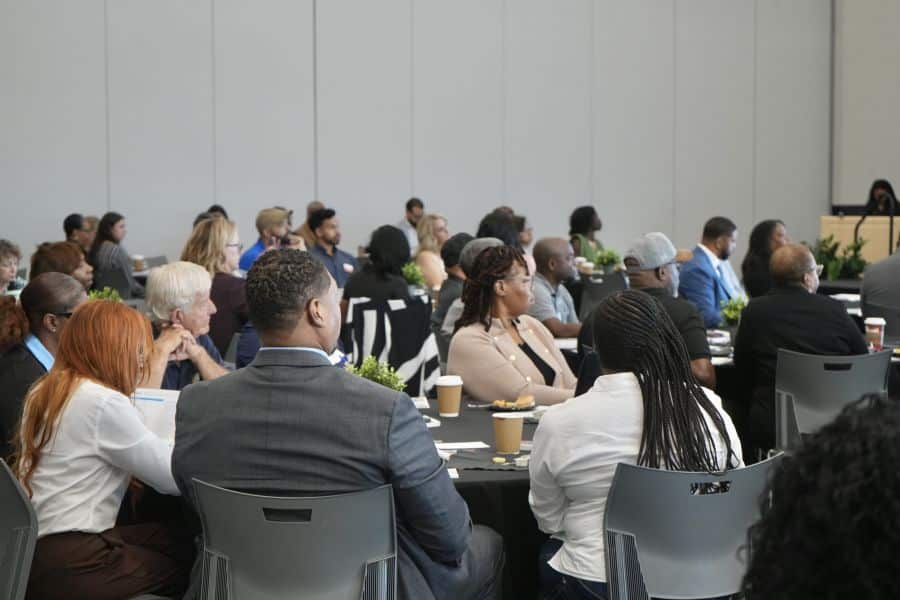
 Tampa Bay community leaders seek solutions to region’s affordability issue (Children’s Board of Hillsborough County).
Across the Tampa Bay region, working families struggle with the rising cost of living.
In November, community leaders from the nonprofit, government, and business sectors gathered at Feeding Tampa Bay’s Causeway Center in Tampa for From Surviving to Thriving, a workshop to collaborate on solutions to the region’s affordability issue.
Feeding Tampa Bay President and CEO Thomas Mantz described the plight many households face.
“Tonight, a lot of us who work here will be standing at food lines handing out resources for 1,000 families who will drive through just to get food to put on their table,” Mantz says. “This is the United States of America. This ought not be. It is our obligation and responsibility as members of the community to figure out how to make that not happen.’’
The Children’s Board of Hillsborough County sponsored the workshop in partnership with United Way Suncoast, CareerSource Tampa Bay, Vistra Communications, and The Junior League of Tampa.
In response to a similar gathering in 2023, the Children’s Board launched its ONEhillsborough Initiative to address the root causes of food insecurity by supporting nonprofit organizations that help people in poverty with resources, job training, tutoring for children struggling in school, stress management, and other needs to improve their quality of life.
Struggling households
Numbers show how widespread the affordability issue has become. United Way Suncoast Vice President of Community Impact Doug Griesenauer says the regional nonprofit’s latest ALICE (Asset Limited, Income Constrained, Employed) report reveals “the true cost of living’’ in the Tampa Bay region. It says a family of four living in Hillsborough County, two parents with two children in daycare, has to earn $98,000 a year to meet its essential needs.
“A family needs a hundred grand just to get by successfully in our communities,’’ Griesenauer says, his tone incredulous.
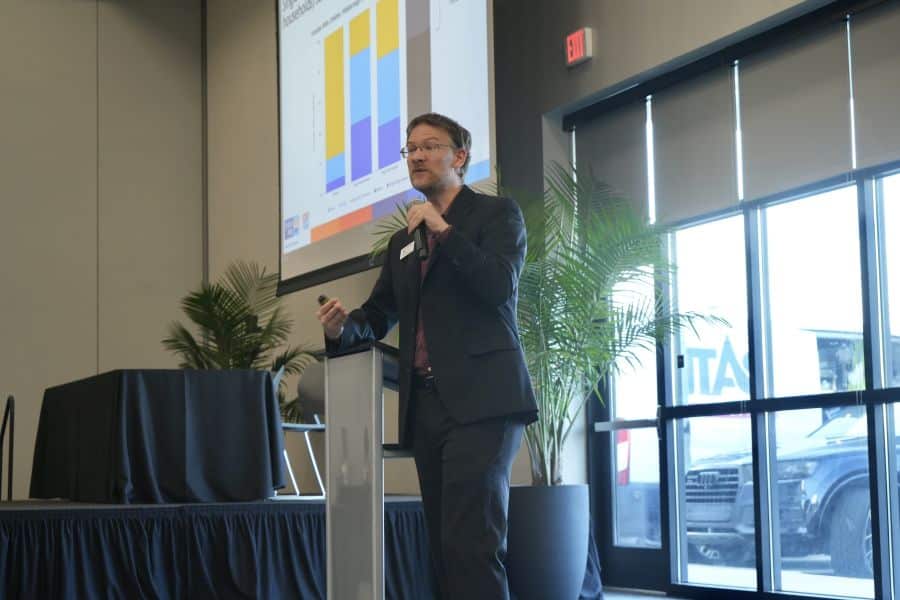 United Way Suncoast’s Doug Griesenauer (Children’s Board).
About 650,000 households in the five-county area United Way Suncoast serves – Hillsborough, Pinellas, Manatee, Sarasota, and DeSoto – are struggling to get by, he tells the audience. And 150,000 families receive SNAP benefits, formerly called Food Stamps, to supplement their groceries.
“That’s 150,000 more households that are struggling without food today,’’ Griesenauer says, speaking before the government shutdown ended.
Children’s Board Director of Strategic Initiatives Tewabech Genet Stewart explained the psychological effect that struggling financially has on families.
“The inability to consistently pay bills doesn’t just drain a family’s finances. It strains the entire household,’’ she says.
Many people work but can’t keep up with the cost of living.
“The result is a cycle of effort and stress that seeps into every corner of home life,’’ Stewart says.
It impacts the entire family, affecting the parents’ health, their relationships, and their ability to “be fully present for their children,’’ she says.
Stewart says it shows up differently in mothers and fathers, but weighs heavily on both.
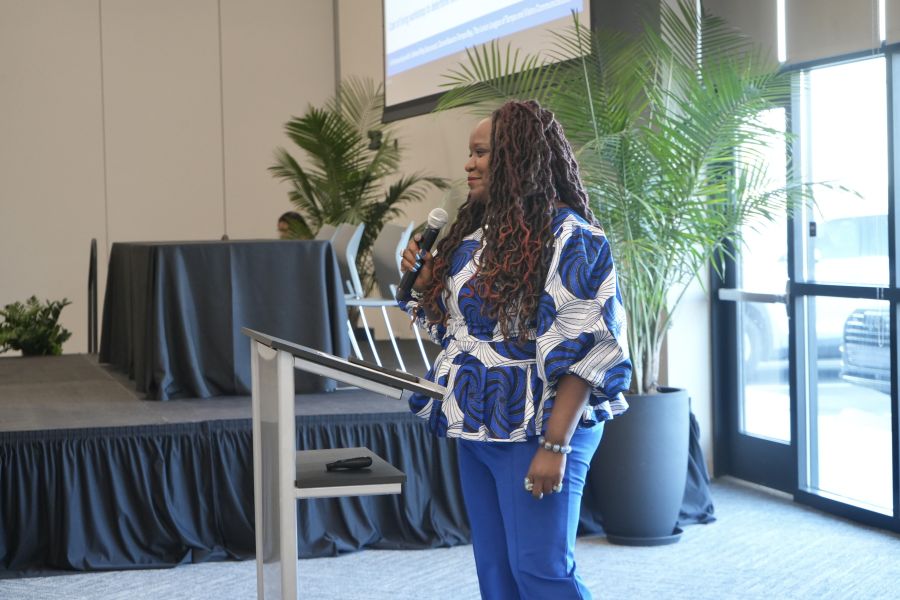 Children’s Board of Hillsborough County’s Tewabech Genet Stewart
“We intentionally put our focus on men’s mental health because the pressure to provide and the inability to earn a living wage often manifest in ways that are misunderstood,’’ she says. “For many men, that pressure leads to isolation, frustration, or depression. What may appear as anger or withdrawal is often a deep sense of defeat.’’
The ONEhillsborough Initiative has adopted Barbershop Conversations, a national mental and emotional health initiative for Black men, who tend to avoid getting professional help because of the stigma among their peers, who see it as a weakness. The program recruits barbers in the community and trains them to be mental health advocates. The barbers learn to listen for hints of deeper problems during conversations with regular customers. If needed, they try to persuade customers to get help and tell them where to get it.
Community support
Another focus of From Surviving to Thriving was connecting and providing community members with the education and training to improve their earning power.
Many people struggling to keep up with the cost of living are above the poverty line, sometimes well above it, Griesenhauer says. About 45 percent of people in Florida fall into that category, according to the ALICE report.
Single parents are vastly more likely to struggle than two-parent families, Griesenauer says, and one-third of the households with children in Hillsborough County are single-parent homes.
Mantz delivered another sobering statistic.
“Seventy percent of SNAP users are children, seniors, and the disabled,” he says. “Seventy percent of folks who are using SNAP today are our most vulnerable population.”
To meet community need, Feeding Tampa Bay has put food pantries in 90 schools across five counties so parents picking up their kids can also pick up groceries to help feed the family.
Mantz says teachers and principals reported more attentive students, better behavior, and improved schoolwork.
“We had terrific outcomes,’’ he says.
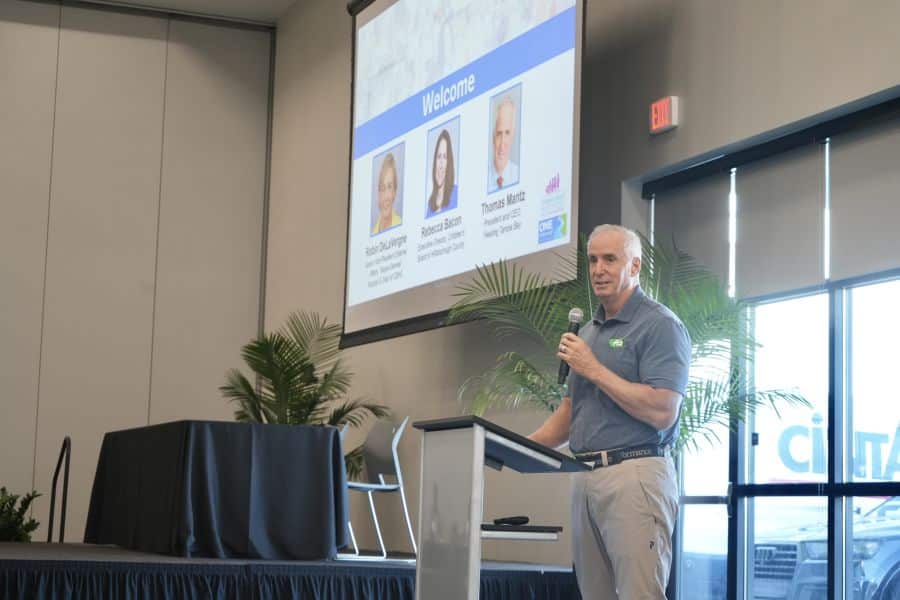 Feeding Tampa Bay’s Thomas Mantz (Children’s Board).
But he told an eye-opening story. A few weeks ago, Feeding Tampa Bay’s Board of Directors went into the community to get feedback on the organization’s work and heard praise for the school pantries.
“The person who did the tour with us really talked at great length and beautifully of how this was changing the lives of the families and kids in her particular community,” Mantz says. “And then she ended with this: ‘But you should also know that half of the food we give out is going to teachers.’”
“The very people that we ask to take care of our children, to nurture them, to educate them, to care for them, they’re having to come to Feeding Tampa Bay and other organizations to feed themselves,’’ he continues. “This isn’t all right. And it’s not someone else’s problem. It’s ours. We have an obligation, morally, and responsibility to do something about it.”
Affording a house or an apartment has become a daunting effort for many since the beginning of the pandemic. New residents, many of them young professionals freed by their companies to permanently work from home, poured into the sunny Tampa Bay area.
“When you talk about growth, we’re getting an A-plus,’’ says Tampa Bay Partnership President and CEO Bemetra Simmons.
That coalition of business and nonprofit leaders works to advance the region’s economic and social well-being. Along with Community Foundation Tampa Bay and United Way Suncoast, it puts out an annual Regional Competitiveness Report, which compares Tampa Bay to peer communities across dozens of economic and quality-of-life indicators. The 2025 report showed the Tampa Bay region was number one in growth for the third year in a row, Simmons says.
“But with that growth comes challenges,’’ she notes. “Something that used to be a big selling point for our community was how affordable it is. And that’s not necessarily the case today.’’
For every dollar Tampa Bay area residents earn, they spend over 55 cents just on transportation and housing. And housing costs in Hillsborough County alone have gone up by nearly 48 percent as the growth in wages lags, she says.
Children’s Board Chairwoman Robin DeLaVergne said families’ requests for housing support have increased by nearly 67 percent since 2023.
Griesenauer passed on some hopeful news. Florida has more than $220 million in unspent federal block grant funding for social assistance programs that has rolled over from year to year. Tennessee, Ohio, and some other states have passed legislation to release those funds for the state’s ongoing social needs, he says. United Way Suncoast representatives have been meeting with Florida legislators about releasing Florida’s rollover funding to help struggling citizens, Griesenauer says, and he hopes a bill will be introduced next year. He told the crowd that the legislators he talked to didn’t know the rollover fund existed.
“Once we informed them about this, they’re now on board,’’ he says, “which I would say is very exciting to see.’’
For more information, go to Children’s Board of Hillsborough County
This story is part of an underwriting agreement between the Children’s Board of Hillsborough County and 83 Degrees