
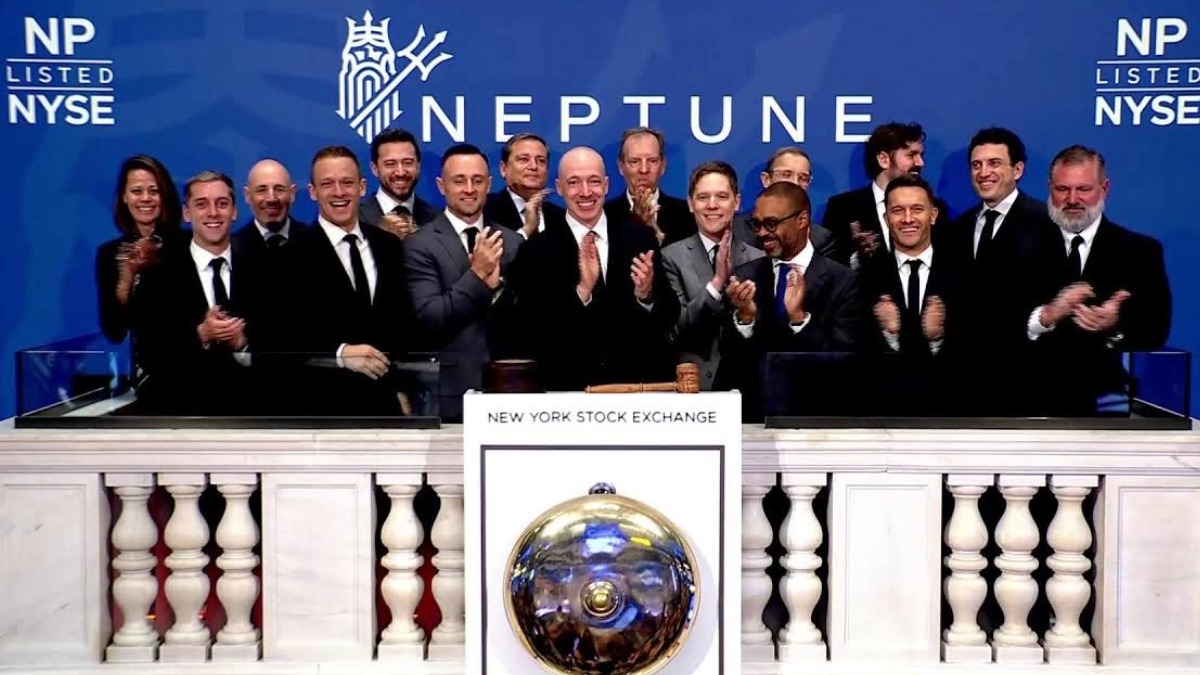
Neptune Insurance Holdings, the St. Petersburg parent of Neptune Flood, has made the jump from fast-growing insurtech to publicly traded company on the New York Stock Exchange, where it now trades under the ticker NP.
On the heels of that Wall Street debut, Neptune reported third-quarter 2025 results showing double-digit growth, strong margins and a business model built on artificial intelligence rather than human underwriters.
In this article, we’ll walk through Neptune’s latest numbers, explain how its AI-driven managing general agent model works and explore what this means for Tampa Bay, local investors and property owners facing rising flood risk.
What happened?
Neptune first signaled its Wall Street ambitions when it filed for an initial public offering with plans to list on the NYSE under the symbol NP.
The filing outlined an offering of 18.4 million shares of Class A common stock at an expected price range of $18 to $20 per share, with a 30-day option for underwriters to buy up to 2.7 million additional shares.
Morgan Stanley served as lead left bookrunner, with J.P. Morgan, BofA Securities and a long list of other major firms in the syndicate.
Founded in 2018, Neptune Flood described itself at the time as a data-driven managing general agent that sells residential and commercial flood coverage nationwide.
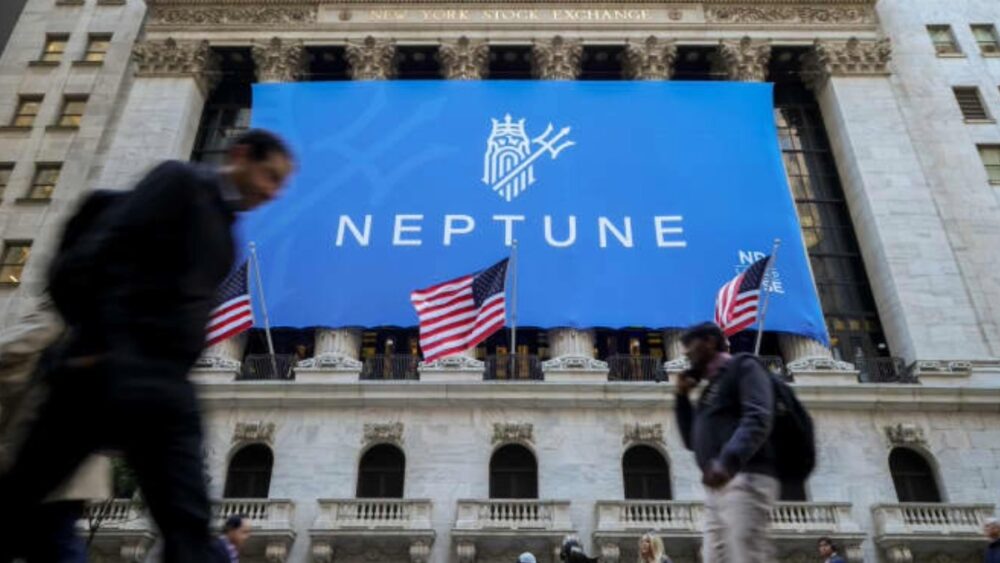 Neptune marks its Wall Street debut with a full building banner at the New York Stock Exchange.
The company emphasized that it operates without traditional human underwriters, using artificial intelligence to underwrite, price and issue policies through its proprietary Triton platform.
READ: Melting Pot CEO JC Crawford pushes bold menu and expansion strategy
By the time Neptune reported third-quarter 2025 earnings on Nov. 12, the IPO process had moved from plan to reality. The company now appears with the NYSE ticker NP and describes the third quarter as the period just before the full impact of being public shows up in the financials.
For the quarter ended Sept. 30, 2025, Neptune reported:
Revenue of $44.4 million, up 31.2% from $33.8 million a year earlier
Written premium of $101.6 million, up 30.7% from $77.7 million
Net income of $11.5 million, down 4.8% from $12.1 million, with a 25.9% net income margin
Adjusted EBITDA of $26.7 million, up 28.6% from $20.8 million, with a 60.2% Adjusted EBITDA margin
On a trailing 12-month basis, Neptune reported revenue of $147.3 million and Adjusted EBITDA of $88.4 million, implying a 60% Adjusted EBITDA margin over the past year.
The company also highlighted how lean its operation is. Trailing 12-month revenue per employee reached $2.5 million, while Adjusted EBITDA per employee hit $1.5 million. The average employee count over that period was 58.
Neptune also used the quarter to strengthen its balance sheet. Total debt stood at $264 million as of Sept. 30, with a trailing 12-month net leverage ratio of just under 3x.
After the quarter ended, on Nov. 10, Neptune refinanced its term loans into a $260 million revolving credit facility, with $251 million outstanding.
Looking ahead, Neptune issued full-year 2026 guidance of $186 million to $189 million in revenue and an Adjusted EBITDA margin of 60% to 61%.
Chairman and CEO Trevor Burgess framed the quarter this way:
“The excellent results delivered in Q3 showcase the scalability and efficiency of our model.”
He pointed to expanding distribution, record new business policy sales, strong renewals and “continued technology leverage” as the drivers behind 31% revenue growth and a 60% Adjusted EBITDA margin.
Why this matters
For Tampa Bay, Neptune’s trajectory is about more than one company’s earnings. It is another proof point that a niche, technology-led financial services business can start in St. Petersburg, scale nationally and end up on the New York Stock Exchange.
Burgess has done it before. As founder and CEO of C1 Bank, he took the company public on the NYSE in 2014 and later sold it in a $402 million deal. That experience shows up in how he designs businesses.
“I’ve always designed companies so that they can make money,” he said in his earlier TBBW cover story, noting that many technology startups grow fast without clear paths to profitability.
Neptune’s current numbers reflect that philosophy. An Adjusted EBITDA margin of around 60% is unusual for a public company of this size, especially in a regulated, catastrophe-exposed line like flood insurance.
 Trevor Burgess photographed during his TBBW cover interview shoot.
Burgess underscored that point while speaking with TBBW on Wednesday.
“One of the really interesting things about Neptune is our EBITDA margin, which we announced was 60%. And it has been 60% plus for some time. That is very unusual for any public company,” he said. “So many AI startups, technology companies, they may have fast growth, but they are not actually making any money. A big difference at Neptune is that we are a successful actual company, earning money.”
That profitability matters for customers, capacity providers and employees. If policyholders, distribution partners and global insurers all feel they are winning, Burgess argues, then Neptune has a long-term, sustainable business.
READ: Tampa brokerage sparks bidding war for $5.2M Georgia hotel
There is also a regional stake.
“I think it is good news for Tampa Bay to have another public company on the New York Stock Exchange that is headquartered in Tampa Bay, that was founded and grew up in St. Pete,” Burgess said. “We need as a community those kinds of success stories to help attract more venture capital or private equity. This is a great place to grow a business.”
What you should know
For business leaders, investors and property owners in Tampa Bay, there are three practical angles to pay attention to:
How Neptune’s AI actually works
When most people talk about AI today, Burgess said, they mean large language models like ChatGPT.
Neptune is not using those models to underwrite insurance. Instead, the company relies on data science and automated decisioning to perform calculations that human underwriters cannot at scale.
“We do use a huge amount of data science and artificial intelligence, just not large language model AI,” he said.
Neptune analyzes each property, not just its zone. About 20,000 times a day, agents and consumers across the country ask for a flood quote. Neptune’s algorithms then:
Decide yes or no on whether to write the risk
Set a property-specific price
Allocate that policy across one of seven A-minus or better-rated insurance carriers, so no single carrier ends up with all the risk in one region
Over tens of millions of historical quotes, Neptune has said no to only about 5% of cases. Burgess uses that as a blunt consumer signal.
“If Neptune says no, you should know you should not live there,” he said.
Burgess is direct about why AI is not a side feature.
“We would not be able to have this company if it were not for AI,” he said. Neptune has more than 260,000 customers and around 60 employees. “You could only do that if you were using artificial intelligence.”
Required versus not required flood insurance
Neptune’s growth also depends on education. Many Florida homeowners still misunderstand when flood coverage is required and when it is simply smart.
The federal rule is straightforward. If you live in a FEMA-designated high-risk flood zone, any zone starting with an A or a V, and you have a government-backed mortgage, you are required by law to buy flood insurance. Banks enforce that requirement.
But a large share of Florida properties are bought with cash. Burgess estimates 30% to 40% of properties in the state fall into that category.
READ: Waldorf Astoria plans 18 story tower in downtown Sarasota
If you own your home outright, “even if you are in a high-risk flood zone, you are not technically required to buy flood insurance,” he said.
Storms like Helene and Milton have exposed the cost of that gap. Homeowners discovered too late that no one had forced them to buy flood insurance and their losses were uncovered.
Despite Florida’s exposure, Burgess said only about 13% of the state’s buildings carry flood insurance. His view is simple.
“Everyone in the state of Florida needs to have flood insurance, without question, every single person,” he said.
For now, Neptune sells mainly through independent agents. About 98% of its sales come from local and national agents who offer Neptune’s product to their customers.
Burgess said more agents are now offering flood insurance every time they write a policy, not only when the law requires it.
Neptune’s role alongside the federal program
Neptune’s main competitor is not another private carrier. It is the National Flood Insurance Program, the federal government’s long-standing flood program, which holds most of the U.S. market and, according to Burgess, is not using AI in its underwriting.
Neptune positions itself as the primary private alternative. That mattered during the federal government shutdown that began on Oct. 1, the same day Neptune went public.
During the shutdown, he said, Neptune stayed open for business and continued to insure customers. “When the government is closed, it sort of raises the question, do we need the NFIP at all? And the answer may be no,” Burgess said.
READ: Steve King leaves Meals on Wheels Tampa stronger than he found it
Federal regulators temporarily paused some requirements for banks to enforce flood coverage during that period, which reduced the “have to” buyers.
However, Burgess said many people still chose to protect their own risky properties.
What’s next?
Neptune’s 2026 guidance signals that it expects double-digit top-line growth to continue with profitability intact. The company is targeting revenue between $186 million and $189 million and an Adjusted EBITDA margin of 60% to 61%.
Operationally, Neptune is expanding on three fronts:
Capacity: At quarter’s end, Neptune worked with 33 capacity providers across six programs. On Oct. 1, it launched a new program and added six reinsurers, bringing the panel to 39 providers across seven programs.
Technology: The company completed a full rewrite of its Triton underwriting system and deployed a new machine learning model aimed at improving quote conversion.
Distribution: Neptune recorded record new business sales in the third quarter and a record number of new agencies binding policies. Required purchases accounted for under 20% of new business, which the company sees as evidence that the overall flood market is expanding, not just the regulatory slice.
Retention remains high. For the nine months ended Sept. 30, policy retention was 86.2% and premium retention was 98.7%, both higher than the prior year.
For talent, Burgess sees the public listing as a recruiting tool. Nearly half of Neptune’s employees are engineers or data scientists.
READ: Hotel ORA buys 2nd property in downtown Tampa for $13.5M all-cash
“As we think about recruiting and retaining that kind of talent, having a public currency and being able to offer equity-based compensation is pretty critical,” he said.
Takeaway
Neptune Insurance’s pathway from concept to a nationally scaled, AI-first flood MGA and now a public company is a rare combination of tech story, regulatory navigation and a Tampa Bay success narrative.
The company is growing revenue more than 30% year over year while maintaining a roughly 60% Adjusted EBITDA margin, refinancing its capital structure and deepening relationships with global insurance partners. At the same time, it is trying to shift how homeowners and agents think about flood risk in a state where most buildings still lack coverage.
For Tampa Bay business leaders, Neptune is a case study in how to design a profitable, asset-light financial services company that uses AI as its core engine, not a side feature, and keep it anchored in this region.
Stay Connected