
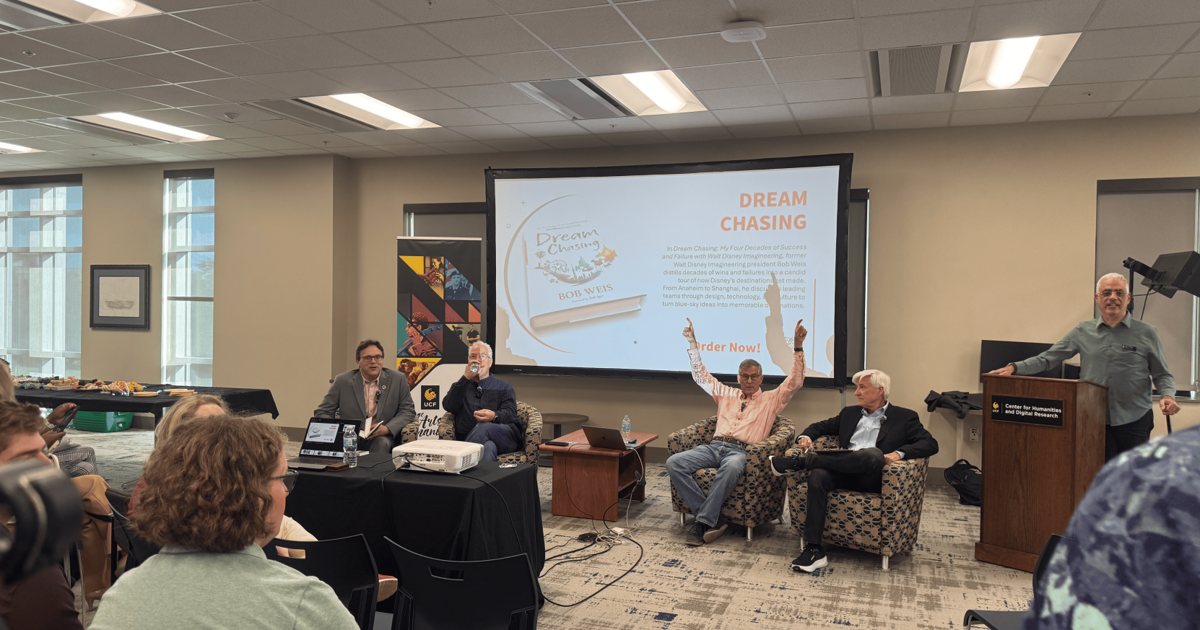

The four panelists introduce themselves at the “Talking Story: How Stories Become Legends” event at Trevor Colbourn Hall on Friday.
park ranger
Lukas Miller
For the first time, UCF Themed Experience and Zennovation Network hosted four panelists at their “Talking Story: How Stories Become Legends” event at Trevor Colbourn Hall on Friday afternoon.
The event introduced four creatives who have experienced firsthand how stories have become legends throughout their lives and careers. Panelists included Bob Allen, a former Disney creative executive, his brother Rick Allen, a former Walt Disney World operations executive and Bob Weis, an author and past president of Walt Disney Imagineering.
The event first began, though, with Jody Maberry, a former park ranger, telling a story about a squirrel.
Maberry described how a squirrel attacked him while he was working as a ranger, how he handled the situation and how the incident helped make him a local legend.
“Well, after I dealt with the squirrel, every one of my peers were heckling me forever about my experience,” Maberry said. “For ages, that’s what everyone knew me for, and the story became legend within my job.”
Maberry said people would send him squirrel-themed gifts and only remember him from the story.
Bob Allen, former Chief Storytelling Officer at Disney, shared fictional stories he’s heard throughout his career.
Bob Allen shared a story about a man named Jack and the extraneous adventure he had to illustrate how people imagine narratives differently. He said those different perceptions are what allow a simple story to grow into a legend.
“Stories are great integrators, and each one can be a legend,” Bob Allen said. “Stories turn out to be how your brain already wants to remember things.”
Bob Allen went on to discuss the six characteristics of a story that make them memorable for people.
First, the character is the main element that connects people to the story. Next, the plot keeps the audience engaged. The third trait is the setting, which helps ground the story in the reader’s mind. Bob Allen then listed the most important factor to him: conflict, which drives the narrative. He added emotion, which helps the audience feel the story, and finally, voice, which defines the story for the reader.
Bob Allen said that because we all perceive these things differently, that’s what makes stories so great and important for our society. Bob Allen’s brother, Rick Allen, came up to tell his thoughts on how stories become legends.
Rick Allen told stories about his career to the audience. He went on to say that these stories are what keep the traditions and good times alive.
“I think these stories are very important for our team building,” Allen said. “At Disney, our teams are the way we keep these legends alive.”
Weis was the last speaker. He went in front of the crowd and reflected on his own stories from Disney. Weis was very descriptive as he wanted the audience to visualize his stories about his career as he told them.
Weis told stories about bad interviews, crazy guests and team-building experiences within Disney. He tied all his stories back to his point that stories don’t have to be fictional, but they can represent something real.
“Storytelling can be more than entertainment,” Weis said. “It can be life as well.”
Caden Mahony, senior theme park management major, attended the panel and listened along with the crowd throughout each story that was told.
Mahony said an event like this was extremely fun and was thankful the university hosted something related to what he wants to pursue. Mahony said he would want to come to another one in the future.
“Events like these are very insightful, hearing people like this with a bunch of experience is awesome,” Mahony said. “As someone who wants to work in theme parks, this is such a cool thing.”