
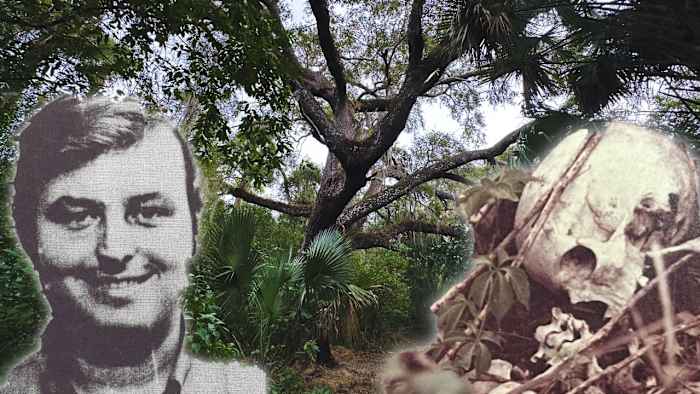
PORT ST. LUCIE, Fla. – It might sound crazy, but this is based on a true, horrifying story.
Most drivers passing through Port St. Lucie along I-95 have likely never even heard of the “Devil’s Tree,” but for those willing to explore the local Oak Hammock Park, it could be an unnerving experience.
Near the middle of the park is a small clearing with a massive oak tree, with gnarled limbs shooting out in all directions. For the unprepared, it’s a creepy sight.
A small trail clearing in Port St. Lucie’s Oak Hammock Park where the “Devil’s Tree” is located (Anthony Talcott)
But what makes the scene all the more eerie is the tree’s ties to an infamous Florida serial killer — Gerard John Schaefer.
“THE KILLER COP”
Schaefer was a law enforcement officer in the 1970s, serving as a police officer near Fort Lauderdale and eventually as a deputy in Martin County. This fed into his later moniker as “The Killer Cop.”
Wilton Manors police applicant photo of Gerard John Schaefer (1970) (Public Domain)
In an interview with Boca Raton Magazine, historian Mark Muncy explained that Schaefer had a habit of picking up hitchhikers by the pair before taking them back to an abandoned house and chaining them to a tree.
“He would do terrible things to them,” Muncy told the magazine. “And then he would make them decide which one dies first, kill the other one, and then still do terrible things to the dead one, so that the other one would see what was going to happen to them after they died.”
Investigative photos kept on file at the St. Lucie County Sheriff’s Office show the remains of Schaefer’s victims. (Copyright 2025 by WKMG ClickOrlando – All rights reserved.)
But court records show that Schaefer was ultimately caught after two of his victims — a pair of teenage girls he’d captured while they were hitchhiking — managed to escape their bonds and alert investigators.
Initially, Schaefer was accused of false imprisonment and assault, reportedly having tied the girls by their necks and ankles to a tree, news reports at the time show. Schaefer claimed it was meant to be a lesson for the girls not to hitchhike, though the excuse didn’t stop him from getting fired.
Despite the kidnapping, Schaefer was able to post bail shortly after his arrest, and later that year, a couple more teenage girls went missing: Susan Place, 17, and Georgia Jessup, 16.
It wasn’t until around half a year later that their remains were discovered buried by a large tree in Port St. Lucie.
An investigative photo kept on file at the St. Lucie County Sheriff’s Office showing an aerial view of the woods where the girls’ remains were discovered in April 1973. (Copyright 2025 by WKMG ClickOrlando – All rights reserved.)
While much of the area has since been cleared out to make way for the small neighborhood of Oak Hammock, it used to be a heavily wooded site, making it an ideal place for Schaefer to murder the girls.
“Port St. Lucie was just rural nowhere, and it had all these little dirt roads that went around, and that’s where Schaefer had this place that he knew was abandoned and safe for him to hunt,” Muncy told News 6. “And so he took them there, and then he tied them to the tree and just did terrible things to them. And then he decapitated them. And then the necrophilia… I mean, it’s everything you can possibly imagine — this guy being terrible did.”
Old building materials found near the Devil’s Tree, which Muncy said may have once served as the foundation for an abandoned house that Schaefer used. (Anthony Talcott)
However, Muncy explained that Schaefer wasn’t used to operating in this area, so after he stashed the bodies, they were soon found by a homeless man wandering around the area.
After police arrived at the scene, they realized that the girls had been tied to the tree, which mirrored what Schaefer had done with the other two hitchhikers the previous year.
“They put two and two together, and that’s how they piece together what he had done,” Muncy continued.
Another investigative photo shows law enforcement agents examining the remains of the two girls in Port St. Lucie. (Copyright 2025 by WKMG ClickOrlando – All rights reserved.)
Schaefer was ultimately arrested and found guilty of first-degree murder in the girls’ deaths, and he was sentenced to life imprisonment in 1973 (a U.S. Supreme Court ruling had prevented Florida from implementing the death penalty at this time).
However, investigators believe that Schaefer may have had dozens of other victims, based on so-called “trophies” that they had dug up from Schaefer’s home.
“There were lots of people’s things (in his room). He was tied to a lot of missing persons cases,” Muncy said. “The problem was, he swore he was innocent, right? ‘I didn’t do any of this, and I’m being framed because they need somebody. I know how the police work because I was a cop.’”
Gerard Schaefer, chats with newsmen in the hall as he escorted to court for sentencing. Schaefer was sentenced to life imprisonment for the murder of two Broward County girls. (Getty Images)
Regardless, Schaefer was only ever convicted in Place and Jessup’s deaths. To pour salt in the wound, his wife left him for his defense attorney immediately after the conviction, and Schaefer was fatally shanked by a fellow inmate decades later in 1995.
But the “Devil’s Tree” itself still stands at Oak Hammock Park.
THE LEGEND OF THE DEVIL’S TREE
The area around it has largely been developed, leaving the tree isolated on the small forest trail next to the neighborhood’s park space.
A closer look, though, reveals that the tree has been gouged and filled with cement at some point in the past.
The Devil’s Tree, with an open hole filled with apparent cement and several gashes along its trunk (Anthony Talcott)
According to Muncy, these features stem from legends about the tree that erupted after Schaefer’s capture.
“People say the whole reason he went crazy is because the tree is the devil’s tree. It put him up to this. It called him to bring his victims there,” Muncy explained.
Muncy claimed that the mythos surrounding the tree attracted unwanted attention.
“They’re having all these people come visit it, and people in cloaks… trying to perform rituals there,” he said. “And the city of Port St. Lucie is like, ‘We gotta get rid of this damn tree!’”
A statue of a small girl left near the remains of the abandoned home Schaefer reportedly used (Anthony Talcott)
Per Muncy, the story goes that city officials hired a couple of men to chop it down with a chainsaw, though the chain ended up breaking. So they went to get another chainsaw, which also stopped working once they tried to cut the tree.
“What they did was they take their chainsaws, put them back in their truck and are driving away to get it repaired,” he stated. “And I could never find the truth of this, but it might have happened: they said that those two men were killed in a head-on collision while leaving the tree.”
Gouges in the tree are alleged to have been caused by contracted workers trying to fell it (Anthony Talcott)
Muncy added that there are several similar stories out there of people taking pieces of the tree before meeting unfortunate ends, further cementing the tree’s dark reputation.
“Now the city’s like, ‘We’ve really gotta get rid of this tree.’ So they tried poisoning it, and it didn’t work. There’s that hole in the side of it — supposedly it dripped black sap,” he said. “And of course, the reason that people kept going with the cloaks, collecting that sap to make Satanic candles.”
With the tree’s reputation putting pressure the city, Muncy said, local officials decided to fill it with cement.
However, the tree instead grew around it, creating a trunk that now can’t be cut down.
The trunk of the Devil’s Tree as it appears nowadays (Anthony Talcott)
It doesn’t appear as though the tree poses much of a threat nowadays, though a local man told News 6 that he still sees “Satanists” come out to visit the tree some nights, placing candles near its base.
BUT WHAT’S THE TRUTH?
News 6 reached out to the city of Port St. Lucie to confirm whether these legends had any validity.
As it turns out — the answer is a resounding “No.”
“The tree everyone thinks is the “Devil Tree” is NOT the tree that is associated with the murder and discovery of two female bodies in the early 1970’s by former Martin County Sheriff’s Deputy Gerard John Schaefer. The tree known as the Devil Tree is a Southern Live oak, probably over 100 years old.
As a healthy, mature live oak in a public park, the City has not attempted to have the tree removed in the past 25 years. Any action to remove the tree prior to 25 years ago is not known.
However, there is evidence to suggest that over the years, unknown persons have attempted to damage, mar and/or deface the tree, including chopping bark off the main trunk, spray painting the trunk and on at least one occasion, setting a small fire at the base of the tree.”
Sarah Prohaska, Communications Director for the City of Port St. Lucie
According to Prohaska, some unknown people tried to burn the tree years ago by setting fire to the trunk.
Although the fire was extinguished, it created a cavity in the trunk that had to be filled with cement to prevent potential wood rot and discourage further arson attempts.
As for the story about work crews being killed by the tree? Prohaska said it is “100% urban legend.”
[BELOW: The terrifying story behind Florida’s most evil tree]
“Various versions of the urban legend include stories of chainsaws that wouldn’t start or the chains not being able to cut through the bark of the tree,” she told News 6. “Staff is not aware of any story involving workmen dying in a car accident.”
Regardless of the truth, the huge oak tree is accessible to the public, and the local trails can serve as a fun way to pass the time outdoors.
To find the so-called “Devil’s Tree,” simply head to the nearby parking lot and walk up the path along the local canal. Eventually, you can take a left turn onto a path that will lead directly to it.
The canal path leading to the Devil’s Tree (Anthony Talcott)
In the meantime, you can check out plenty of other stories about odd and fascinating places across the state by clicking here.
You can also check out Muncy’s other work in his book “Eerie Florida.”
[VIDEO BELOW: Why is there an abandoned bank vault in this Florida yard?]
Copyright 2025 by WKMG ClickOrlando – All rights reserved.