
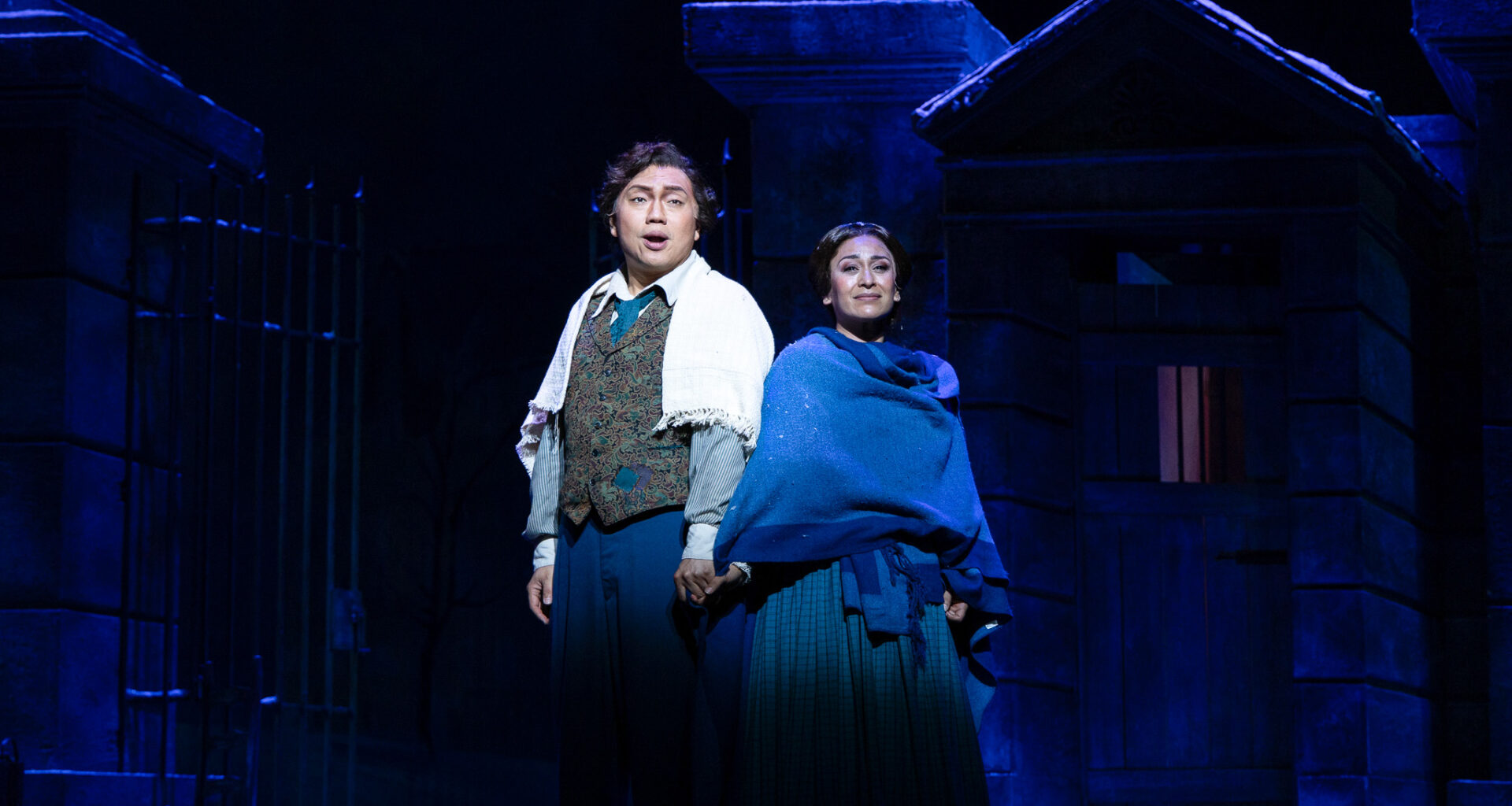
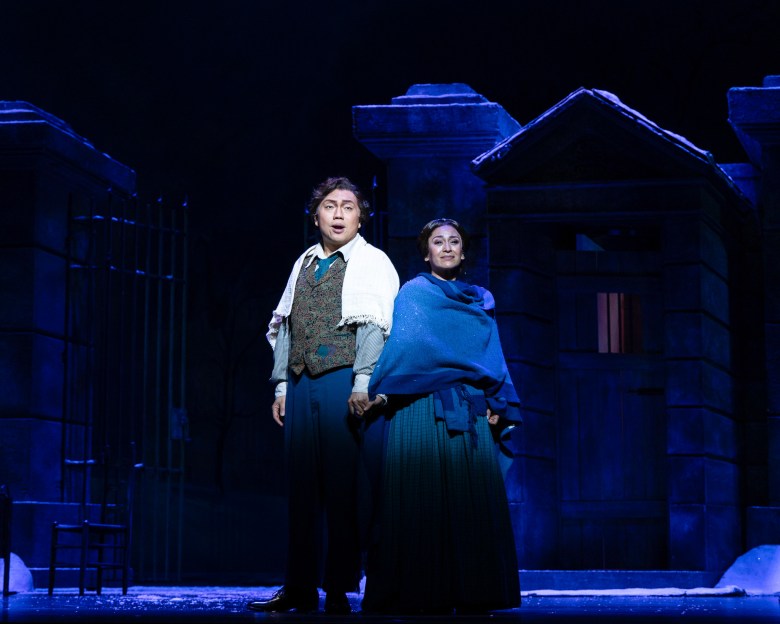
 Yi Li (L) and Cecilia Violetta López in Opera Tampa’s ‘La Bohème.’ Credit: OperaTampa / Facebook
Back in the 1990s, when Opera Tampa was new, its offerings focused on works at least somewhat familiar to everyone, even to people who didn’t know or care about opera. Pretty much everyone has heard of “La bohème,” “Carmen,” and “La traviata.” And you know a lot of the music even if your knowledge of opera begins and ends with old Bugs Bunny cartoons. The repertoire was kind of like the greatest hits of opera, designed to introduce a city that had never before had a major opera company of its own to the joys of the art form.
“I’d say it was probably the top 15 operas,” Robin Stamper told Creative Loafing Tampa Bay. He’s been part of the Opera Tampa family for a decade, in various roles, and is now in his fifth year as artistic director.
Over the years, Opera Tampa has injected more and more works that aren’t as commonly known or frequently staged. That’s especially true this year.
Opera Tampa’s Robin Stamper: ‘I’m trying to bring new stuff in every year’
Opera Tampa’s mainstage season gets underway this Friday with an operatic adaptation of Henry James’ “The Turn of the Screw.”
Three of the four productions are respected but somewhat lesser-known operas based on classic works of literature. Besides “The Turn of the Screw,” the season includes opera versions of Stephen King’s “The Shining” and William Shakespeare’s “Macbeth.” Mozart’s “The Magic Flute” is probably the most well-known opera in the season.
“We will always be performing the top 15 or top 20,” Stamper said. “Those will always be the anchors of our season. But one thing that has been happening consistently, over the past seven years or so, with the exception of one season, is that we’ve been performing something new, something that’s not outside the mainstream but that has never been done in Tampa before. I’m trying to bring new stuff in every year.”
Opera Tampa focuses on the supernatural for its 2025-26 season
There aren’t necessarily discernible themes to most Opera Tampa’s seasons, but this year, Stamper said, there’s a deliberate focus on the supernatural.
“The Turn of the Screw” is a classic Gothic ghost story. “The Shining,” of course, is the gold standard of 20th-century terror. “Macbeth” is populated by witches and ghosts. And there are otherworldly, if not exactly ghostly, elements in “The Magic Flute.”
But perhaps more significantly, Stamper said, the season spans the history of opera as much as a four-production season can. “The first opera was written in 1597 or something like that,” Stamper said. “So opera has been spanning a lot of centuries. And this season, one of the things that was also deliberate was that we’re covering four centuries of opera. ‘Flute,’ 18th century, ‘Macbeth’ 19th century, the Britten piece (‘The Turn of the Screw’), 20th century, and then ‘The Shining,’ which of course was written just a few years ago.”
“The Shining” (Jan 30. and Feb. 1) is likely to have the widest appeal, thanks to the novel and the movie, both of which were wildly popular. And it has played to sold-out houses ever since its premiere in Minnesota in 2016. But it’s not some low-brow novelty opera that panders to a mass audience. The music comes from Paul Moravec, a Pulitzer Prize-winning composer (“Tempest Fantasy,” 2004) and the libretto from Mark Campbell, who won a Pulitzer in 2012 for “Silent Night” and a 2019 Grammy in for “The (R)evolution of Steve Jobs.”
Campbell’s libretto, Stamper said, stays faithful to King’s novel, which Stanley Kubrick’s film version did not.
“It’s a hell of a ride,” reviewer Jay Gabler of Minnesota Public Radio said.
“Is it scary?’ It is. Moravec has created a soundtrack to the chaos within Jack Torrance’s heart, and it’s truly terrifying.”
Benjamin Britten’s “The Turn of the Screw” probably won’t be as terrifying, and definitely not as violent. But it should be chilling. James’ story, which has become a template for spooky stories ever since, concerns a governess who comes to a house full of ghostly secrets, and encounters progressively creepy behavior from the house’s two young children. (The novella was adapted into a film called “The Innocents” in 1961.)
“The Magic Flute,” (Feb. 27 and March 1) is Mozart’s most famous opera. It’s also the most famous example of a singspiel, a German form of opera that blends spoken dialogues with songs, arias and choral numbers.
The season winds up with Giuseppe Verdi’s “Macbeth (April 24 & 26). This is the second time Opera Tampa has produced “Macbeth.” The first production, which came during a spate of below-par seasons before Stamper’s tenure, sold a lot of tickets but disappointed some opera aficionados. This season’s production is completely different and, Stamper said, much improved.
Opera Tampa’s season actually opened a few weeks back with an odd chamber opera in the Jaeb Theatre. It was the world premiere of a two-in-one opera. The first part was the true story of a Florida who lived for seven years with the rotting corpse of a woman he was in love with. Part two was about Typhoid Mary. But since that was a chamber opera (with limited sets and a small orchestra) it wasn’t part of Opera Tampa’s Mainstage season.
More Tampa Bay opera
Incidentally, if you’re opera-curious, Opera Tampa isn’t your only local choice. St . Petersburg Opera, now in its 20th season, produces excellent opera and a slightly smaller scale at the Palladium Theater. Next up there is Handel’s “Giulio Cesare” Jan. 30-Feb. 3). And the area’s most venerable opera company, Sarasota Opera, offers “La Boheme” beginning Feb. 14.
This article appears in Nov. 20 – 26, 2025.
Related