
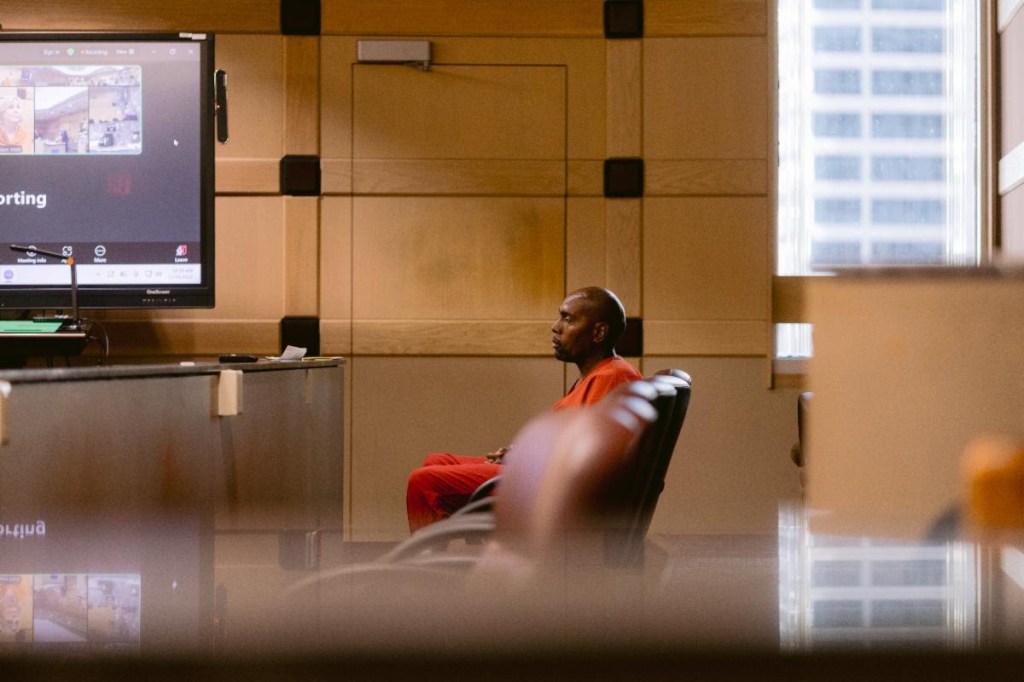
Broward State Attorney Harold Pryor deserves credit — but only up to a point — for the release from prison of a man who served more than 26 years of a life sentence for a robbery he likely did not commit.
Pryor has not explained, beyond generalities, why he did not agree also to erasing the dubious conviction that put Tavares Hutchinson, 49, behind bars for more than half of his life.
He deserves to have the slate wiped clean.
A joint investigation by the state attorney’s Conviction Review Unit (CRU) and the Innocence Project of Florida effectively debunked the evidence and testimony that convicted Hutchinson after a trial that lasted five hours.
Had the case been tried as thoroughly as the reinvestigation was conducted two decades later, the verdict would surely have been “not guilty.”
It might even have been tossed before trial.
The CRU’s 22-page report, with multiple interviews, documents glaring flaws in the conviction. There were major discrepancies among the alleged victim’s statements and testimonies, his questionable identification of Hutchinson, who didn’t resemble how the victim had described him to the police, and unheard testimony from a friend of Hutchinson’s that could have cleared him.
The CRU agency’s independent review panel concluded there was “reasonable doubt as to his culpability.”
Set aside his conviction
The details make it clear that the doubt is profound, not just “reasonable.” Even a reasonable doubt obliges a jury to acquit a defendant.
The report, signed by two CRU prosecutors, concluded “that, in light of the issues that have arisen, it would serve the best interest of justice to modify the sentence.”
Pryor agreed. But if the sentence was wrong, so was the finding of guilt.
The state attorney should reconsider and join the Innocence Project in asking a judge to set aside the entire conviction.
Much more is at stake here than simply clearing a serious crime from Hutchinson’s record. Without a formal exoneration, he can’t be eligible for the more than $1 million to which he would be entitled under Florida’s wrongful conviction compensation law.
A vague explanation
We asked Pryor to elaborate why he did not recommend exoneration. His answer, through spokeswoman Paula McMahon, was not specific.
“As you know,” Pryor said, “I have not shied away from recommending exoneration and supporting requests for compensation when I believe that is appropriate. After fully reviewing this case, its extensive appellate history, and discussing it with senior prosecutors, I believe the resentencing we recommended was the appropriate course of action in this case. Each case is reviewed individually on its own merits and under the law.”
Former Broward Public Defender Howard Finkelstein, who served for 16 years, viewed the same set of facts differently.
“He should never have been convicted,” Finkelstein said in an email to the Sun Sentinel Editorial Board.
The message criticized the original defense and Pryor’s halfway solution.
“The state attorney’s office is using doublespeak,” Finkelstein said. If Hutchinson was released because of insufficient evidence “then he should be exonerated as well as being released.”
Hutchinson’s appointed lawyer, Louis Pironti, was the third lawyer assigned to his case. The Public Defender’s Office had a conflict: It had represented Dan Sharpe, the man who accused Hutchinson of robbing him of a wedding ring and gold chain at gunpoint.
Weak trial preparation
According to the CRU report, the defense took no depositions until the eve of trial and did not attempt to challenge Sharpe’s eyewitness identification of Hutchinson, who did not resemble the assailant Sharpe had described to police.
The police showed him only Hutchinson. There was no lineup of suspects.
Hutchinson was a passenger in a car that police had stopped for a traffic offense in northwest Fort Lauderdale. They found a gold chain that seemed similar to the one Sharpe had reported stolen that night.
Police did not recover the wedding ring. They found no gun in the car. Prosecutors at the time suspected Sharpe might have traded the jewelry for drugs and falsely reported a robbery as a cover story for his wife, whom he had married that night. But they didn’t pursue the theory.
“The number of diamonds in the ring Dan Sharpe says he was robbed for changed with every given description,” the CRU report said.
Recanted testimony
Pryor’s reluctance to properly exonerate Hutchinson could owe to the man’s juvenile record and to his simultaneous convictions for cocaine possession and sale and driving with a suspended license. He served five years for those while continuing to contest the conviction that could have kept him locked up for life.
The alibi witness, whom the jury never heard, told the CRU that he had seen Hutchinson exchange cocaine for the necklace days before the alleged robbery.
The accuser, Dan Sharpe, has recanted his identification of Hutchinson.
Wrongful convictions are among the worst mistakes a society can make.
It may never be possible to prevent them entirely. That’s why a handful of prosecutors — too few by far — have established conviction review units like Broward’s. It is why Florida has its compensation law.
Florida can never restore the years of freedom that Hutchinson lost, but it can and should pay him what it owes him to rebuild his life.
The Sun Sentinel Editorial Board includes Opinion Editor Steve Bousquet, Deputy Opinion Editor Dan Sweeney, editorial writers Pat Beall and Martin Dyckman, and Executive Editor Gretchen Day-Bryant. To contact us, email at letters@sun-sentinel.com.