
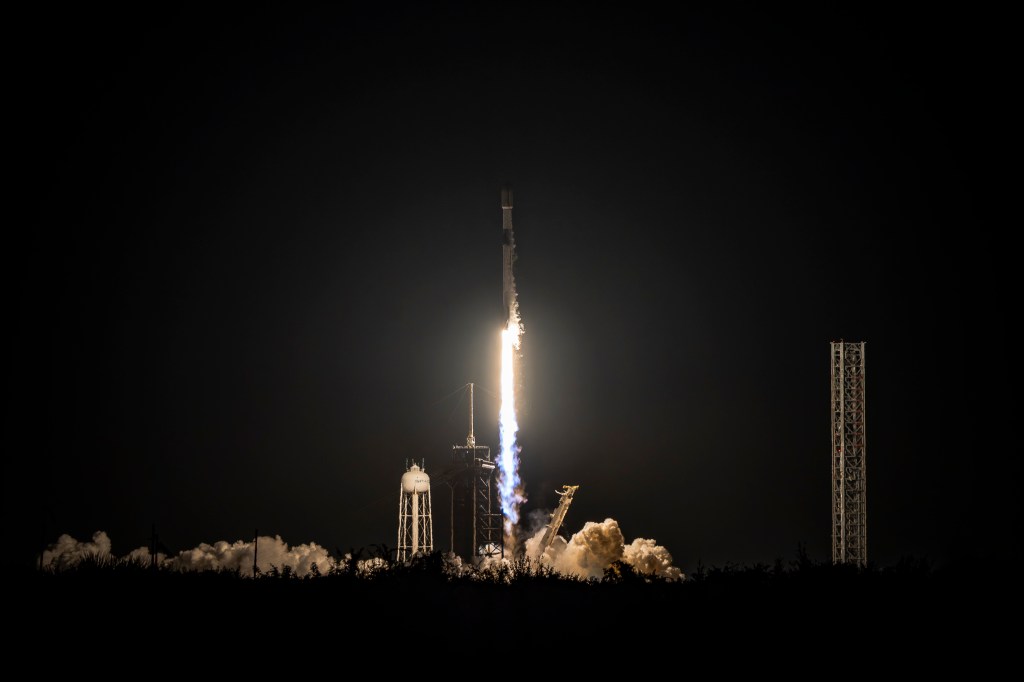
It will have been two days, three hours and twenty-six minutes since the Space Coast last saw a rocket launch as SpaceX looks to knock out what would be the 100th orbital liftoff of the year on Thursday night.
A SpaceX Falcon 9 is targeting a 10:38 p.m. liftoff from Kennedy Space Center’s Launch Pad 39-A on the Starlink 6-78 mission carrying 29 satellites during a launch window that runs from 10:01 p.m. to 2:01 a.m. Friday.
Mission No. 99 came Tuesday evening from neighboring Cape Canaveral Space Force Station.
Space Launch Delta 45’s weather squadron forecasts a better than 95% chance for good launch conditions.
This marks the 23rd flight of the first-stage booster, which will aim for a recovery landing downrange on the droneship Just Read the Instructions stationed in the Atlantic.
Today, SLD 45 is scheduled to support the 100th orbital launch of 2025.
Tonight’s launch window is from 10pm Thursday 20 Nov until 2am Friday 21 Nov. Stayed tuned as SLD 45 pushes to #100andBeyond. @USSpaceForce | @USSF_SSC pic.twitter.com/Y3z1SuLTR9
— Space Launch Delta 45 (@SLDelta45) November 20, 2025
SpaceX has had the lion’s share of what would be 100 missions flown from either KSC or CCSFS this year, having launched all but seven of them.
United Launch Alliance has flown five, including one Vulcan and four Atlas V rockets, while Blue Origin has flown its first two New Glenn launches.
Combined, the three launch service providers surpassed the record 93 launches seen in 2024 hitting mission No. 94 on Nov. 10, then kept the cadence rolling. They managed a record four rocket launches marking the 95th-98th missions in under 34 hours last week from four different launch pads.
At the offset of the year, Space Launch Delta 45 officials, who oversee the Eastern Range, had said they were prepared for as many as 156 launches for the year, which is an average of 13 a month.
That pace wasn’t realized, but with 100 launches through 324 days out of 365 so far, that is an average of one launch every 3.24 days. The Space Coast saw 10 launches a month in January, May, June and August, and is on pace to equal that this month with tonight’s launch as well as another planned from SpaceX on Saturday.
This will mark KSC’s 23rd launch of the year while the other 77 have been from three pads at CCSFS.
The workhorse pad is SpaceX’s Space Launch Complex 40, which has flown 70 of those.
SpaceX this year received the OK from the Federal Aviation Administration to increase the previous limit of 50 launches per year at SLC-40 to as many as 120 a year while it’s still awaiting the FAA OK to up launches from KSC’s 39-A from a base of 20 launches to 36. SpaceX has in the last few years been allowed to surpass those limits to some degree.
The fastest turnaround at SLC-40 has been two days, seven hours, 29 minutes, which SpaceX managed between two launches in October.
The company is also building a landing pad at SLC-40 and wants to build a pair at KSC able to support double booster landings from Falcon Heavy launches. The Space Force has already ended SpaceX’s use of Landing Zone 1 at CCSFS; Launch Complex 13, although it has still been able to continue use of Landing Zone 2 at LC 13 for now.
The launch rate has climbed on the Space Coast steadily with 57 missions flown in 2022 followed by 72 in 2023 and 93 in 2024.
What’s coming up for the Space Coast in the coming years, though, could see combined launches from all providers that surpass 200 per year by 2028, and 300 a year before the end of the decade. A study commissioned by Space Florida, the state’s aerospace finance and development authority, released in 2024 regarding maritime support of launch service providers projected as many as 1,250 annual launches on the Space Coast in the next five decades.
SpaceX has designs to launch as many as 120 Starship and Super Heavy missions from two pads under construction at KSC and CCSFS, but is awaiting results of environmental impact reports. Those flights would be on top of the 156 combined Falcon 9 and Falcon Heavy launches sought at its existing pads.
United Launch Alliance, meanwhile, looks to knock out at least 24 missions per year from SLC-41 while Blue Origin has signaled it wants to surpass its current limit of 12 launches a year from LC-36.
On top of that, Relativity Space could return with its new Terran-R rocket from LC-16, used once in 2023, while newcomer Stoke Space looks to fly its Nova rocket for the first time from Cape Canaveral’s SLC-14.
Other launch providers with Canaveral access include Firefly Aerospace from SLC-20, Vaya Space and Phantom Space sharing LC-13 and potentially the return of Astra Space from SLC-46.