
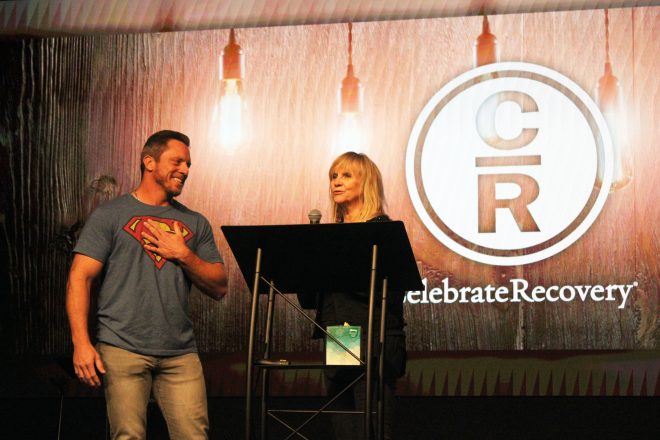
THOMASVILLE — Celebrate Recovery of Thomasville welcomed special guests Renee Napier and Eric Smallridge on Tuesday night to honor 13 years of freeing others from life’s hurts, habits, and hangups.
Napier and Smallridge’s story was one of forgiveness, something they hoped those in Celebrate Recovery could learn to do, first by forgiving themselves.
On May 11, 2002, Napier’s daughter, Meagan, and her friend Lisa were killed in an accident by a drunk driver. The driver, later identified as Smallridge, crashed into the back of Lisa’s vehicle before hitting a median in the road. He was later forgiven publicly by Napier. Her gesture of forgiveness helped lead Smallridge on a path to redemption and a life with Christ. The duo now travels and speaks at public events about the dangers of drunk driving, the importance of forgiveness, and the power of making positive choices to prevent future tragedies.
Growing up in the church, Napier was taught to “repay no one evil for evil,” and to “live peaceably among all men.”
Still, she felt an unimaginable pain the day she received word from her sister-in-law about Meagan’s passing.
“I remember this horrible cry from the depths of my soul came out,” Napier said. “I did not want to believe that. I wanted it to be a really bad joke, and I kept looking at her face to see if it was, but it wasn’t.”
Napier then asked if the driver was drunk, and she was informed that authorities did believe alcohol was involved.
As Napier began to process the loss and grieve, she attended Smallridge’s hearings and eventually his sentencing in October 2003.
During his sentencing, Napier read her victim impact statement.
“I had it all typed out because I didn’t want to forget anything,” she recalled. “As I looked into his eyes and told him what I had lost, I said, ‘Eric, I forgive you.’”
Napier said this moment was freeing for her.
“I’m so thankful God laid it on my heart to forgive,” she said. “I struggled with some things, and I had to block out what everyone else thought about me, but God had to take care of that, because that was too big for me.”
Napier admitted that one of the struggles she faced was wondering if she was betraying Meagan, but she felt as if Megan would want Smallridge to experience an act of God’s love through her mother’s forgiveness.
Even though she forgave Smallridge, Napier said Smallridge still had to accept the consequences.
“The only consequence for something like this is to go to prison,” she said. “Forgiving someone doesn’t mean what they did is erased. He is a good person who made a bad choice.”
Upon seeing Napier’s public forgiveness, friends and other family members joined in and forgave Smallridge, feeling the power of freedom.
“When you forgive someone, it’s like it sets a prisoner free, and that prisoner is you,” Napier said.
Napier’s words can now be heard in Matthew West’s song “Forgiveness,” based on her and Smallridge’s story.
This song has not only been an inspiration to Napier, but it has also served as a tool for Smallridge, who now ministers to those imprisoned, after his sentence was reduced due to Napier’s public forgiveness.
“God does not want you to live in shame and isolation,” she said. “That’s the enemy. God wants to set you free from that.”
Smallridge appreciated that sentiment.
“When the world said yell at him and tell him how much of a disgrace he is to his family and society, she just spoke the words of Christ,” Smallridge said. “That changed my life.”
Smallridge explained he grew up in a traditional family with a father in the military, but he had a Superman mentality and believed nothing could touch him.
“I was a happy, go-lucky soccer player, but I wasn’t serving Jesus,” Smallridge said.
Throughout his life, Smallridge said he did not allow Jesus to lead the way; he continued to run from Him, feeling the “fiery darts of the devil.”
“The devil wants you to fall down and give up,” Smallridge said. “When you give the devil a foothold, he’s going to climb on up, but never lose sight of God.”
For Smallridge, the devil found a foothold the night he drank and drove, but through Napier’s apology, he was able to see himself as still a child of God.
“In my brain, I didn’t think I was worth anything to God,” Smallridge said. “I knew better than to drink and drive. I was given every opportunity to succeed, and I blew it. Not only did I victimize two beautiful girls, but I victimized their family and friends and victimized my own family.”
Smallridge went on to say his family taught him well, but he was too busy running with the world to heed their warnings.
He realizes that many of the individuals who end up in prison are guilty of the same exact actions, but not all of them are afforded the opportunity to be forgiven by those whom they hurt.
“Some victims don’t forgive, but that’s between them and God, because the ones they are really freeing are themself,” Smallridge said.
Napier’s forgiveness also allowed Smallridge to forgive himself and become a vessel for the Lord.
Smallridge now leads a prison ministry at Jefferson Correctional Facility, where he was an inmate from 07-08.
“It’s only by the grace of God that I’m able to do this,” Smallridge said. “I go there and see men sitting on the same benches I used to sit on, having no idea what God would do in my life.”
But for every person, God has a plan and a purpose.
Smallridge said volunteering in the facility where he was once imprisoned was never something he imagined, but through God, all things are possible.
It was only through Napier’s connection with the Warden at Lowell Correctional Institute that Smallridge was paired with a prison ministry known as Pain to Purpose.
“All things are possible through Christ,” Smallridge concluded.
Napier and Smallridge then shared that they wanted to pray for those in attendance who needed forgiveness and to be set free from all the pain they’ve been carrying, ending the night with “Forgiveness” blaring over the speakers, as one by one, more people came to know God’s love through one simple act of forgiveness.