
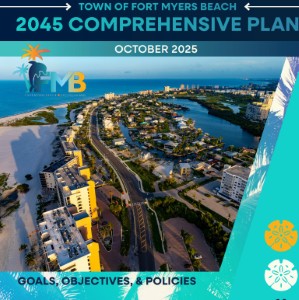
On Tuesday at 9AM the Fort Myers Beach Town Council and Local Planning Agency will hold a joint meeting to discuss changes to the town’s Comprehensive Plan. Two former Town Council members spoke at public comment on Monday to voice their concerns about the document. Town Manager Will McKannay addressed those concerns.
McKannay addressed the concerns point-by-point and sent his responses around to the Town Council this week. After discussing the Comprehensive Plan with the LPA on Tuesday, the Town Council is expected to vote on the document Monday, December 1st.
Florida requires state approval of municipal comprehensive plans to ensure they align with state growth management goals, such as protecting the environment, managing growth, and ensuring infrastructure is in place. The state review process verifies that local plans provide a consistent policy foundation for future land use decisions and are in compliance with Florida’s Growth Management Act. This state oversight helps maintain a level of consistency across the state and protects public health, safety, and welfare.
You can review the plan the Town Council and LPA will review Tuesday HERE.
Below are the point-by-point responses to the objections from the two former Town Council members, both were members when the town first incorporated in the mid 90’s.
Concern 1 — “The coastal and environmental element is all but eliminated, taking away protections.”
Response:
The coastal and environmental protections from the 1999 Comprehensive Plan are not eliminated. They are carried forward, though reorganized into the modern structure required by Florida’s Evaluation & Appraisal Report (EAR) process.
Key protections that remain fully intact in Exhibit A/Revised Comp Plan include:
Prohibition/limits on shoreline hardening
Protection of dunes and natural vegetation
Wildlife protections (sea turtles, shorebirds, CCCL activities, lighting restrictions)
Water quality protections for Estero Bay
Stormwater management requirements
Conservation of wetlands and mangroves
Beach and bay public access safeguards
Recognition of the entire island as a Coastal High Hazard Area
Hazard mitigation and post-disaster redevelopment policies
These appear in Exhibit A/Revised Comp Plan under the Conservation, Coastal Management, Future Land Use, and Capital Improvements elements.
What changed:
The older plan included long narrative chapters describing environmental science, local history, and regional organizations. Exhibit A/Revised Comp Plan places these protections into clearly enforceable Goals, Objectives, and Policies, rather than maintaining background narrative. The protections remain—the format changed.
Concern 2 — “South Florida Water Management District identified concerns that don’t appear to be addressed.”
Response:
SFWMD submitted the same type of standard comments they routinely issue for comp plans across the region: urging clarity on water supply, stormwater, and resource protection.
These concerns are addressed through the Conservation and Water Quality objectives in Exhibit A/Revised Comp Plan, including:
Stronger policies requiring “all feasible measures” to protect water quality
Direct requirements to amend the Land Development Code to align with stormwater and floodplain best practices
Capital Improvements priorities tied to resilience, water quality, and flooding
None of SFWMD’s comments indicated that policies were missing—only that they wanted to ensure consistency. Those changes are already reflected in the 2045 version.
Concern 3 — “There’s a section requiring an ordinance identifying public benefits, but no ordinance exists yet.”
Response:
This is correct: Exhibit A/Revised Comp Plan includes a policy recommending the Town adopt a “Public Benefits Ordinance” to standardize community benefits for development agreements.
This is forward-looking policy, not a deficiency.
The Comp Plan sets policy direction; the ordinance is a future implementation step, as is typical in comp plans. This is standard practice across Florida.
Concern 4 — “The plan talks about the Town’s parking obligations, but we are shifting that responsibility to property owners.”
Response:
The 1999 plan included extensive language about the Town exploring public parking strategies and shared parking systems. Exhibit A/Revised Comp Plan carries this forward but updates it to reflect current practice:
Policies still allow public-private partnership parking strategies
The Comp Plan does not require the Town to own or operate parking
It recognizes modern best practices allowing the LDC to assign responsibility based on district needs and local conditions
Nothing in Exhibit A Exhibit A/Revised Comp Plan commits the Town to operate public parking facilities.
The LDC will determine details, as always.
MCkannay told council members, “These updates should provide comfort that the essential “Town DNA” carries forward unchanged, while also acknowledging the meaningful additions that strengthen the plan: formal Property Rights guidance, clearly defined FAR limits, and mixed-use districts that elevate design consistency and predictability.”