
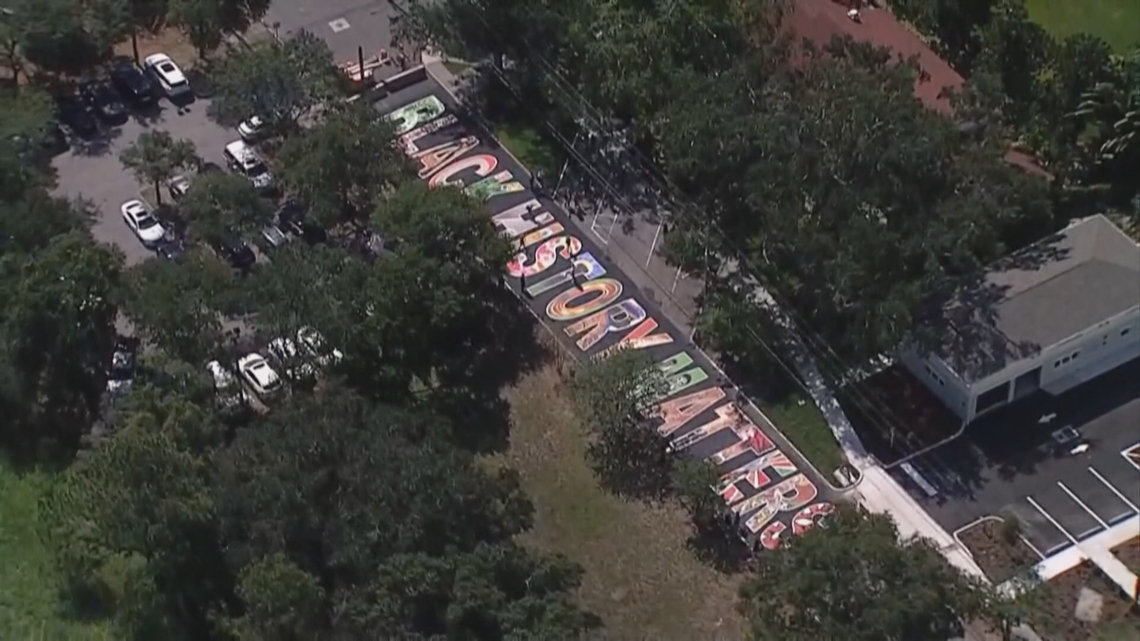
The Florida Department of Transportation’s memo said non-compliant surface paving can be any art with a social, political or ideological message.
ST. PETERSBURG, Fla. — Right now, the city of St. Petersburg has less than a month to comply with a new Florida law that could force the removal of certain street murals.
The Florida Department of Transportation’s (FDOT) memo said non-compliant surface paving can be any art with a social, political or ideological message.
St. Pete said it is currently compiling an inventory list of sites to send to FDOT.
For Catherine Weaver, painting the letter “Y” in the “Black History Matters” mural was more than an artistic opportunity. It was a personal honor for her to highlight a part of history that helped liberate people.
“It’s still important, and it always will be important whether they erase it or not,” Weaver said.
The mural, along with others like the “Inclusive Pride” mural in downtown St. Pete, could be removed as FDOT targets non-standard surface markings saying they may distract drivers and pedestrians. Transportation Secretary Sean Duffy issued a memo acknowledging traffic fatalities have dropped, but stressed more work is needed.
But, Domenico Pontoriero disagrees.
“Those murals are not just artwork. They are intent on bringing people together around identity and making people feel comfortable,” Pontoriero said.
He spoke out at the city’s public arts commission meeting. Councilman Richie Floyd also said while many murals aren’t city-owned, their removal isn’t necessary.
“There’s a lot of data that shows that slowing people down in the road with things like street murals, slows the traffic down and makes it safer for pedestrians and drivers. To hear them say it’s a distraction doesn’t align with the data I’ve seen,” Floyd said.
FDOT said failing to remove non-compliant markings could result in withheld state funding.
“They’re trying to erase the message. It doesn’t really matter. We’re still going to express ourselves.” Weaver said.
The city said it’s working with state partners to clarify the memo’s scope, timeline and whether any public art qualifies for exemption. FDOT said exceptions may be granted if a public agency can show good cause.