
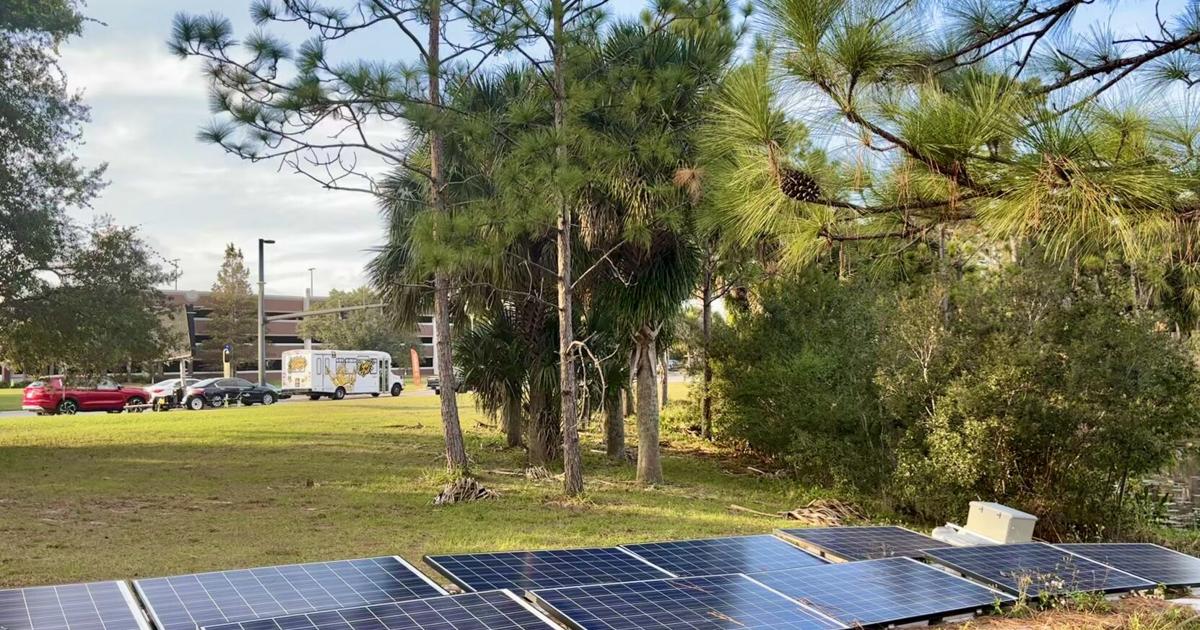
The University of Central Florida laid off 65 employees from its renewable energy research center, technology department and the arboretum.
Last week, the university let go 57 professors, researchers and other employees from the Florida Solar Energy Center, a renewable energy research facility in Cocoa, on short notice.
“UCF has made the difficult but necessary decision to reduce staffing at the Florida Solar Energy Center to ensure responsible stewardship of university and state resources,” the university wrote in a statement.
The layoff follows a substantial cut in federal funding by the Trump administration last month for 223 research projects, which Secretary of Energy Chris Wright said were not “economically viable.”
“President Trump promised to protect taxpayer dollars and expand America’s supply of affordable, reliable and secure energy,” Wright wrote in a release.
The university confirmed that the FSEC, which was created by the Florida Legislature in 1975 to advance research in clean energy methods, now has only seven employees.
The FSEC, defined as the state’s premier energy research institution, provides research on renewable energy, energy efficiency, sustainable transpiration methods, energy education and more, according to its website.
UCF representatives said that the research was no longer sustainable due to “shifting federal priorities,” which Florida House Representative Anna Eskamani, a UCF alumna, said was counterproductive for the state.
“Florida has some of the greatest potential to move off fossil fuels and towards new and innovation sources of energy production,” Eskamani said in an email. “This decision is primarily based on the federal government’s shift away from renewable energy, a policy I do not support.”
UCF additionally laid off two employees of the UCF Arboretum and six people in the technology department, though reportedly unrelated to the loss of federal funding.
The decision has generated concern in the UCF community about the direction of the university.
“Universities are supposed to be centers for innovations,” Ryan Miles, a UCF alumnus, said. “If the problem is that renewable options aren’t feasible, these research centers are supposed to be places that make them possible.”
Miles graduated from UCF in May 2025 with a degree in environmental studies. He now works at the Florida Governmental Utility Authority as a geographic information technician.
“Who knows what’s going to happen with the current projects and research that were already underway,” Miles said.
Representatives for the university wrote in an email that the affected employees were provided with “individualized information and support.”
However, Talat Rahman, UCF faculty union president, said that those who were let go were “shocked” and “dismayed,” and were notified last Friday of their immediate termination.
Out of the 57 employees fired from the research center, Rahman said that 18 were a part of the bargaining unit of the faculty labor union. She added that the organization requested a consultation with the university administration to request further reasoning and evidence of an inability to support the faculty.
“When you claim financial unsustainability, you have to prove that is the case,” Rahman said. “My hope is that the university will find a way to sustain the research and these faculty members.”
The statement released in early October by the Department of Energy stated that the projects and research “did not adequately advance the nation’s energy needs.” But Eskamani said that not everyone agrees with the assertion that the center was unproductive.
“The Florida Solar Energy Center has played an important role in advancing energy research, policy and innovation,” Eskamani said. “For decades, its faculty and staff have provided essential expertise that has supported industry, informed decision-makers and strengthened Florida’s energy landscape.”
Rahman echoed this, stating that FSEC was a “very productive unit of UCF.”
“The center is very critical to the energy section,” Rahman said. “The cut is not good for the university, the nation or the state.”
However, university officials said that the institution was dedicated to reflecting the government’s goals, stating that “UCF remains committed to aligning our research strengths with state and federal priorities.”